

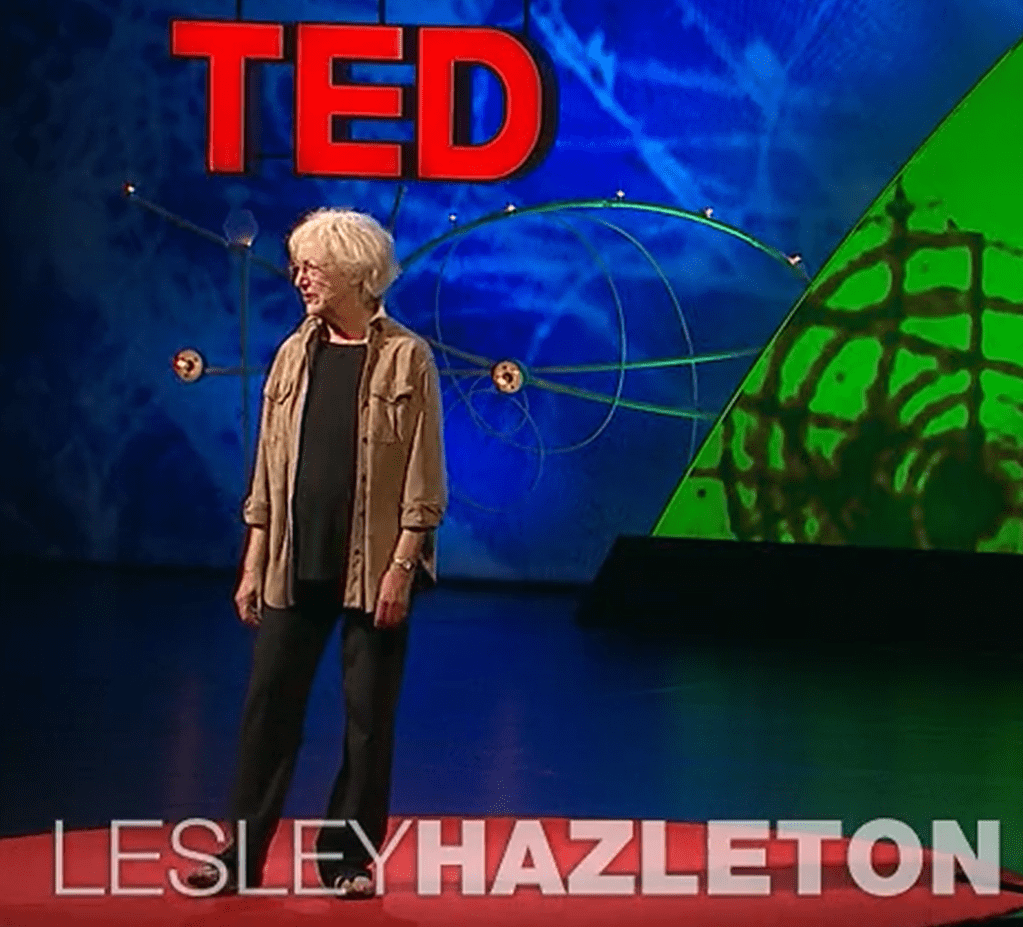
Lesley Hazleton (RIP), a self described “accidental theologist”, has a wonderful ted talk on “Doubt is essential to faith“. I saw it for the first time around ten years ago. This was pre-deconstruction, however the message still rang true in my head. Even though I hadn’t started to strongly doubt yet, I was beginning to ruminate on some questions. Questions that sure felt like the seeds of doubt.
To this day I occasionally will go back to this video to remind myself that what I’m experiencing is a good thing. To remind myself that doubt is a healthy part of what a faith journey holds in store for those seeking truth, those truly seeking God.
To me doubt is as concrete and undeniable as, say, sleep deprivation. (I use that example as I sit here at 6am wishing I could have slept in longer!)
You can do certain things like mask the exhaustion, like with caffeine. You can go for a walk in the sunshine to help perk you up and get rid of the mental fog for a bit. However until the need is truly satisfied with more sleep, the symptoms will always be present.
Doubt is like that. We can often distract ourselves from it for a time, some more effectively than others. We can attempt to just ignore it, and try to live with this thought rattling around in our heads like a small rock in our shoe. However it’s not until after it is addressed head on, fully inspected and probed to its depths, that one can find peace.
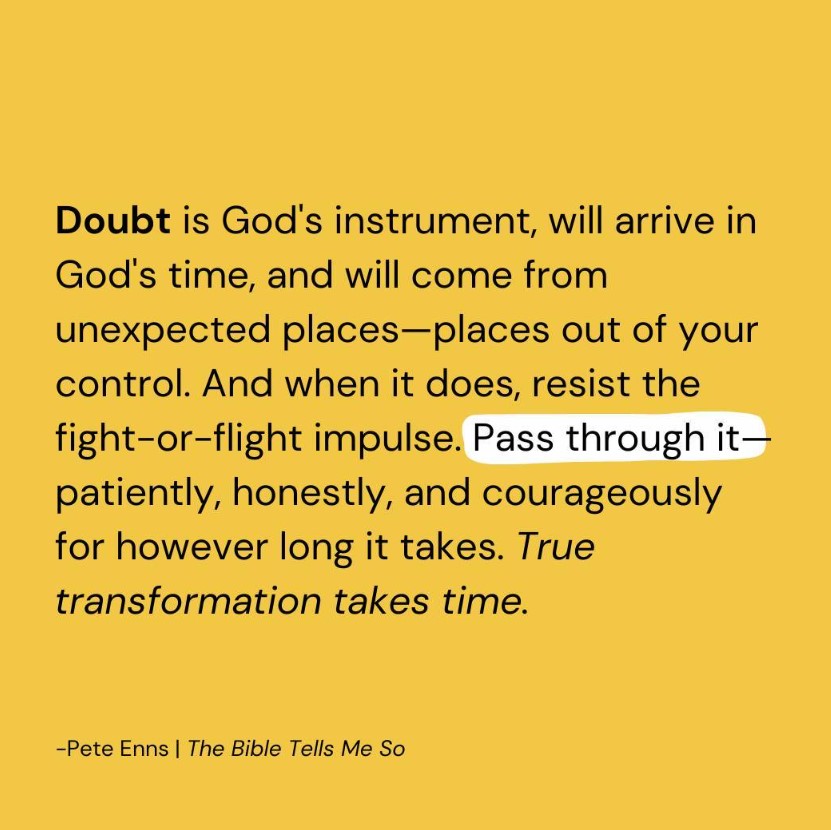
The nice thing about doubt is that, in my opinion (and others…see quote), doubt is not something we can predict or that is in our control. It’s just a thing that happens sometimes.
The bible talks a lot about not doubting. It seems to paint doubt in a rather negative light. Yet….we also have a story where God Himself seems to accept and even prefer the doubter over the staunch traditionalists.
Yes, I’m talking about Job. It’s here we see God Himself issue an assessment of the doubter. (or at least as relayed by the author, who is unknown) Here we see God interact with doubt as a real thing, and not a 30,000 ft view cerebral statement on the concept itself, as we see from various other writers throughout the bible.
For 34 chapters of Job, his friends and he go back and forth in an attempt to properly assign blame for his suffering. Job’s friends argue that it was Job that did something wrong. He should repent. He should know what it is that he did to anger God to such a degree. Job defiantly refuses and maintains his innocence. He dares to question God.
In chapter 38, God Himself finally enters the chat. God does push back against Job’s criticisms fairly hard in the subsequent chapters, but something interesting happens in Chapter 42 when it comes to Job’s friends.
He doesn’t agree with what they’ve been saying. Speaking of which, let’s see a few highlights of what they have been saying about Job’s “doubts” and how they perceive God perceiving those doubts.
“How long will you say these things,
and the words of your mouth be a great wind?” – Job 8:2
“Should a multitude of words go unanswered,
and a man full of talk be judged right? Should your babble silence men,
and when you mock, shall no one shame you?” Job 11:2-3
“For your iniquity teaches your mouth,
and you choose the tongue of the crafty. Your own mouth condemns you, and not I;
your own lips testify against you.” – Job 15:5-6
“But you say, ‘What does God know?
Can he judge through the deep darkness?” – Job 22:14
“Why do you contend against him,
saying, ‘He will answer none of man’s words’?” – Job 33:14
“Surely God does not hear an empty cry,
nor does the Almighty regard it.” – Job 35:13
Job’s friends here are making a character assessment of God that, apparently, God is not too pleased with. In Chapter 42, we see God level this statement at Job’s friends:
After the LORD had spoken these words to Job, the LORD said to Eliphaz the Temanite: “My anger burns against you and against your two friends, for you have not spoken of me what is right, as my servant Job has.” – Job 42:7
God seems to want to correct the misunderstanding that Job questioning in the first place was the great sin that his friends thought it to be. God is not happy with the character assessment Job’s friends assign Him.
Random aside: We can see here a crack in the prosperity gospel preaching. Afterall if Job’s suffering is not his fault, then in a way, the prosperity gospel loses power. A heavily implied part of that line of thinking is that bad things happen because you didn’t do the good things enough. (In addition to doing the good things gets you the good things)
Back on track, here we see God justifying Job in front of his friends. God can be questioned. In God’s eyes, Job maintained his innocence and righteousness throughout, despite the questioning.
This leads me to an interesting take from the theologian Pete Enns on doubt. We all know the bible on its face is pretty rough on the concept of doubt. We see this strongly in many places.
Pete has argued, with merit in my opinion, that our translation of the word for “doubt” could use some help. At least with respect to how we perceive it today.
He says the word diakrinō used for this, should be more aptly translated as “divided loyalty” and not intellectual struggling/doubt due to life experiences.
With Job, we see that his loyalty to God was not shaken throughout this whole questioning process. He still held fast to God, but was not afraid to question Him. God in turn, justified Job in the end.
Intellectually questioning that how God created the world might differ from His second book’s account (the bible), is not dividing your loyalty.
Ethically questioning why God would order the genocide of entire nations doesn’t mean you have divided your loyalty.
So what would divided loyalty look like?
Perhaps flippantly dismissing God’s authority, with an express intent to pursue selfish earthly pleasures over a pursuit of the truth. Your new loyalty is to the world. Your doubt is rooted in selfishness and not a desire to know the truth. God can see past this facade.
God has infinite space for genuine and honest truth seeking doubt.
The Old Testament especially provides us with a number of examples where authors of scripture are expressing their faith struggles. It’s a little bit of a strange flip here. The NT seems to be more against doubt than the OT was, at least textually. However if we leave room for a minor revision to the translation of that Greek word, we see room for us to intellectually hold doubts in the NT as well.
In my mind this checks out logically. If doubt is not something we can control, how are we supposed to stop it? I believe God knows this about us humans. Afterall He designed us. All He wants is our loyalty to the truth, which in turn will wind up with us being loyal to Him.
So question away. Doubt the bible. Doubt God’s actions themselves if you want! God has space for your doubt.
After all, according to Lesley, doubt is essential to faith.
Peace
 Space For Doubt
Leave a comment