

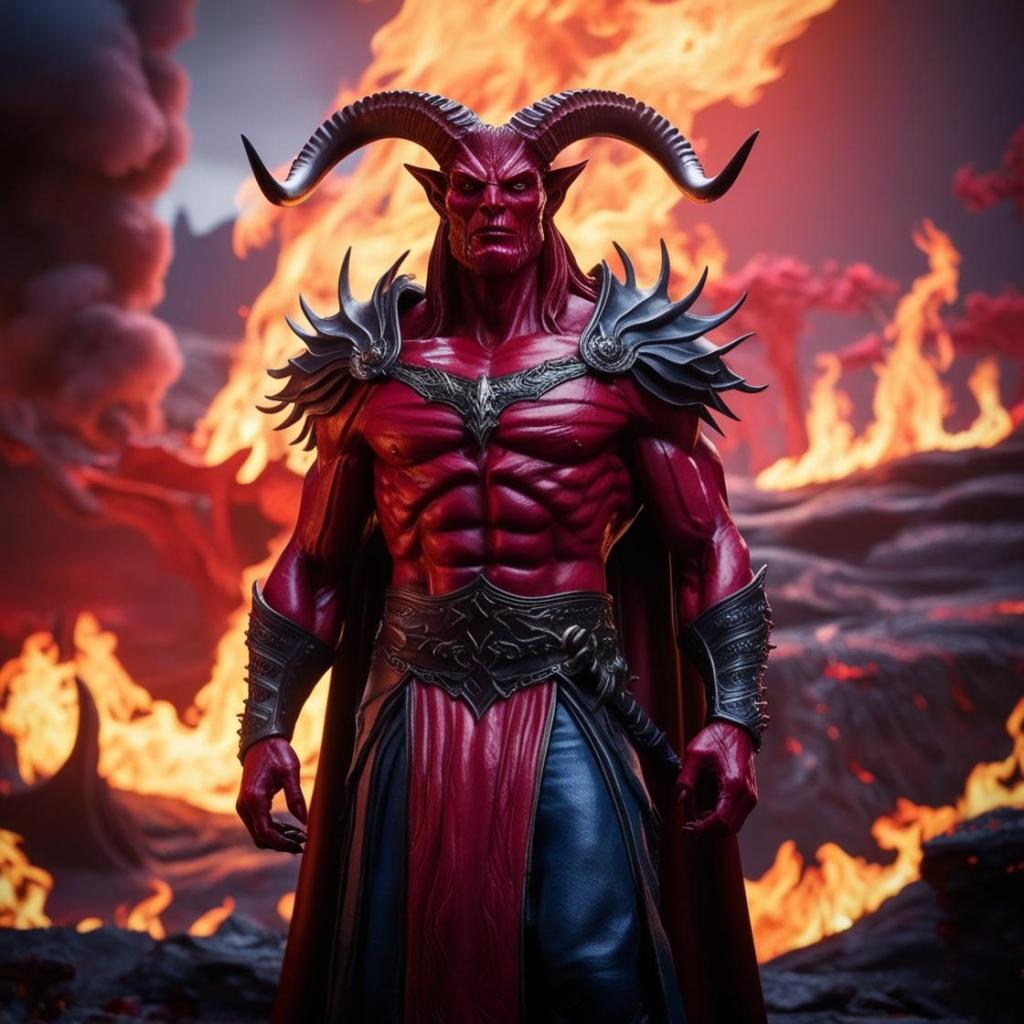
The more I read and think about our modern idea of Satan, the less sense what I read in the bible makes. I thought I’d lay out some interesting notes on this Satan that we think of today.
Let’s start with the word Satan itself. It’s translated from the Hebrew śāṭān. Which means “The Adversary” or “The accuser”.
The first mention of this accuser comes in Numbers and it’s….the angel of the Lord? Twice it uses this exact word, and twice it most definitely is not referring the red horned angry evil guy we think of.
- But God’s anger was kindled because he went, and the angel of the LORD took his stand in the way as his adversary. Now he was riding on the donkey, and his two servants were with him. – Num 22:22
- And the angel of the LORD said to him, “Why have you struck your donkey these three times? Behold, I have come out to oppose you because your way is perverse before me. – Num 22:23
Some say it’s because this word is used as a colloquial descriptive term as well as a proper name (Think if someone said… man that guy is being a real Satan right now) They would say because of that, the idea that this is also a real evil being is valid. I’m not convinced this holds enough water though. Most scholars seem to agree that this is not sound interpretation.
Looking at all the rest of the mentions of this accuser in the Old Testament, we are left with what appears to be some type of entity or idea in opposition to man, not God. In fact it’s most often man acting as the adversary to man.
The accuser, either via man or spirit, serves at the direction and approval of God. In fact all evil is attributed to God. Demon possession isn’t a thing. Some will say “Ah but what about King Saul being afflicted by a harmful spirit?”
Now the Spirit of the LORD departed from Saul, and a harmful spirit from the LORD tormented him. – 1 Samuel 16:14
Two things here. First, the spirit is said to be from the Lord. Again there is no diametrically opposed figure that evil spirits come from (yet). Secondly, this spirit is able to be calmed down and removed with some pretty music from David. Kind of like, you know, a bad mood? Or a psychiatric disorder? It doesn’t really fit with any demon exorcism we see later in the bible. This must have been one very weak demon if a little harp music was all it took!
There are just a very few other OT verses supporting what has traditionally (from the NT onward) been viewed as proof of demons. (Deuteronomy 32:17, Psalm 106:36) Some modern scholars will take issue with that, saying that these are not demons but idols of foreign gods. [source]
Up until the NT, all evil is almost always attributed to God. Calamities of all types, illness, death, loss in battle, etc. These things are punishments from God.
Does disaster come to a city,
unless the LORD has done it? – Amos 3:6
The word translated as disaster here, raʿ, can also mean:
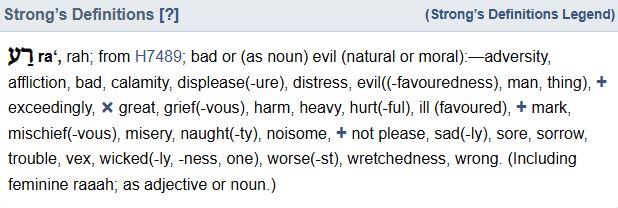
I make well-being and create calamity; – Isaiah 45:7
Calamity here is that same word raʿ.
In the Old Testament days (pre-exile), the reader of the day would understand that all punishment was from God. Other surrounding nations had multiple Gods, but Israel had just one all powerful God. He therefore was responsible for all of the good and all of the bad.
Going back now, to idea of a powerful personified evil figure in opposition of God, I want to appeal to some thought logic here.
Does it not strike one as odd that no Old Testament writers/prophets/leaders, would warn their people against the supreme evil being that we think of today if they thought that being existed? They are warned against magic, against sorcery, against idolatry, but never against this evil entity or the demons associated with it.
The concept of a being in direct opposition to God, didn’t come to exist until around the 3rd century BCE in the post-exilic time period. Along with that came the beginnings of our “modern” take on demons and Satan.
By the time Jesus arrives on the scene, we go from this not being a thing, to suddenly being widely accepted and common place.
What happened? Where did these ideas come from? Let’s back up just a bit, when the Israelites were captives in Babylon.
Cyrus the Great conquered Babylon in 550 BCE. That established the Persian empire. An empire that contained the state cult of Zoroastrianism. In that cult, evil was seen as the polar opposite of good.
Ahura Mazda (“Wise Lord”), was the source of everything good. “Druj”, which came to be known as Angra Mainyu (“evil spirit” or “dark spirit”) lived at the other end of the spectrum.
In 539 BCE, Cyrus allowed the Jews to return home. Many did, and they brought some of this Persian influence with them. They began the process of integrating this new idea of a personification of evil with the prior “Satan” of the OT scriptures. Satan became not just an accuser of man, but an instigator of evil in direct opposition to God. A being which no longer served at the direction of God.
The earliest evidence in this period for demonic descriptions comes from the book “The Watchers“, which consequently was gobbled up into the book of 1 Enoch. Here we see “angelic beings” who descend from heaven to have relations with human women. The offspring of these unions are a race of giants, the Nephilim. We see a possible reference to that in Genesis 6:1-13.
Now don’t lose me here. The book of Enoch is actually quoted in our canonized scripture (see Jude 1:14-15), so there’s worth in taking what it says with some seriousness.
If we jump forward a bit, to the Essenes (a Jewish sect), we see the first personification of evil. In these texts, God had created two spirits in humans, light and darkness. The demons were under the control of Satan and he sent them into those humans living in the darkness. The intent was to make them commit evil acts. The Essenes gave the symbolic name Belial (Worthless) to Satan. It is he who would lead the sons of darkness against those in the light, in the final battle. [Source]
The Book of Jubilees, another apocryphal text, echoes the sentiments of The Watchers when it comes to the creation of the Nephilim. Satan’s name in this book is Mastema (hated). He wanted to be higher than God and rebelled. God put him and his fellow angels in the bottomless pit, but granted Mastema and 10% of his demons (the disembodied spirits of the Nephilim killed in the flood) the ability to wander the earth and lead mankind astray. Mastema was then written back into the earlier stories. In the Jubilees account it was Mastema who tested Abraham with sacrificing his son Isaac. We see this theme of rewriting history in the Jewish Mysticism book, the Kabbalah. In this book, some of the past OT stories have Satan woven back into them as the culprit during their retelling.
Ellen White herself was heavily influenced by apocryphal writings and seemed to have a view of these writings as inspired works. [Source 1] [Source 2]
By the time Jesus came on the scene, the concept of demons and a personification of evil (Satan), had been established. It was just accepted common knowledge. If you took someone from around Moses’ time, and dropped them in at 30 AD, they’d be very confused about this Satan fellow and his demon possy.
If we want to claim that the NT stance on demons and Satan is correct, we must therefore by admission, agree that the apocryphal books these beliefs are based on have significant truth to them as well. Keep in mind these are not books within our canonized scripture.
The only way we get the NT Satan from the OT, is by reading the NT back into the OT. By interpreting through the lens of the NT. By adding detail in interpretation that the readers of the day would never have known, or thought to interpret in that way. That’s not how they wrote in the first place.
The Christian church didn’t even make the link between the serpent in the Garden of Eden and Satan until a few hundred years after Jesus’ death. Revelation 20:2 does call Satan a serpent, however that alone lacks footing to rest a view of Gen 3:1 squarely on.
Many Torah based Jews do not believe Satan is a real independent malicious being. Rather, they believe this being to be an accuser acting at God’s behest, or simply a metaphor for sinful purposes. In Jewish mysticism, the texts do merge somewhat with apocryphal texts in that the Kabbalah goes down the road of a real evil being existing.
Our concept of who and what Satan is has changed much throughout several thousand years. Our modern ideas of Satan and demons have far more of a basis in apocryphal literature than canonized biblical literature. After all, the canonized material was based on the apocryphal material. Additionally we have the writings of EGW that are based on this same source material. At this point we need to stop and take a breath. All of this this necessitates us to go back and have a rethink on a number of topics.
As far as what/who Satan is, how he works, how demons work, and to what degree it is an independent being apart from God? I personally think that remains in the realm of relative unprovability. Scholarship opinions are diverse on these questions. It’s a real choose-your-adventure scenario, and I’d be wary of anyone who says they have it all figured out.
I have a part 2 coming where I’ll talk a little more about the New Testament Satan, the post-biblical development of the associated concepts, and the impact this all can have on our faith.
Peace
 Space For Doubt
Leave a comment