

I’ve been a big fan of Marvel movies since 2008’s Ironman came out. Something about the story telling of superheroes makes me feel like a giddy kid inside.
Deadpool and Wolverine was no different. In this movie, at one point, Deadpool makes the statement “I…am….Marvel Jesus.” It was comical and got a little chuckle out of me. Perhaps slightly more so because of what I have been recently researching, the origins of YHWH. The God who modern Christendom believes occupies the seat of the one and only God.
The origins of YHWH is not a topic I had ever though about before. It was so absolutely foundational, that surely such a basic concept had to be rock solid right? Well, it turns out to be a bit of an interesting history. The church certainly doesn’t teach this history lesson. None of my religion classes in academy did. Let’s break down what we know, from what limited hard physical evidence we have and using a little logic with bible itself.
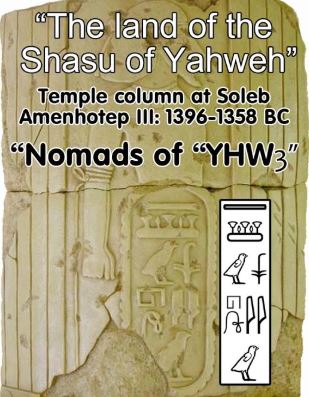
The oldest well regarded (but still somewhat debated) mention of YHWH comes from an Egyptian inscription from the reign of Amenhotep III (1402-1363 BC). The Cartouche (inscription) translates as “The land of Shasu of YHWH”. The Shasu are generally best understood as simply a nomadic people group. According to typical biblical dating models, this would sort of line up with the people of Israel eventually living in the land of Egypt, so that makes some sense. (Israel is never mentioned. More on that later) There is some debate that this YHWH is a place name and is entirely coincidental to the divine entity of YHWH, but that seems unlikely.
We find another identical inscription from the following century at the Amarah-West, built during the Reign of Ramses II (1279-1213 BC). Again the phrase is “The land of Shasu of YHWH”. [Source]
The land of Shasu is generally thought (there is still debate) to have been roughly Edomite territory. From a biblical point of view that actually makes sense. Let’s look a few verses that shed some light on this.
He said, “The LORD came from Sinai
and dawned from Seir upon us;
he shone forth from Mount Paran;
he came from the ten thousands of holy ones,
with flaming fire at his right hand. – Deut 33:2
“LORD, when you went out from Seir,
when you marched from the region of Edom,
the earth trembled
and the heavens dropped,
yes, the clouds dropped water. – Judges 5:4-5
Seir is where the Edomites first settled. They then expanded their territory west. It appears as though YHWH made His entrance into the land of Canaan from Edomite territory. [Source]
Moses, our eventual YHWH champion, experiences YHWH revealing Himself via the burning bush at Mt. Horeb. Though not clearly defined in the bible, and somewhat lost to us today, it is thought this mountain is in or borders the territory of Edom. The evidence supports YHWH worship originating in the land of Edom and predating Moses. (This complicates the traditional thought that Moses was the first person YHWH introduces Himself to by that name…but let’s move past that)
Now things get a little more complicated. I eluded to this in my post on the exodus. When YHWH arrived into Canaan, He was not coming into empty territory, but one already populated by a number of “Gods”. The main three were El, Baal, and Asherah.
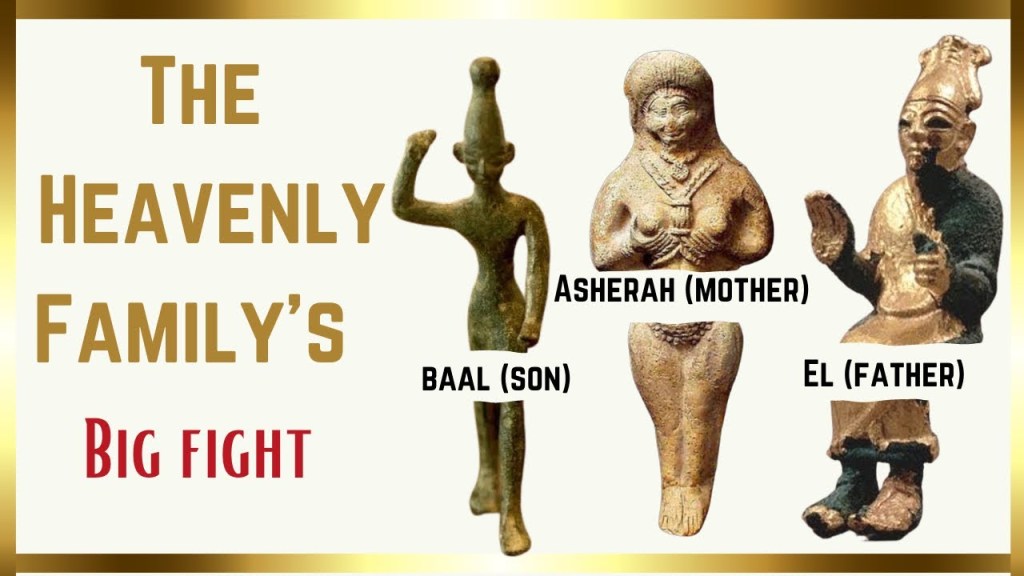
You might at this point, recognize the first of these three. Why? Well, we find El in the bible as “God”. In fact El is the God of creation! Well at least the Genesis 1 account anyway. YHWH appears to have been written into Genesis 2’s very different account of creation sometime later. (There is a majority consensus that Genesis itself was likely compiled from numerous authors’ work during or shortly after the post-exilic time period.) El appears to have been native to the Canaanite region and predates the arrival of YHWH by some margin.
The authors of the Pentateuch, generally containing some of the oldest texts (there are some exceptions), vary with who they regard as the “one and only” God. One author, the Elohist, uses El, or some form of it, in reference to the Israelite God. Another author, the Jahwist uses YHWH. Yet another author, Priestly, seems to blend the two together in what reads like an attempt to merge and polish the narratives into one cohesive bundle.
The evidence for two separate beings, exists in more than just name only. When we look at the characteristics of these two, we also find some significant differences.
El is the grandfatherly, wise, old God who is a distant and less personal God. A God relegated to the heavens.
YHWH is the tattooed up, late 20’s, violent and vengeful God. A more personally intervening God as well, who walks in the Garden. Who shuts the ark door.
Often scholars describe YHWH’s characteristics in the beginning of textual history as a violent storm God, similar to Baal (or Thor…there’s the marvel reference!). They write that it would be impossible for two storm Gods to coexist and that one had to go, hence the bible being so vociferously anti-Baal.
Beyond their characteristics, we have the bible itself that sheds some light here. We see an interesting thing happen in Deuteronomy 32:8-9. (Take note of the bolded text as we will come back to that.)
“When Elyon gave the nations their inheritance, when he divided all the sons of man, he set the boundaries of the peoples according to the number of the sons of Israel. For Yahweh’s portion was his people, Jacob was the lot of his inheritance” – Deut 32:8-9 (MT: KJV)
The word used in V8 for “Most High” here is Elyon. The word used in V9 for “Lord” is “Yahweh” (YHWH). It certainly appears as though these two are separate beings here.
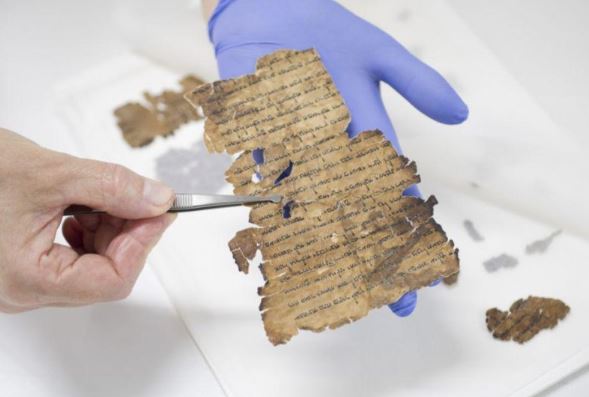
The Septuagint and Dead Sea scrolls give us a little more insight, in the LXX and Qumran versions of this text respectively.
“When Elyon gave the nations as an inheritance, when he separated the sons of man, he set the boundaries of the peoples according to the number of the sons of God. For Yahweh‘s portion was his people; Jacob was the lot of his inheritance”. -Deut 32:8-9 (Qumran)
“When the Most High divided the nations, when he separated the sons of Adam, he set the boundaries of the nations according to the number of the angels of God. And his people Jacob became the portion of the Lord, Israel was the line of his inheritance”. – Deut 32:8-9 (LXX)
What we’re seeing here is a supreme being that is dividing up the earth/nations to other Gods. YHWH at this time, is still the lesser being to El. The LXX and Qumran versions open the door to other Gods or supernatural beings being allotted portions of the nations. [Source]
Some scholars argue that this MT text should be the correct one, however contextually it doesn’t make sense this way. Dr. Michael Heiser, an American Old Testament scholar with training in ancient history, Semitic languages, and the Hebrew Bible has a valid point here. Why would God divide the nations of the earth according to the sons of Israel? A nation which as of yet did not exist, and a people who did not inhabit all of the nations of the earth?
On a related note, in Daniel 10-12, we see other divine beings associated with nations. We have the angelic Prince of Persia, the Prince of Greece, and Michael the Prince of Israel.
While not in agreement of all scholars, it seems most probable that the state of affairs in the Israelite culture at this time was a Henotheistic one. We see two distinct trains of independent thought on just who the one supreme God is. If this people group would have been of one origin (just as the bible portrays eventually), it would seem unlikely that this type of disagreement on character, naming, and textual evidence would exist.
When it comes to the MT text difference, the thought of many theologians is that the LXX and Qumran versions were too polytheistic. The Masoretic text is the later attempt to smooth this out by eliminating any reference to polytheism. The Dutch–Israeli biblical scholar and linguist, Emanuel Tov, calls this change to “sons of Israel” (and things like it) an “anti-polytheistic alteration.” Essentially an after-the-fact scribal change to the original text to align with a more monotheistic faith. Some MT english translations (see ESV) actually revert back to “Sons of God” in light of this most likely being the original and intended version of that specific text.
I also want to point out that there is still debate on many of these topics. I’ve tried to present a balanced view. Some still maintain El and YHWH are one. To accept that requires (in my opinion) some mental hermeneutical gymnastics and some ignoring of evidence that I’m just not comfortable with. It smells of a predetermined end idea in search of an explanation that allows it to exist. That’s not how scholarship should work.
To me it seems that on balance, the evidence points to El and YHWH being separate entities. It points to the nation of Israel having a much more complex and complicated origin than most think and that our modern English translated bible of today portrays.
This concept is easily understandable from a humanistic viewpoint, and could also be supporting evidence for the Levite origin theory (and limited exodus viewpoint) I discussed in my previous post. Historical evidence seems to support there being a separate Canaanite people group that evolved independently from the Levites in or near Egypt, and that these people groups were reconciled to each other, likely by force over several hundred years by the more violent Levites. The resulting nation of Israel being monotheistic but containing traces of its Henotheistic roots.
It does seem a bit odd that an all powerful and singular God would allow Himself to be represented in such a chaotic way. But again….the bible is written by man. All inspiration is through the lens of man, even if given directly from God. And we know that man gets things wrong, virtually always. I don’t think this chaotic history invalidates God’s gift of Jesus’ sacrifice on the cross. I think that direct intervention and sacrifice was necessary in part, because of our tendency to cause a chaotic history.
Peace.
 Space For Doubt
Leave a comment