


The storyline of David contains some pretty crazy stuff, and I say that for reasons that are probably a lot different than you think.
Everyone knows how he stole Bathsheba. Everyone knows how he danced before the Lord. Everyone knows how he ascended to become king and was a hugely successful leader.
What is not commonly discussed is how he is given credit for killing Goliath when in reality, he likely did not. What is not commonly discussed is how the bible has dual narratives surrounding David’s rise from being unknown to famous (meeting Saul along the way).
Let’s look at these competing stories and discuss why they can’t both be taken literally. Bullet points for brevity.
1 Samuel 16
- Samuel is directed by the Lord to go anoint a king
- Samuel looks at all of David’s brothers before the Lord tells him David is the man for the job
- Saul is plagued by a troubling spirit from God. His servants seek out someone to play the Lyre before Saul, in order to calm him down
- David is chosen to fulfill this role and does the job admirably
- David is described as “a man of valor, a man of war, prudent in speech, and a man of good presence, and the Lord is with him.” (V18)
- Saul sends a message to Jesse (David’s father) that David is now in his service and as such is to remain in his company
- Saul specifically calls out David’s name twice
- We are told Saul loved David
- We are told David became Saul’s armor bearer
1 Samuel 17-18
- A giant named Goliath demands a fight
- David’s family is introduced (but we already know this?)
- David himself is introduced
- David is said to go back and forth from Saul to his sheep
- David meets with Saul to discuss his desire to fight Goliath
- Saul gives his blessing and sends David off to fight
- David is called Saul’s armor bearer
- David kills Goliath
- Saul asks Abner, the army commander, who’s son this boy is
- Saul never mentions David’s name at any point and continues to call him “boy” and “young man“
- Saul is told by David that David’s father is Jesse, a man who Saul supposedly already sent a message to
- Saul “took” David and did not allow him to return home.
Discussion:
Let’s first start by assuming things are in the correct chronological order. How does that play out?
Why would Saul not know David’s father is if he just messaged this person in 16? How would David have time to tend his sheep in 17 if in 16 Saul has directed Jesse to let him keep David there in his service? Why is David referred to as a youth, and in a disparaging way, that this Goliath has been a man of war since he was a boy. Was David not just described in 16 as a man of war?
Some say these stories are swapped and should not be read chronologically in this order. That doesn’t solve all the issues though. Go ahead and swap them and see.
Let’s assume chapter 17-18 came first. How is it we find David at home in chapter 16 tending sheep when in chapter 18 has stated Saul would not allow him to go home? Why would someone have to explain so thoroughly who David was to Saul in 16 if 17 had come first? Why would David “become” Saul’s armor bearer in 16 if he was already stated to have been fulfilling that role in chapter 17?
No matter which way you try to slice and dice this, it doesn’t make sense. Thankfully many wise and well educated theologians have tried to make sense of this.
It’s here I want to cite a section of Joel Baden’s The Historical David that sheds some logical perspective on this. Joel is a professor of Hebrew Bible at Yale Divinity School.
The conclusion of the Goliath story is to be found in the first verses of the next chapter, 1 Samuel 18, where we read that “Saul took him [into his service] that day and would not allow him to return to his father’s house” (18:2). And with this the parallel nature of the two stories is fully revealed.
Both begin with no foreknowledge of who David is, such that we have to be introduced to him, and to his family: his father, his three eldest brothers, and his four unnamed brothers. Both describe how David comes to Saul’s attention: through his skill at playing the lyre, and through his bravery on the battlefield. Both have Saul being pleased with David: because he soothes Saul’s spirit, and because he is victorious against Goliath. And both conclude with the explicit notice that Saul took David into his permanent service, thereby severing David from his home in Bethlehem.
In short, what we have in these two chapters are two stories of David’s rise to prominence in Saul’s court—two stories that are identical in function and parallel in structure, but thoroughly incompatible as sequential episodes in a historical narrative.
The parallel and independent existence of the two accounts is, remarkably, proved by the evidence of the Greek translation of the Hebrew Bible from the third century BCE, the Septuagint. For in the Greek text of 1 Samuel 17, huge chunks of the Goliath story we know from the Hebrew Bible are missing—and those chunks are precisely the ones that contain almost all of the contradictions with 1 Samuel 16 noted above. The Hebrew version preserves a fully separate account of David’s defeat of Goliath, one that likely circulated independently—hence its reintroduction of the main characters, its distinctive description of David, its ignorance of David’s established relationship with Saul, and structural parallels with 1 Samuel 16. Only at a much later point was this independent story of David’s victory over Goliath combined with the alternative story found in the Septuagint, thereby creating the literary mess that is the canonical text of 1 Samuel 16–17.11
We therefore have two independent and truly irreconcilable stories about how David emerged from obscurity to become a presence in the royal court of Saul.
These contradictions illustrate one of the main difficulties with reading the Bible as history: the Bible preserves disparate and frequently irreconcilable traditions, even about a single figure. These traditions may have great value from a theological perspective—and after all, the Bible is nothing if not a theological work—but they cannot provide us with firm grounds for historical reconstruction. In a situation like that presented by these two chapters, we are forced to make a decision as to which tradition seems more likely to have any historical value, a decision that we can make only on the basis of a close analysis of each tradition independently. Unfortunately, when we look closely at these two famous biblical traditions about David—as the musically gifted author of the psalms and as the uniquely courageous slayer of Goliath—we find that not only can both not be historically true, but in fact neither is historically true.
Let’s talk about that last line there. David slaying Goliath. That’s a pretty cool story to be able share about yourself right? You slayed a giant? Way to go! Just one issue though…..Goliath was also supposedly slayed by Elhanan, a relatively obscure figure with little mention.
And there was again war with the Philistines at Gob, and Elhanan the son of Jaare-oregim, the Bethlehemite, struck down Goliath the Gittite, the shaft of whose spear was like a weaver’s beam. – 2 Samuel 21:19
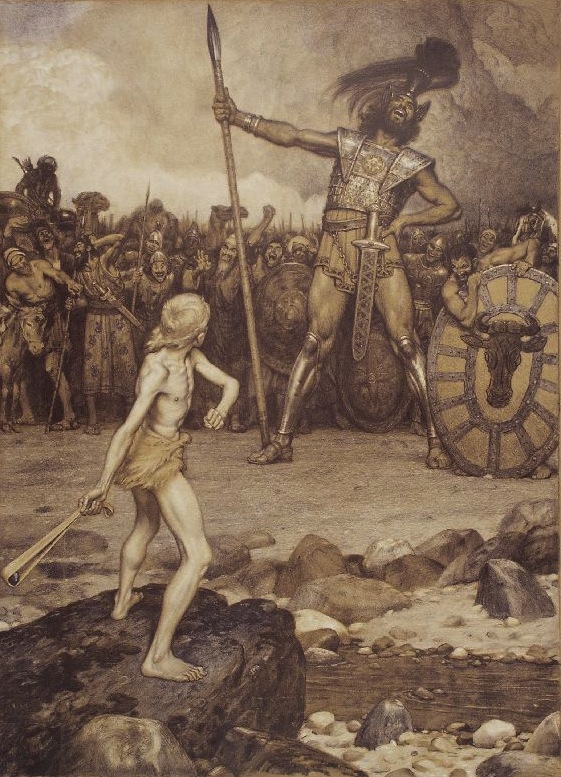
We can be pretty certain this is the same Goliath because the exact same language is used to describe him. Could it be a different giant also named Goliath? I mean…ya I guess so. But I could be struck by meteorite on my way home too. That doesn’t mean it’s very likely. This being a different figure doesn’t fit with the text.
What is interesting here is that in order to “solve” this discrepancy, the KJV translators just boldly insert the words “the brother of” before Goliath in 2 Samuel 21:19, despite there being no scriptural evidence to do so. (The KJV is one of the worst translations…it’s just garbage) You won’t see this in better translations.
Now generally speaking, when an accomplishment is attributed to two people in two different texts, and one is famous/powerful and the other is not, scholars apply the attribution to the obscure one. Some of these occurrences are more “provable” than others. The logic is that biblical authors would have little motivation to reattribute something true away from a powerful and well known character to someone insignificant. Additionally, why would an obscure figure even think they had chance at stealing the thunder from a known and loved icon? It just doesn’t make sense this way.
To view it as a powerful figure who’s stealing credit for themselves is a far more understandable scenario. It fits with the evidence. From a humanistic perspective it makes sense. We’ve seen this happen throughout all of human history. It’s the simplest solution with the least amount of problems generated.
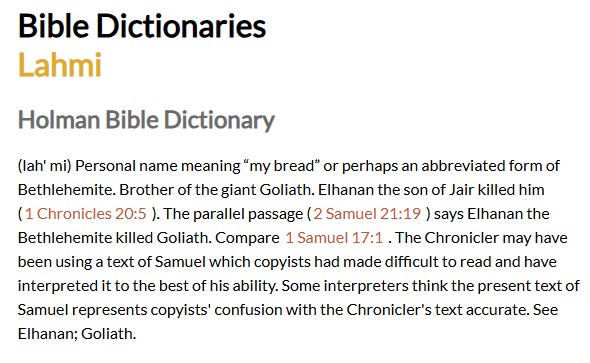
In 1 Chronicles, a book written much later and full of other revisionist changes, we see it is Goliath’s brother Lahmi that is slain by Elhanan. This doesn’t really make sense either. “Lahmi” is not a name found in that time or place and it’s a silly name. It means “my bread“. It’s also a Semitic name and we are talking about a Philistine here. The author(s) of 1 Chronicles surely were aware of competing narratives and had to make an attempt at cleaning up history. They had to go back and change Elhanan’s story just a little to ensure the history was clear on David’s accomplishment. We also see 1 Chronicles conveniently leave out the Bathsheba debacle, seemingly wanting to pay as much honor to the Davidic history as possible!
So David stole Bathsheba. He (or a later scribe) stole the credit for killing Goliath in pursuit of honoring the Davidic throne. An even later scribe tried to clean things up with a little alteration. And you know what? That’s fine. It doesn’t reduce Jesus’ sacrifice. It doesn’t reduce God’s love for us. All it proves is that the bible is not inerrant or infallible, and should be read with reason and logic. It should be approached with an open mind and a willingness to let truth differ from the answer we may “want.”
Remember, the truth has nothing to fear from being held up to the light.
Peace.
 Space For Doubt
Leave a comment