

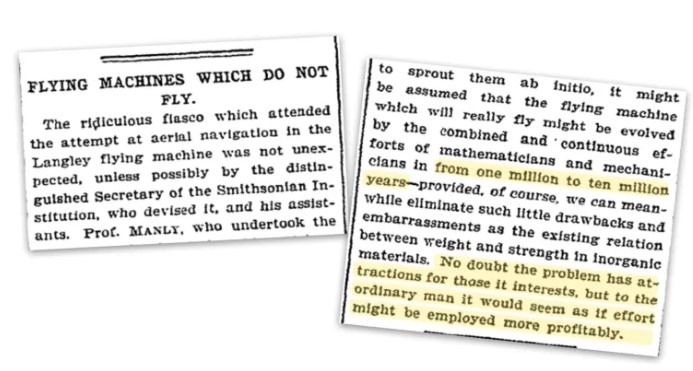
On October 9th, 1903, the New York Times published an article that mocked the recent human attempts to fly. The writer boldly and with certainty, proclaimed that human flight would not be achievable for another 1 million to 10 million years.
Just 9 weeks later on Dec 17th 1903 , the Wright brothers flew.
This article became infamous over time as one the best examples of a wrong prediction in human history.
“Doubt is not a pleasant condition but certainty is an absurd one” – Voltaire
With religion and politics, one of the shared traits when it comes to us humans is certainty. Not that it can’t extend beyond to touch other topics, as it most assuredly does, however certainty is more often found in realms where admitting “wrong” is far less palatable.
Consider publicly admitting you were wrong about the fact that you miscounted the change the cashier at the grocery store gave you. It was in fact the correct amount. Ok….no big deal (at least for most)
Now consider publicly admitting you believed in error, that your side of the political isle was doing the right thing on a range of issues. That in fact, it was the opposite side that was right. Not going to happen (again for most).
Our politicians today generally behave in a way that says they’d rather die, be impeached, or be disgraced, before admitting they had done or believed something wrong. Religion is no different.
Almost all of the brilliant people I’ve encountered in my life have had a common trait. That is, on topics they understand to be highly subjective and vague, they possess an air of humility and open-mindedness. I would say as a general rule, IQ and absolute certainty are inversely related when it comes to these issues. It’s a bit of a Dunning Kruger effect that’s taking place, except in these murky areas, there’s no definitive “100% full truth correctness” to arrive at after becoming a true “expert.”
The late Dr. Carl Sagan was such an individual.
“An atheist is someone who is certain that God does not exist, someone who has compelling evidence against the existence of God. I know of no such compelling evidence. Because God can be relegated to remote times and places and to ultimate causes, we would have to know a great deal more about the universe than we do now to be sure that no such God exists. To be certain of the existence of God and to be certain of the nonexistence of God seem to me to be the confident extremes in a subject so riddled with doubt and uncertainty as to inspire very little confidence indeed.” – Carl Sagan
Many scientists are maligned by the God-believing crowd as being atheists who hate religion. Dr. Sagan did not hate or denigrate religious people. He left open the door to believing in God. Despite his incredible intelligence and education, he did not display an air of absolute certainty.
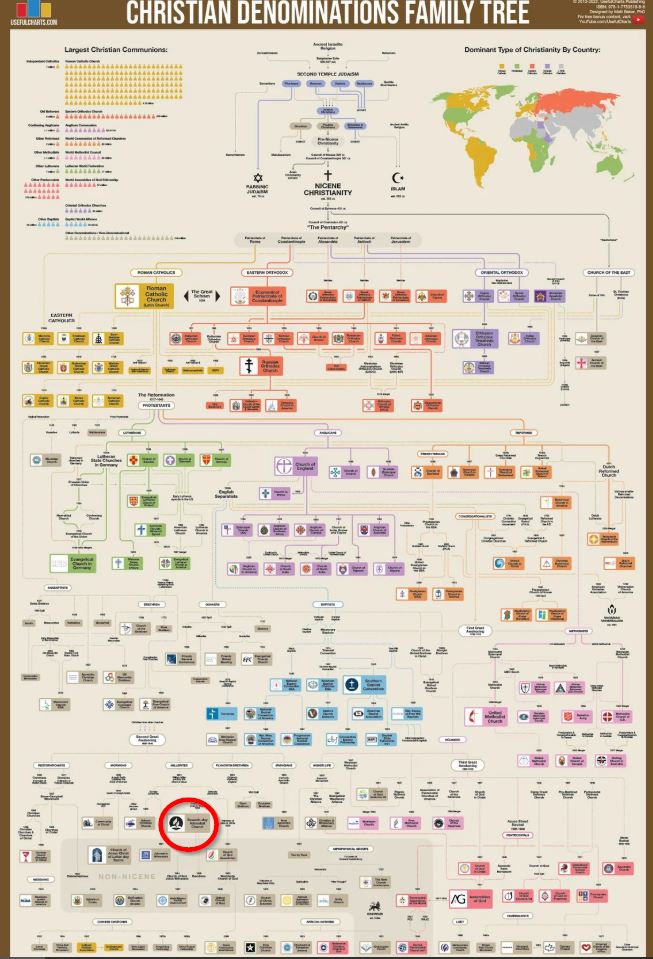
Sometimes we need a reminder of why being absolutely certain is so ridiculous. We need a big picture reset. Here’s a fun one (above). This Christian church ancestral tree starts with the ancient Israelites and goes right up to the present day. That red circle is the Seventh-Day Adventist church.
When you look at the many splinters and the numerous branches, it really puts into perspective just how complicated and debated Christianity is. It puts into perspective just how debated and “obvious” the meaning of the bible is. Each of these branches contain many very well educated and incredibly intelligent people. Each branch contains biblical scholars and pastors/priests. Each branch thinks they have the corner on “truth.”
It is with such a defiantly arrogant certainty that many churches operate. The SDA church is a textbook case. The last SDA baptismal vow is this.
“Do you accept and believe that the Seventh-day Adventist Church is the remnant church of Bible prophecy and that people of every nation, race, and language are invited and accepted into its fellowship? Do you desire to be a member of this local congregation of the world church?“
You’re telling me that the SDA church is “the” remnant church? As in they’ve got it all figured out, and everyone else will need to come into fellowship with them?
What Hubris! How absurd of a notion that is.
I have had many conversations with former and essentially former (IYKYK) SDAs. The common grievance is the arrogant certainty on display. The rigid unyielding resistance to new understanding, whether that be scientific, cultural, or moral, is digging the grave of the future church.
The thing people often forget is that it does not take a full knowledge of the truth to understand the flashing red light of an obvious error. For example, I don’t have to hold a PhD in Biomedical Science to understand that blood letting is clearly the wrong course of treatment for the flu (or anything else for that matter). The more educated one becomes, the easier it is to spot these errors. I can think of one politician who says he “loves the poorly uneducated” for precisely this reason. An uneducated mass of people is easy to sway into alignment with whatever gibberish you want drum up.
An organization cannot, unfortunately, seem to survive in this world if it leaves its dogma as grey as would-be-necessary to accommodate the growing and maturing nature of faith. As such, it seems institutionalized religion as a whole is unsuited for the very task it attempts to undertake. It cannot be a hospital for the sick, if those who are “sick” doubt and question its doctrines. You can’t have a pastor who openly questions your fundamental beliefs. You can’t have a private school teacher who teaches the world was created in a different way than a literal reading of Genesis suggests (if that is your dogma).
The complexity and depth of current church orthodoxy comes across as a bid to ensure certainty is available at every turn. Anything that challenges even a remote axial portion of the accepted doctrine is met with defensive shackles raised. The apologists come out to defend the status quo in a way that winds up just looking like petty boundary maintenance. An appeal not to evidence, but to a desire to cling to the past, truth be dammed.
In describing some aspects of his idea of an ideal faith, in the book “The Sin of Certainty“, theologian Pete Enns says the following.
“A faith that remains open to the ever-moving spirit and new possibilities, rather than chaining the Spirit to our past. A faith that welcomes opportunities to think critically and reflectively on how we think about God, the world, and our place in it, rather than resting at all costs on maintaining familiar certainties.” – Pete Enns
That last line. Ooof.
In the last several years I haven’t operated on a copious amount of certainty when it comes to my faith. It’s been more of a trust scenario. I trust that I am serving a loving God. I trust that I might be led into greater light by that God as I continue to educate myself. But certainty? Not so much.
To be clear, there are things I am fairly certain on, but those things are primarily the discoveries of clear errors in my past belief. The remains of what once was.
I suppose my idea of an ideal faith would be a life of not blindly adhering to any institutionalized religion’s dogma. A life lived based on trust in a loving God. A trust that one may carefully apply ethical, societal, moral, intellectual, and scientific principles to better interpret scripture. A trust that yields an attempt to live a life that better mirrors that of Jesus. A trust that can live in the spaces where not all answers exist.
Peace.
 Space For Doubt
Leave a comment