


Slavery. A topic that is usually swept under the rug if you will. How many sermons or Sabbath Schools have you spent actually learning what the bible has to say on it?
The Bible is unsurprisingly univocal about condoning slavery (I mean, think about the times and places it was written). That’s not just my take on it, but once you get away from the Christian apologists, you will find that is the consensus of the majority of biblical scholars.
Today humanity almost universally condemns slavery. You would be hard pressed to find a Christian who says slavery is ok, and if you did, my guess is they probably wouldn’t represent any other Christian value very well either.
I’ll get to why I’m bringing this up at the end, but for now let’s see the very best verses that apologists use to prove the bible actually does condemn slavery.
“Whoever kidnaps a person, whether that person has been sold or is still held in possession, shall be put to death.” – Exodus 21:16 (ESV)
On the surface a plain reading here may lead one to believe the author condemned slavery. Despite being such a short passage, there is a lot to unpack that unravels that thought.
Issue 1:
Being in the OT, this verse is surrounded by many passages that promote slavery. Some go so far as to claim owning slaves is a sign of God’s blessing.
The Lord has greatly blessed my master, and he has become wealthy; he has given him flocks and herds, silver and gold, male and female slaves, camels and donkeys. – Genesis 24:35 (NRSV)
(Remember fundamentalists, you believe Moses wrote the first five books, so in your world this is the same author.)
But the Lord will have compassion on Jacob and will again choose Israel and will settle them in their own land, and aliens will join them and attach themselves to the house of Jacob. And the nations will take them and bring them to their place, and the house of Israel will possess the nations as male and female slaves in the Lord’s land; they will take captive those who were their captors and rule over those who oppressed them. – Isaiah 14:1-2 (NRSV)
From a societal context basis, everyone would agree that time period in Israel’s history was very much pro slavery. Every nation had slaves and was itself at some point in history also subjected to being someone else’s slaves.
Issue 2:
For this verse to represent an abolishment of slavery, you have to presuppose that kidnapping was the only means of acquiring slaves. In reality, kidnapping was not the only way, or even the main method of, obtaining slaves. There were two primary types of slavery in that day. Debt slavery, which was reserved for mostly native Israelites, and Chattel slavery, which were slaves acquired either through purchase or in battle (both from foreign nations). Neither of the two main ways of slave sourcing were considered kidnapping in that culture’s context.
Since this verse specifically calls out only kidnapping, it seems the authors saw fit to continue allowing slave ownership through the above two means.
The use of this verse by apologists represents faulty exegesis and a fundamental misunderstanding of the historical context and methodology of slavery.
Now we know that the law is good, if one uses it legitimately; this means understanding that the law is laid down not for the righteous but for the lawless and disobedient, for the godless and sinful, for the unholy and profane, for those who kill their father or mother, for murderers, the sexually immoral, men who engage in illicit sex, slave traders, liars, perjurers, and whatever else is contrary to the sound teaching – 1 Timothy 1:8-10 (NRSV)
This is the second verse used by apologists to claim the bible does not actually condone slavery. It’s here that the context of the original language and society is key. Again there are two major issues.
Issue 1:
The word rendered “slave traders” here is andrapodistēs. This word only occurs one time in the bible and it’s here.

Note the definitions here. Slavery wasn’t seen as unjust in that time (yes even in the NT) as long as it occurred via typical methods. I.E. buying and selling slaves on the up-and-up, conquering nations in battle, debt slavery, etc. The primary cause for concern among the people of that day were people who illicitly traded illegal slaves, those who were stolen (see: kidnapped). This verse does not condemn slavery as a whole.
Issue 2:
If context matters (it should), the author must clearly be ok with slavery as just a bit later in Chapter 6, they say this.
Let all who are under a yoke as bondservants regard their own masters as worthy of all honor, so that the name of God and the teaching may not be reviled. Those who have believing masters must not be disrespectful on the ground that they are brothers; rather they must serve all the better since those who benefit by their good service are believers and beloved. Teach and urge these things. 1 Timothy 6:1-2 (ESV)
The word rendered “bondservants” here is Doulos, which has the following definition.
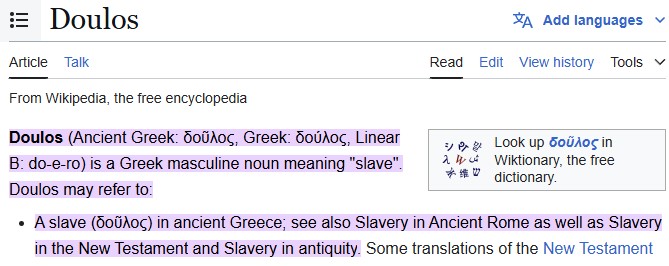
The author of 1 Timothy (maybe Paul) does not seem to be condemning the masters, who he calls “believers and beloved.” He is admonishing the slaves to continue being slaves, but just work all the harder at it.
This use by apologists is again poor exegesis and represents a dogmatic approach towards interpretation.
FYI if you have been under the impression that Doulos should be “servant” or “bondservant” or anything other than just “slave,” I would recommend you read this article.
There is neither Jew nor Greek, there is neither slave nor free, there is no male and female, for you are all one in Christ Jesus. – Galatians 3:28
Slave here is again rendered from Doulos, and is again meaning an actual slave. Apologists use this verse to claim that slavery is ended because we are all one in Christ Jesus.
Well….that’s pretty faulty logic. By that same logic there should be neither male or female either. This verse is clearly figurative and represents the idea that it is not who we are as individuals, but who we are united together in that matters. Once again, this use by apologists represents a dogmatic approach towards interpretation that ignores context.
During the composition of this article I was discussing this matter with my wife and she mentioned growing up hearing a different story. In her formative years, it was told to her that the reason slavery was outlawed was because the Israelites were slaves in Egypt, then rescued, and finally free to live in the land the Lord gave them. Thus we are to no longer tolerate slavery.
I wish I knew who told her this. I’d love to hear what these same people had to say about the Israelites enslaving many different people groups after this miraculous freeing experience. Not only enslaving the other people, but doing it at the direct command of God.
“Your male and female slaves are to come from the nations around you; from them you may buy slaves. You may also buy some of the temporary residents living among you and members of their clans born in your country, and they will become your property. You can bequeath them to your children as inherited property and can make them slaves for life, but you must not rule over your fellow Israelites ruthlessly. – Leviticus 25:44-46 (NIV)
This above passage is the Lord speaking through Moses. That’s a pretty clear endorsement of slavery. Not only is it clear, but it’s…well…ruthless. The Lord is really coming across as pro-slavery here.
The last verse to fall back on for apologists is the following:
So whatever you wish that others would do to you, do also to them, for this is the Law and the Prophets. – Matthew 7:12 (ESV)
This one makes sense from our perspective today. Everyone is part of the “others.” However slaves did not have agency (that’s….sort of the whole point of slaves). They weren’t a part of the “others.” Their station was far below this and was regarded as such with the societal framework of the day. We cannot interpret through the lens of our modern understanding of how words are used.
Note also that Jesus appears to be reiterating something found in the Law and the Prophets. The closest we see today is the following:
You shall not take vengeance or bear a grudge against the sons of your own people, but you shall love your neighbor as yourself: I am the Lord. – Leviticus 19:18 (ESV)
This does essentially capture the essence of the “Golden Rule,” and being in Leviticus, it is certainly located where “The Law” would be. Unfortunately it is also found in company with verses that do condone slavery. It is completely false that the author here in Leviticus meant an abolishment of slavery was needed. Slaves were not considered as lumped into the “neighbor” category.
You could make the argument that Jesus Himself is speaking about abolishing slavery in Matthew and is indeed referencing everyone, but you’d have to also reckon with the story of the ten Minas in Luke 19. In this story, Jesus tells a parable where slaves (Doulos again) are either punished or rewarded based on how they serve their master. This would have been a great time to tell a parable not based in slavery, or condemn slavery itself, but instead we see an abstention on this.
Out of all the verses apologists use, The Matthew 7:12 is probably the closest we get to something that can be construed to mean “no slavery.”
Modern Christianity has closed the door on slavery in part, by coloring outside of the lines of the bible. We used human logic, love, and reason. We also reinterpreted some scriptures to hold a wider context than that with which they were originally viewed (See Golden Rule).
I’m going to quote a passage from Michael Pahl, a minister in Canada who holds a Ph.D. in Theology.
“…this shift has happened because 1) a vocal minority first called for the abolition of slavery, which 2) eventually prompted governments to enact legislation abolishing slavery, and 3) the simple passage of time has normalized this disapproval of slavery among us as a western society.
It is instructive to read arguments back and forth between Christians on African slavery during the 19th century. Christians in support of slavery—mostly powerful white landowners—pointed to all the biblical texts I’ve outlined above, along with things they saw in the Bible that supported the inferiority of Africans in particular.
But a segment of Christians—former slaves and white activists—joined others in opposing slavery. These Christians emphasized biblical teachings like “love of neighbor” and the Golden Rule and all people created in God’s image and “there is no longer slave or free in Christ.” It took decades of arguing their case, often being shamed and vilified by opposing Christians—the dispute even touched off a bloody civil war—but eventually their view won out.
The passage of laws legalized their view, and the passage of time has normalized their view. We no longer worry about the social instability that abolishing slavery might cause, nor are we concerned that somehow we’re being unfaithful to God by not following the biblical teachings on slavery.
And so when Christians today read the slavery passages in the Bible, this is what we do. “Sure,” we’ll say, “the Bible says this here—but we know from Genesis 1 that all people are created in God’s image, and we know from Galatians 3 that there is no longer slave or free in Christ, and don’t forget about God redeeming Israel from slavery and Jesus’ teaching to love our neighbor as ourselves.”
In other words, we no longer take the slavery-approval passages as direct and straightforward teaching for all times and places. Rather we take these as instances of the way things were done in the past but not the way God really wants things to be. They are descriptive of what once was; they are not prescriptive of what is to be. – Michael Pahl
In light of that thought, here now, is my main point.
If it is ok to reinterpret scripture through our modern societal lens and abandon the biblical pro-slavery view due to the Golden Rule, then why can’t we apply the Golden Rule to the LGBT crowd? Why can’t we apply the Golden Rule to a true gender equality within our churches? The bible is less univocal in its oppression of women than it is in the promotion of slavery. Yet today we are still stuck with misogyny while slavery has been left behind.
If this precious Golden Rule can cause an accepted abandonment of something the “inerrant” bible seems to champion, then why not continue down this pathway of reinterpretation for our modern society? Why not follow the Gold Rule to its logical conclusion?
Why can’t we understand these things to be descriptive of what once was; and not prescriptive of what is to be?
Peace.
 Space For Doubt
Leave a comment