

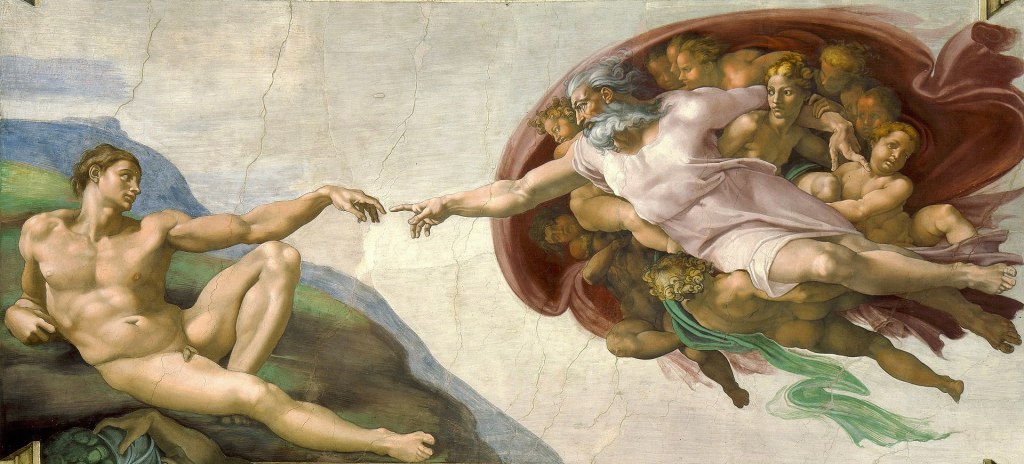
Genesis states that we are created in God’s image and likeness. I’m not suggesting that God is in all ways like us, but He must share at least some attributes.
The Bible is full of verses that testify to God having feelings, or at least that the authors of the day felt that God possessed these feelings. What is interesting is how modern Christianity has limited those He is “allowed” to feel. They’ve said, “No…He cannot possibly share them all.” Some feel He inherently shares none as we understand them.
Let me introduce a topic called the Impassibility doctrine. It is defined as such:
“God is not subject to suffering, pain, or emotional change, and is not affected by external forces, remaining in a state of perfect, unchanging perfection.”
This concept was born out of Greek philosophy. As it relates to Christianity the first mention seems to be from the early 2nd century AD, when the concept was adopted and applied to God by Ignatius of Antioch.
Just like the Trinity, it is a concept developed by human thought, and post-Biblically applied to the concepts in the bible.
To be clear, this is not a universally accepted doctrine. Plenty do not ascribe to it, or only partially ascribe to it. There are certainly good reasons not to!
Let’s look at some of these reasons.
Love
Everyone is good with God feeling love. How can you not? The Bible is crystal clear about this. We see examples like this:
“Anyone who does not love does not know God, because God is love.” – 1 John 4:8 ESV
“For God so loved the world, that He gave His only Son, so that everyone who believes in Him will not perish, but have eternal life.” – John 3:16 NASB
There are MANY verses that support God feeling or embodying love in some way or another.
Jealousy
You shall not bow down to them or serve them, for I the Lord your God am a jealous God, visiting the iniquity of the fathers on the children to the third and the fourth generation of those who hate me, – Exodus 20:5 ESV
For the Lord your God is a consuming fire, a jealous God. – Deut 4:24 ESV
The Lord is a jealous and avenging God; the Lord is avenging and wrathful; the Lord takes vengeance on his adversaries and keeps wrath for his enemies. – Nahum 1:2 ESV
Again, there are many more, but it’s clear enough. The Lord our God is a jealous God.
Anger/Vengefulness/Wrath
For the wrath of God is revealed from heaven against all ungodliness and unrighteousness of men, who by their unrighteousness suppress the truth. – Romans 1:8 ESV
I will execute great vengeance on them with wrathful rebukes. Then they will know that I am the Lord, when I lay my vengeance upon them.” – Ezekiel 25:17
The Lord is merciful and gracious, slow to anger and abounding in steadfast love. – Psalm 103:8 ESV (Being slow to anger, doesn’t mean never angry. In fact this confirms He can get angry.)
You may not be surprised that this category gets a lot of Biblical mentions!
Compassion
As a father shows compassion to his children, so the Lord shows compassion to those who fear him. – Psalm 103:13 ESV
Behold, we consider those blessed who remained steadfast. You have heard of the steadfastness of Job, and you have seen the purpose of the Lord, how the Lord is compassionate and merciful. – James 5:11 ESV
“I will strengthen the house of Judah, and I will save the house of Joseph. I will bring them back because I have compassion on them, and they shall be as though I had not rejected them, for I am the Lord their God and I will answer them. – Zechariah 10:6 ESV
For the “sin of empathy” crowd, the Bible sure does have God showing a lot of compassion. Jesus likewise shows great compassion throughout His earthly ministry.
Grief
How often they rebelled against him in the wilderness and grieved him in the desert! – Psalm 78:40 ESV
But they rebelled and grieved his Holy Spirit; therefore he turned to be their enemy, and himself fought against them. – Isaiah 63:10 ESV
And the Lord regretted that he had made man on the earth, and it grieved him to his heart. – Gen 6:6 ESV
All of these, so far, are commonly acceptable feelings that modern Christianity can ascribe to God. However, what about that last one? Don’t look at the bolded “grieved” part. No, back up a bit. Look a few words before that. What word is italicized?
Regret
He regretted. To many this is unacceptable. God cannot possibly feel this right? That would impugn His Omnipotence and Omniscience they reason.
This insistence that God cannot feel regret is so strong, that in his 2001 Genesis commentary, John Walton lays out the following options when attempting to translate this word.

1.) We can simply rethink our view of God, within the new theology called the “Openness of God”
[Openness of God, or Open Theism is defined below]
[It] is a theological movement that has developed within Christianity as a rejection of the synthesis of Greek philosophy and Christian theology. It is a version of free will theism and arises out of the free will theistic tradition of the church, which goes back to the early church fathers. Open theism is typically advanced as a biblically motivated and logically consistent theology of human and divine freedom (in the libertarian sense), with an emphasis on what this means for the content of God’s foreknowledge and exercise of God’s power. – Wikipedia
TLDR version: Essentially God is not Omniscient to the degree that it would inhibit our free will.
2.) We can justify the terminology by seeking to understand ways in which anthropomorphic language is used in describing God’s actions without imputing human limitations
3.) We can reassess the lexical data to see if we are on the right track when we translate terms in particular ways.
John Walton ultimately takes option #3 as the first two (especially #1) present too much of a risk to current held theological dogmas.
He goes on to introduce an entirely off-topic lexical interpretation schema of the root word under the guise of “accounting.” Supposedly this is some type of terminology used in bookkeeping that relates to balancing of the ledgers. He provides no justification for this. It is not found in any other theological discourse, journals, or commentaries. It’s nowhere in any other lexicon, at least prior to his publishing. [I’m conveying this debunking of John Walton’s interpretation from a recent piece by Dr. Dan McClellan on this topic]
According to John Walton, God is auditing the accounts of mankind and finds a remedy is needed.
This is just silly apologetics. It’s these absurd interpretive antics that just betray a devoted and concerted effort to avoid the clear and present meaning of the word.
Do we really think that this author, living in ~700-500 B.C. was writing this down thinking in these complex financial terms “Ah yes God is auditing the accounts of mankind.” Or….and hear me out…the author just thought “Wow. God really regretted what He made! He’s gonna wipe em’ all out!”
These mental gymnastics are just nonsense. We should have explored option #1, and reached a fuller understanding of God. Instead we box ourselves in to a God limited by our modern philosophical framework. We limit God by our theology.
To a person who believes in inerrancy, having your theology inform your Bible of what it can and can’t mean, seems like a pretty twisted concept.
Other Feelings
Wouldn’t it stand to reason that God, in some capacity at least, feels all the same feelings we do? (not counting physical feelings like hunger/thirst)
Curiosity comes to mind. The very concept of being curious rules out omniscience though, so that’s historically not been allowed. However, I’d argue the very fact the earth/humans were created in the first place seems to support at least some curiosity being present.
Eagerness is plausibly alluded to here.
Therefore the Lord longs to be gracious to you,
And therefore He waits on high to have compassion on you.
For the Lord is a God of justice;
How blessed are all those who long for Him. – Isaiah 30:18 ESV
Surprise is another one not allowed, but seems to be hinted at here.
They have set up kings, but not by Me;
They have appointed officials, but I did not know it.
With their silver and gold they have made idols for themselves,
So that [a]they will be eliminated. – Hosea 8:4 NASB
“…and have built the high places of Baal to burn their sons in the fire as burnt offerings to Baal, a thing which I did not command nor speak of, nor did it ever enter My mind;” – Jeremiah 19:5 NASB
Humor
I’ve heard a number of pastors who have said God must have a sense of humor because we humans do, and we were created in His image.
Like….ya man. I’m with you! But why does not same sentiment not apply elsewhere then?

My favorite Hollywood portrayal of God was done by Morgan Freeman in Bruce Almighty and Evan Almighty. Clearly operating with a sense of humor (in a very respectful way I might add), Freeman’s portrayal of God conveys a desire for connection and relationship with His human creation.
Conclusion
Our full articulation of the concepts of God’s Omnipotence, Omniscience, and Omnipresence, are debatably post-Biblical concepts to a degree. I’m not claiming they are not alluded to or present in any way in the Bible, but I am saying that we define them differently and understand their extents to be greater today than in the Bible’s time period.
In some ways, that feels limiting. I’m not sure this is a good thing we’ve got going on here. A God that is a maximal 100% all-of the-Omnis (Omnipotent, Omniscient, Omnipresent) raises some significant philosophical and ethical issues that I won’t get into here.
Just a basic thought game eliminates true Omnipotence. Can God create a prison cell so strong that He Himself cannot escape? In either a Yes or No scenario, God fails the test of Omnipotence, as He either cannot escape (not Omnipotent) or cannot create this prison cell (also not Omnipotent). So clearly, there ARE some complications that arise with maximal Omnipotence.
It also denies Him the capacity to really feel what we feel, and I think that’s the most important aspect here. I believe God created us in His image and likeness. He gave us feelings of humor, anger, sadness, joy, love, etc because He understands and feels them too. He gave us these feelings because these are some of the ways we come to know Him.
I don’t have a great answer for the greater question as to what extent and capacity God feels our exact feelings. I do know that it seems way more reasonable to choose John Walton’s proposition of choice #1 here, and not go invent something just to allow for one’s theological dogmas to remain unharmed.
We should want to grow in understanding, not spending our efforts building stronger walls for the box that keeps our preferred dogmas contained and safe.
Peace
 Space For Doubt
Leave a comment