

Humans have this two steps forward, one step back approach to making progress towards equality. Seeing as we’re currently in a one step back phase right now, it feels like a good time to cover a lesser known figure.
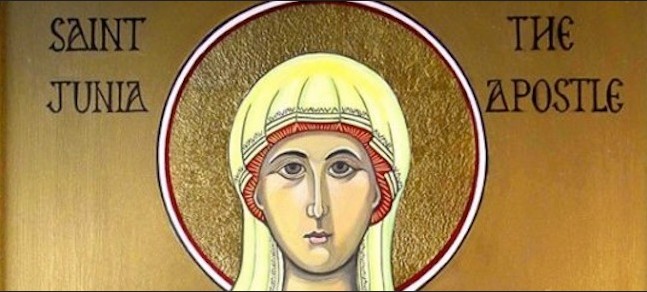
Meet Junia, the female apostle.
You may have heard of her before, but have you heard about the controversy and history surrounding her? Not once in my life, had a mention of her ever come up in a Sabbath School, sermon, Bible study, or casual biblical discussion.
That makes sense when you think of how strong the patriarchy still is. It makes sense why the SDA church would like to sweep that one under the rug, what with their whole anti-women’s ordination stance and all. EGW doesn’t talk about her and the Adventist Church doesn’t appear to have officially addressed it head on, to my albeit limited searching.
Let’s get a little background on this lovely lady.
Greet Andronicus and Junia, my fellow Israelites who were in prison with me; they are prominent among the apostles, and they were in Christ before I was. – Romans 16:7 NRSV
There she is. Our Junia. Prominent among the apostles, and in Christ before Paul was.
Here’s where our story gets interesting. We’re going to work through this story chronologically so you can watch the two steps forward, one step back phenomenon play out. First though, we need to understand the arguments that the pro-patriarchy crowd will use to counter her gender and her status.
The name
Due to the lack of accents on this name in the original and oldest Greek texts, the name Junia is gender neutral. It could be a man’s name. Despite the neutrality here, attempting to read this person as a man is a tortured argument.
The name Junia isn’t common in Greek. Our records today have it being found in one other instance, and in that instance it is a female. It is, however, found often in Latin. We have over 200 examples of this name occurring in Latin 1st century CE texts (non-biblical), and in all cases it is a female.
The first and only example of this being a male name doesn’t come until the 2nd century CE. Even then, we only have one.
To attempt to use the gender neutral argument in support of a male figure here is a textbook case of misogynistic apologetics. People want to gin up the smallest sliver of “well it’s not impossible, so therefore it’s probably what happened.” Sure Bob.
The interpretation

The Greek preposition for “among” (ἐν) here is what is contested by some. This word could be interpreted as “by.” That changes the meaning. Instead of being prominent among the apostles, Junia could be prominent (or well know) by the apostles. Many modern English translations do exactly that.
This is an unlikely translation for a few reasons.
1.) To read it exclusively (Aka “known by the apostles”) is strained due the the Greek used. The lack of similar usage in comparable contexts is problematic.
2.) To read it exclusively under the guise of wanting this to be a man, is silly in itself. If it was a man, why the desire to have him excluded from apostleship? You can’t have your cake and eat it too. Additionally, Paul calls himself an apostle and he clearly wasn’t one of the 12. You can’t use “the 12” as an argument either.
3.) Paul generally didn’t care about what the other disciples thought, as long as they were teaching the right things. He didn’t need their validation or their support to lend him authority. Paul likely would not have cared, such that he would essentially write “Look. See that Junia? She’s awesome! Don’t just take my word for it. She’s well known by the apostles!”
4.) No early Christian church fathers interpreted it in this way.
Timeline
Our earliest Christian fathers were totally fine with this being a woman. In fact, we have an early and very influential Greek-fluent witness who attests to this:
“Greet Andronicus and Junia . . . who are outstanding among the apostles. (Romans 16:7) : To be apostles is a great thing, but to be distinguished among them—consider what an extraordinary accolade that is! They were distinguished because of their works and because of their upright deeds. Indeed, how great was the wisdom of this woman that she was thought worthy of being called an apostle!” – John Chrysostom, Bishop of Constantinople (~400 AD)
Bishop John here is not only confirming the translation choice of (ἐν), but he is confirming her gender, and celebrating this fact.
What’s more powerful about John’s statement, is that he was no particular friend to women. He did not advocate for women’s ordination/leadership and had negative things to say about them elsewhere. If this verse could have been interpreted in another way, it’s pretty likely he would have done so.
We also see numerous other early 4th and 5th century church fathers quote this verse. Every single time they confirm that the translation of her being an apostle is accurate, and that she is indeed a female. How do we know this if the name is gender neutral? Well, when they write, they add the feminine accent marks to the name in Greek!
All the way up until the 13th century, there is universal agreement that not only was she a she, but that she was also an apostle. It’s around this time that the patriarchy apparently decided enough was enough. This needs to stop. She’s gotta be a he!
Aegidius of Rome (1245-1316) calls Junia a man. This gets the broader patriarchy all excited and people start jumping on the bandwagon.
Father Stapulensis (Paris, 1512, p.99b) wrote a commentary that attributed Junia as “Junias”, a male name. This was used by the very well known Martin Luther, who took up the mantle of a pro-patriarchy approach to scripture. It was through him this argument was firmly embedded and accepted by most.
There was occasional push back over the subsequent centuries, but none so powerful as Luther. None were influential enough to change the minds of the patriarchal powers-that-be away from their opinion.
It is not until we get to the 20th century that we start to see tide shift back towards viewing Junia as female. Today a definitive majority of scholars hold this view.
What is sad is that this scholarly majority is not a univocal agreeing entirety. You can Google this and find a sliver of extremely biased people who, even today in the 21st century, adamantly demand this Junia be a man. It’s simply the inability of people to see past their own biases and dogmas of how the Bible MUST be.
Once again I am left thankful for modern critical scholarship. Truth always seems to find its way to the surface. It may take hundreds of years, but truth has this resiliency that social constructs and dogmas do not. Those come and go. The truth existed before them, and it’ll be around long after they’re gone.
Peace.
 Space For Doubt
Leave a comment