

Have you ever questioned why any particular piece of traditional Biblical history must be taken as literal?

Don’t overthink this. Don’t think about who else believes that, or how it’s always been taught. It’s not that deep. The question is simply why does the story itself have to be literal?
Perhaps a better way of asking this is why CAN’T the story be metaphorical? Does it somehow reduce God’s sovereignty? Does a non-literal reading interfere with prophecy or other text? What harm does it do? Does it better fit the science, psychology, and evidence we have today if it was literal or figurative?
Let’s look at the “literal” 7-day creation week. What is it that demands this specific interpretation?
Everyone knows the creation story. Most know there are two creation stories in Genesis. Slightly less people realize that these two stories are incompatible.
Straight away this incompatibility should be a clue, however we’ll skip over that for the purposes of this article. There are some apologetic attempts to harmonize these two stories, but despite the good ole college try, they just remain attempts.

What does the Bible say about this alleged 24-hour, seven day creation week?
Let’s start with the word for day (yôm). Right away, in its introductory usage in Genesis, we see that it doesn’t have to mean a literal 24-hour period. It has two meanings here.
God called the light Day [yôm], and the darkness he called Night. And there was evening and there was morning, the first day [yôm]. – Genesis 1:5 ESV
Looking at the Blue Letter Study Bible’s outline of biblical usage, we see this:
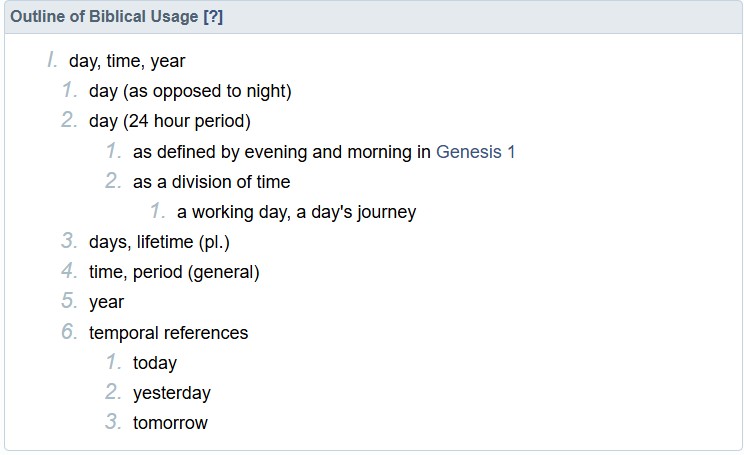
We have a word that conveys multiple meanings. In many cases, it is just used to describe a general period of time. We’re not talking about the plural form of this noun (days). The singular form is used to reference non-24hr time periods in the bible as well.
You might say “But there was evening and morning!”
To which I would reply…yes of course there were. Now tell me what is an evening and morning? Is it not just a vague time period denoting roughly the beginning and ending of each “day?”
Evening and morning, and 24-hours are not directly connectable. One is a set of constructs of human creation, and one is a factual passage of time. An evening and morning on Venus would be months apart, as the rotation of Venus makes a day roughly 6,000 hours there.
Keep in mind here, that the Bible also says there was evening and morning before the Sun is created. The sun is a very necessary item to have in place before the tracking of said “evening” and “morning” would be possible, let alone the establishment of a 24-hour day.
The only other place in the Bible we get anything to backup the literal interpretation of the creation week is in the Ten Commandments. Well…not the literal Ten Commandments, but what we call the ten commandments today (see here for more on that).
Exodus 20:11 calls out God creating in six days and resting on the seventh. That word yôm is again used, and just as before, seems to offer the same ambiguity.
Can we find anywhere else that might scripturally require this literal 24-hour interpretation? I’m not coming up with anything logical. I’m actually just not able to find anything at all. I even consulted with the Answers in Genesis people and found this little comedic gem:

Apparently according to them God could easily do the first five days of work in only 12 hours out of each day. (but definitely not 11. That would just be too much of a stretch 😂) However according to them it’s that sixth day that is the sticking point?
People…please. If there’s just one thing you take from my blog, just one small thing, please let it be this. Please do not go to Answers in Genesis for any answers. It’s a real mess over there. You’re going to be confused. They already are confused. Nothing will make sense. You’ll just have to unlearn it eventually anyway. It’ll be a bad time for everyone.

The only thing that requires this be interpreted as seven literal 24-hour periods is long-held dogma. For SDAs I guess you follow EGW’s interpretation…which I suppose is basically the same thing.
That’s it. That’s truly it. There’s no scenario that satisfies logic or critical thought in which this must be 24-hour periods.
Is God somehow less powerful if He took longer than seven literal 24-hr days? If you answer yes, why? What requires that yes in your mind? Can He not create on whatever timeline He so chooses? Why would, say, 7,000 years make God less powerful than a God who created in 7 literal days? If it was 7 million years, still…who cares?
Why choose the route that just creates more problems? Why choose the interpretation that attempts to solve a problem that didn’t even exist in the first place?
It’s understandable if your SDA here and you’ve been force-fed EGW your whole life. She claims this 24-hour day is necessary to maintain the importance of the Sabbath day. However….again….why does that have to be correlated? Because she says so?
The Sabbath day has no necessary correlation with exact length of each creation day. It can simply be an analogous symbol, given by God, and not a literal copy and paste time-frame. God instituted a Sabbath rest for the land too, and that was only once every seven years. So…there’s that.
The Sabbath is not harmed, delegitimized, or devalued by God Himself instituting it as a symbolic period of rest vs an exact copy of what He did. He knows His creation and He knew after six days we would need a break physically and mentally. Very clearly the rest of the Bible continues to support the Sabbath. Doctrinaly there is no damage done here.
Do you really feel like the God of creation needed 24-hours of rest? You don’t? You say it was symbolic for Him but literally meant for us?
Ah yes…. I see. That need for rest was symbolic but the 24-hours cannot be. Sure. Right. There’s definitely no poking holes in that logic.
The majority of Christian denominations do not hold to a literal 24-hour creation day reading. Only strict fundamentalists do. Only those who have anchored themselves to dogmatic stances on topics that have no relevance to their their salvation.
The only thing a literal 7-day creation doctrine does is reinforce one’s identity politics and keeps the scripture confined to a box of inerrancy that it was never meant to inhabit.
Somehow strict fundamentalists have made this particular issue one of the many hills they will die on. Other hills are at least somewhat understandable. This one? This one feels excessively unnecessary.
When it comes to studying the Bible, it’s really worth taking a 30,000 ft view of a story before any study begins. Ask yourself, if I view this as metaphorical instead of literal, is that a problem? What does the best of our modern knowledge say on the matter? To be clear there WILL be conflicts. For example, science cannot prove a God exists with direct, observable, and irrefutable evidence. If it could, everyone would believe in God.
You have to choose for yourself where the evidentiary bar is set. You can reason your way into believing in God, you can interpret the science to be evidence of a divine creator, but like it or not, there’s nothing inherent to science (which includes biology, psychology, geology, and I’d even argue critical scholarship) that proves He exists. It’s not like we found God’s tunic laying around (shroud of turin joke).

On one end of the spectrum there is God not being in direct, provable, and irrefutable evidence.
On the other end there is willingly ignoring all science, reason, and rational thought to believe in a flat earth, as the Bible would prescribe. (That’s a hyper-extreme case of literalism)
Between these two extremes, you and ONLY you, have to rationalize what level evidence you need, to determine what is literal.
Perhaps a better reframing could be what level of contra-indicating evidence can you ignore and still maintain those literal takes?
For me the evidentiary bar is set rather high. I operate with the understanding that much of the OT is either historicized myth or mythicized history.
How does one evaluate then, what is reasonable? What is logical? What is practically impossible? I’ll show you the framework I use. Generally, more than one needs to apply before it’s dismissed as non-literal.
- There is no archaeologic evidence for it (Example: The as-written Exodus)
- The reading defies the scientifically possible (Example: World Wide Flood)
- The scripture itself does not demand a literal reading (Example: 24 hr/7day Creation Week)
- The scripture itself is not univocal on the topic, such that one particular reading MUST be the chosen one or is even the likely one. (Example: David Killing Goliath)
- The human element in story telling (Example: The Unlikely Origin Story of the Moabites and Edomites)
- The reading makes no logical sense (Example: The Trinity)
- The reading, even if seemingly logical, isn’t based on a proper understanding of the scripture itself (Example: Women not being allowed to speak in church, Satan being present in the OT)
- The reading puts modern ideas into the words of ancient writers (Examples: The Trinity, The Superiority of the White Race, the Rapture)
- The reading goes against the character of what a good loving God would want (Example: Beating your kids)
- The reading is based off of known agenda-driven scribal changes to earlier stories (Example: Anti-polythestic alterations, The pro-Davidic revisions)
- The reading, while theoretically possible, does not fit within plausible human behavior (Example: The allied armies of Israel retreating from Moab because they were offended at the sacrifice of Mesha’s firstborn)
These constitute the bulk of my approach to deriving meaning from scripture. Some are based in science. Some are based in reason. Some are based in my understanding of God. Some are based in my understanding of human nature. All have a seat at the table during this process. At no point is there an assumption that the Bible speaks with one internally agreeing voice, such that every author has to be in harmony with the rest. At no point is there an assumption that the Bible is inerrant.
Critical probing and understanding of the text is not easy work. There’s a reason people outsource brain surgery. There’s a reason people outsource engineering studies. There’s a reason people outsource nuclear physics.
When it comes to scriptural understanding, we all outsource some or all of that work to professional scholars in some capacity. (even professional scholars themselves!)
Here’s a list of Do’s and Don’ts for your scriptural interpretation journey:
- Don’t rely on a single source for your understanding
- Don’t rely on sources that have a vested interest in maintaining a certain reading. I.E. Any pastor employed by a religious institution, who could be fired for going against the grain. They have a financial interest (gotta eat) in maintaining a certain reading of scripture, even if they privately doubt.
- Don’t rely on only atheist critical scholars. They often lack the ability to see the supernatural possibility of God having a hand in things.
- Don’t rely on anyone to tell you what something means, if they themselves clearly have no record of experience or education in how that thing would work. Doubly so if they can’t coherently explain why they are taking that reading. (BTW “The Bible says it, I believe it.” is not a coherent explanation)
- Do search out independent critical scholars (See list of my favorites below)
- Do use your own judgement to evaluate what you are reading. Does this thing really pass the smell test?
- Do use modern tools and materials (Blue Letter Study Bible, newer critical translations, etc)
- Do use extracurricular reading (commentaries, history books, Wikipedia and Reddit)
- Do take your time. There’s no rush here.
My favorite independent scholars (in no particular order)
-Pete Enns
-Dan McClellan
-Kipp Davis
-Michael Heiser
-Aaron Higashi
-Jennifer Bird
-Bart Ehrman
-Heath Dewrell
Be open minded. Truth exists outside of an institutionalized religion’s doctrines. Just because someone says topic X needs be literal, doesn’t automatically make that true. Push back. Ask why.
If you come to the conclusion that topic X doesn’t need to be literal, and that there isn’t much in the way of theological ramifications from that, then just do it. Leave that burden behind, and appreciate the story through a different lens, and from your new perspective.
Consider yourself no longer literally beholden to hollow dogmas. 😉
Peace
 Space For Doubt
Leave a comment