

What does it mean to abandon a biblical belief?
I have two working definitions.
1.) To no longer believe that something is true to the extent that there are no mental gymnastics or interpretive changes that could be implemented to save it.
2.) To no longer believe an interpretation you have been taught about a biblical story, but still have the door open to other potentially valid interpretations.
My deconstruction exists with primarily #2s, with a few #1s sprinkled about. I don’t think I was clear on that in a previous post so I want to set the record straight here.
I think when science disagrees with the bible, it need not invalidate the entirety of the bible. It just means we need a better interpretation of the bible.
The bible was not written as a history book. Even prior to deconstruction, I was on board with this thought. How could it have been? The bible was written by a people that didn’t know where the sun went after it went down. How could they write a scientifically accurate book?
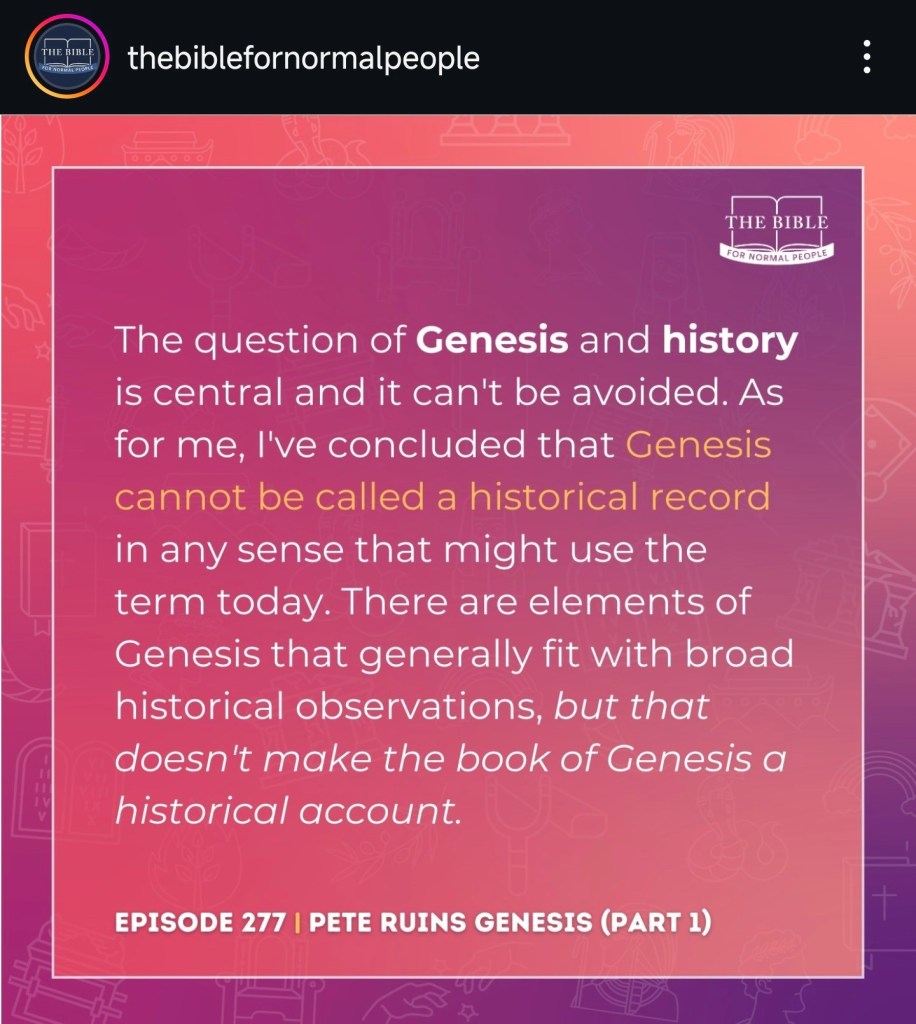
The above screenshot was taken from my current favorite podcaster/writer/theologian/deconstruction specialist, Pete Enns on his Bible for Normal People Instagram page.
He has been instrumental in putting words to the thoughts I have floating around in my head. I find myself in agreement with nearly all of what he writes. Specifically he seems to address the big questions those of us deconstructing have. I would encourage you to read/listen to his work as well.
Where I am trying to get to with this post, is what then happens if you abandon only the interpretation of a belief? Well…there are many resources out there of open minded theologians who are attempting to find answers to exactly these questions. (Reasons To Believe on YouTube is another great resource for the science-minded individual)
As a quasi-Seventh Day Adventist, I believe we (The SDA’s) could in theory be uniquely positioned adapt to modern day deconstruction. I want to get into that in detail, so be on the lookout for that article later. There’s a ton to unpack there but also much frustration.

Generally I adhere to the Occam’s Razor principle. The simplest explanation is most often the best.
Simplest? I’ll explain. If sticking to a traditional interpretation requires a textbook worth of mental gymnastics to make it work, it’s not the simplest. Even if it textually appears that way. Let’s take the flood. The simplest way to describe the flood is….the flood covered the whole world. The end.
A more complicated way is to say: The flood covered the known world of man (the men writing the bible), only killing off the regional areas of population. It was high enough to cover the local hills but was nowhere near global in extents.
However one requires a mountain of mental gymnastics to make “work” and one is far more feasible without bringing up so many impossibilities and issues with geology, biology, geography, and physics.
One is linguistically simple but impossible to achieve. The other is a more complicated and nuanced theory to describe, but still fits within a feasible interpretation AND falls within the realm of plausibility in every other facet.
Occam’s Razor doesn’t just mean simple in how it reads, but simple in the end result of what is required to make it work. How many problems do you create in attempts to solve the first one?
My deconstruction is an attempt to solve problems without creating new ones. To a great degree this has been successful and I am excited to share here what that looks like. None of my current beliefs require mental gymnastics to maintain. I simply don’t have the patience or energy for that anymore.
Peace
 Space For Doubt
Leave a comment