


According to ancient legend, the phoenix is an immortal mythical bird. One day it grew bored of living in paradise and wished to travel to the mortal world. Not long after arrival, the Phoenix became aware of its immortality and wanted to renew himself.
He built a nest and waited for the sun god Ra to come. As Ra drove his chariot across the sky, the phoenix sang a song to get his attention. When Ra stopped to listen, a spark fell from him, setting the nest alight. The beautiful Phoenix was engulfed in flames and perished.
However, after three days, the Phoenix was reborn from the ashes and lived on in perpetuity.
My deconstruction started with a spark, an audiobook. It set alight decades of fuel. The fire burned hot around me. There came a point when I too, finally realized I wanted to renew myself. I let go. I let it all be subject to the fire. Every part of my faith now faces the test of incineration, and only what survives, can remain. I’m not holding anything back in a fireproof safe somewhere in my mind.
For those of us who have/are deconstructing, how do we reconstruct? How do we build back a faith compatible with our view of God?
That’s a question I have been thinking a lot about over the last year. Where do I go from here? Where do we go from here. I think the number of ways one can reconstruct are likely as numerous as the number of those it’s happening to. There’s no one-size-fits-all approach. I can just share things from my vantage point.
To start with, I’m not convinced this reconstruction is a process that is ever “finished.” It’s a journey with no hope of arrival at your destination, but it is a journey where you can be at peace with the direction you are headed.
My approach to the bible has been what has changed the most. I respect it in a new way and hold what it says with greater curiosity but with far less fear. I see it as a truly God inspired work, but transcribed by a people that existed in a completely different time/culture/place/understanding than our own. They wrote in a way they could make sense of. They wrote in a way very different from today’s society, separated by thousands of years and an immense delta in accumulated knowledge in all areas.
The question I have asked myself is, where does one draw the line of divine intervention in scripture transcription? When it comes to the text of the bible, to what degree did God actually force it to be written in a certain way? Did He override His chosen scribe’s free will to ensure the text was perfect? Did He allow that scribe to add flourish and exaggeration, or even…dare I say…errors? If the writing was supposedly all perfect down to the word, then there are a vast array of problems that we have to face. I will most certainly have a post on that.
If you want to learn about these problems from a much more competent source than I, I would encourage the reader to listen to Pete Enns’ content. He is probably the most reasonable, well spoken, calm, and logical theologian I have ever heard. However he is not unique. Many others do what he does, each in their own way.
Another question I had was how involved was God in the human process of canonizing the scriptures? Pete Enns, in one of his podcasts, describes a division between the eastern and western churches during canonization. One side wanted Hebrews and the other didn’t. One wanted Revelation, and the other didn’t. They each respectively disbelieved the validity of the other’s choice. However they reached a compromise where both books were admitted entrance into the canon.
That story struck a chord with me. This was such a human process. Similar sentiments apply for how SDAs today vote in changes to the fundamentals via a G.C. vote.
I’ve heard it said the vote of the G.C. is the will of God. Frankly, I think that take is a big steaming pile of you know what.
Was it the will of God that the doctrine of Righteousness by Faith failed the first time around? We believe firmly in that doctrine today. It makes me return to the sentiment of my post “Blame or Credit,” and I’m not buying it.
The Bible is a valuable tool. I believe it is very much an inspired book. It should absolutely help mold our faith. However, regardless of what the bible appears to say, if an aspect of what we believe seems unloving, unethical, or untrue, it’s something we really need to reexamine. Did we get it wrong in the first go? In what context was it written? Is the bible itself in harmony on the issue? (it’s often not) What do other well regarded theologians have to say on the verse/topic?
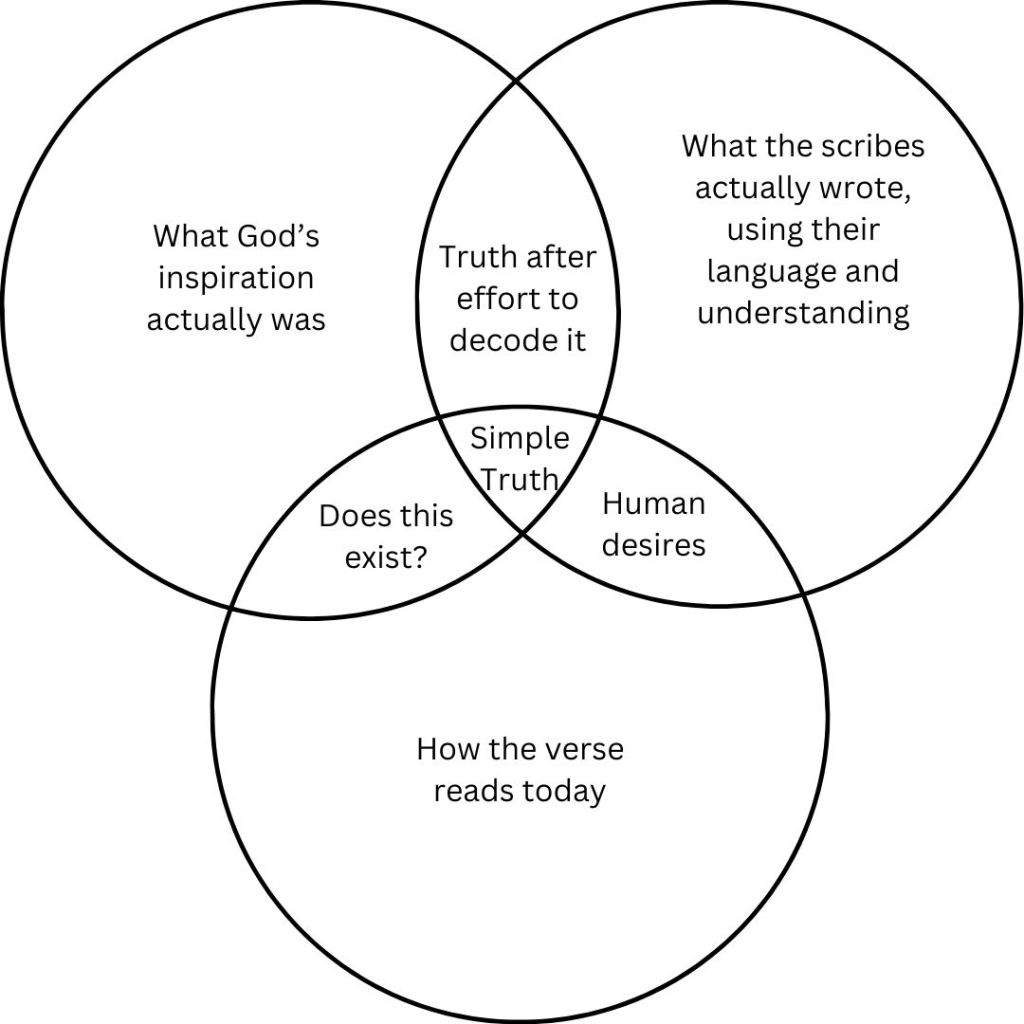
My reconstruction has landed me here, at this place where scripture is tested and scrutinized. No verse or topic is off limits from this inspection. The truth does not fear scrutiny and has nothing to lose by close inspection.
There’s three examples of what this looks like in practice that I want to share. Examples which show how the slow process of reconstruction works (at least for me). We’re going to look at 2 Timothy 3:16, 1 Timothy 2:12, and Ephesians 4:15.
These verses have been turned into weapons by the “faithful.” Seeking license to use them for the purposes of misogyny, “blanket permission to not think,” and God sanctioned hate.
So let’s do it. Let’s defang and declaw this tiger.
2 Timothy 3:16
All Scripture is inspired by God and beneficial for teaching, for rebuke, for correction, for training in righteousness; – 2 Timothy 3:16
This verse has been used to prove that everything in the bible is God-inspired. Everything is inerrant. It’s a “You can’t say anything is wrong with what I’m saying” tool, because, well, it’s all directly inspired by God. Many versions use “God-breathed” instead of “God-inspired,” almost being even more direct.
There is an issue here. I wouldn’t have been aware of it if not for Pete Enns. However it’s where we need to start. The issue? There is no word “is” in Greek. Humans put that there during translation into English for ease of understanding.
At first this might seem minor, but read it again without that word there. All scripture inspired by God….Wait. That’s not quite the same. That, grammatically, leaves room for scripture not inspired by God to be present too.
Imagine I sit you down at a table with 20 small glasses of water. You are thirsty. I say, “here are some glasses of water. The glasses I poured are all safe to drink.” You’d look at me a little hesitantly. “Are there any glasses here that you didn’t pour?”
We have a second problem. At the time of writing this, Paul only had the Hebrew scriptures. That’s what he’s referring to. There was no New Testament yet. Some have argued “well by extension it means that too.” No, actually it doesn’t. That’s you reading in meaning to a text that is not present. You can infer it if you want, but you have to be honest with yourself that it simply doesn’t prove that.
The final problem lies in understanding what this scripture is purporting to be for. It should be beneficial for teaching, rebuke, correction, and training. It sounds more like a recipe for knowledge than a platform to stand on for inerrancy.
You can actually learn from reading something that’s incorrect. We do it all the time. You can learn from something taken out of context too. What do we learn? We learn the writer of the incorrect information seems to be misinformed, have a bias, or is attempting to push a specific agenda. That’s education too, and to my eyes, seems to fit within this verse’s intention.
1 Timothy 2:12.
I do not permit a woman to teach or to exercise authority over a man; rather, she is to remain quiet. – 1 Timothy 2:12
We ALL know this one. This one lets the patriarchy put women in their place with righteous confidence. It’s just another tool in the box of things men love to use to keep women under their thumbs. It’s also conveniently another tool to prevent women’s ordination.
Sometimes, things do indeed seem to be plain and unambiguous. Here, unfortunately, it is. This verse has no translational issues and no grammatical issues. It appears to really be obvious. Thankfully, things aren’t always how they appear.
The first problem we encounter is not unique to this verse. It actually applies to most things in the bible. It’s contextual in nature. Paul here is writing to Timothy at the church of Ephesus where he was the pastor. We don’t know the exact dynamics of what was going on with this church, but Paul appears to be specifically targeting this church with this text. We don’t have grounds to use this prescriptively for all peoples at all times.
One possible reason why Paul might have had an agenda here, is that just a short hop across the Aegean Sea was Athens. Athens was an economic and cultural powerhouse for the region, and its influence and practices were well known. It was here that the cult of Artemis at Brauron was in full swing. It was female deity “led”, with a highly female oriented set of worship rituals. Paul may have been attempting to put some space between the order of affairs at Ephesus and this cult.
The second problem is more plain. We simply see the bible disagree with itself under the full approval of Paul and other gospel writers. How so? Well, in a number of other places we have women preaching over men. Now these gospel writers didn’t expressly say “and that is a good thing.” However they thought it important enough to write about these examples, and to not say “they shouldn’t be doing that.” Let’s look a few of them.
Phoebe
I recommend to you our sister Phoebe, who is a servant of the church which is at Cenchrea, that you receive her in the Lord in a manner worthy of the saints, and that you help her in whatever matter she may have need of you; for she herself has also been a helper of many, and of myself as well. – Romans 16:1-2
In Romans 16:1-2 Paul gives high praise to Phoebe for her helpful nature. What’s interesting is the word used for “helper” here. It’s not used anywhere else. In the Greek, the word is “prostátis.” I’m going to post some screenshots of the translation tools I used for this word.
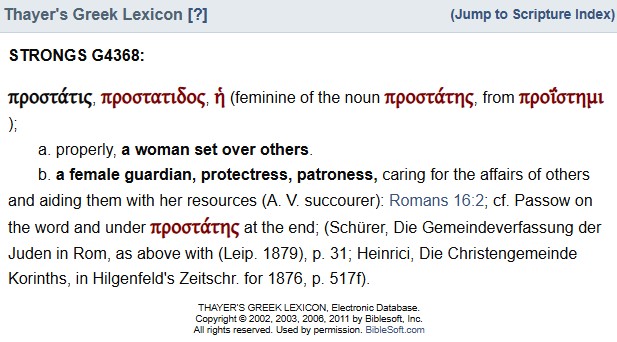
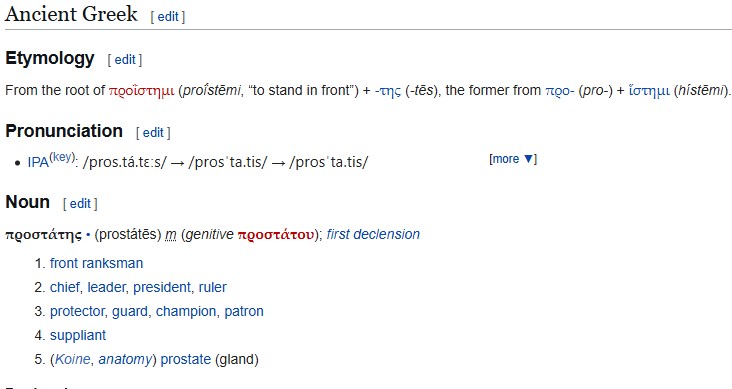
This word shows that Phoebe likely was intended by Paul to be a leader, a woman set over others. Possibly with the intent of her preaching to them. I am curious as to why this was translated helper, when the usage was so unique, and the word was so powerful.
Priscilla
Now a Jew named Apollos, an Alexandrian by birth, an eloquent man, came to Ephesus; and he was proficient in the Scriptures. This man had been instructed in the way of the Lord; and being fervent in spirit, he was accurately speaking and teaching things about Jesus, being acquainted only with the baptism of John; and he began speaking boldly in the synagogue. But when Priscilla and Aquila heard him, they took him aside and explained the way of God more accurately to him. – Acts 18:24-26
I like this one. Paul went out of his way to show that the person they are correcting, or making “more accurate” here, is an eloquent, educated, passionate, but uninformed man. He has all the hallmarks of a man of authority. However what do we see? Both Aquila and his wife Priscilla correct him. We get a female exerting a correcting stance over a powerful and educated male.
There are other examples of women speaking to men, without reproof from the gospel writers, but I hope by now one thing is clear. The bible has clearly disagreed with itself, but only if you want to use this verse in question as a prescriptive text. If you use it in the context I illustrated above, there is no problem.
Ephesians 4:15
Rather, speaking the truth in love, we are to grow up in every way into him who is the head, into Christ, – Ephesians 4:15
This verse has been formed into a cudgel of hate by the modern conservative church. It is used to go forth, find “sin,” and blast the sinner with a twisted and sick idea of what “love” is by vocally correcting them.
I’ve often seen it as the scriptural backing to attack the LGBT community. “We must, of course, call out their sins. We must speak the truth to them.” they appear to be thinking.
I’ll leave the commentary on the biblical validity of the anti-LGBT stance for another post. Here we are focusing solely on the tool they use to justify their proactive approach to go and find the sinner and correct them.
Just to reiterate however, this verse has been used to attack all sorts of sin. Not just anti-LGBT. Let’s look at the problems.
The first one is that just a few verses beforehand, Paul says this:
Therefore I, the prisoner of the Lord, urge you to walk in a manner worthy of the calling with which you have been called, with all humility and gentleness, with patience, bearing with one another in love – Ephesians 4:1-2
Humility, gentleness, and patience seem to be counter to the behavior this verse is often used to permit. The title given to the chapter itself, “Unity of the Spirit” seems in opposition to the idea of turning people away with hate.
We also need to look at the Old Testament Hebrew and Aramaic texts, the only scripture available to New Testament writers, for answers. When truth is mentioned, it almost always is used within the context of a relationship. There is an interest by one party to come to the other and request them to please tell them the truth.
In these passages, truth always comes in the form of “not lying” and “not deceiving” another. This is a very different take than going on the offensive to deliver the “truth” to someone who has not asked for it.
Conclusion
So dear reader, this is an example of what reconstruction looks like, at least for me. It’s an attempt to build a faith that makes sense with a God of Love. Not to discard, but still use the bible as a tool to help understand God. Letting reason have input on the assessment of literal accuracy, of inerrancy.
It’s here I want to reiterate again, regardless of what the bible appears to say, if an aspect of what we believe seems unloving, seems unethical, or seems untrue, it’s something we really need to reexamine.
It’s not easy. It’s time consuming. It requires wrestling with scripture and allowing the existence of the grey. Not everything is simple. For goodness’ sake, humanity has always wanted to boil down scripture and God as this black and white, simple thing. However If history has taught us anything, it’s that scripture is anything but simple! We have Judaism, Catholicism, a thousand sects of Protestantism. All disagreeing with each other on scripture, and all inhabited by many learned and reasoned scholars.
In what world can you call something plain or simple, when for thousands of years we’ve been at loggerheads over that very “simple” thing?
There’s also usually no such thing as “what it’s saying is obvious” when it comes to reading scripture.
No, it is not obvious. It’s anything but. Those loudly claiming it is, usually have an agenda to push by whatever “obvious” reading they want to maintain.
Seeing the grey is not something people, let alone an institution, can easily do. The SDA church, however impressive and right it would be for it to do so, would be effectively thrown into chaos if it allowed grey to exist in any official stance on interpretation. The majority of the congregation just wouldn’t be capable of handling it.
It’s down to us, on an individual level, to discover these things and live a life representative of it. A life in harmony with a loving God, that is ethical, fair, and the best representation of “loving our neighbor” that we can muster. We must do all of this even if it is not in complete harmony with what our Church’s stance is.
A good starting list for reconstruction could be the following:
- Do I still believe in God at all?
- Do I still believe that God is a loving God?
- Do I still believe in Jesus’ authority and mission?
- Do I still believe the bible has any truth in it?
I happen to be a “Yes” to all of those. If you find yourself at the same place as me, buckle up. There’s a lot of extra-biblical reading to do!

Peace.
 Space For Doubt
Leave a comment