

“We need to get back to traditional Christianity!”
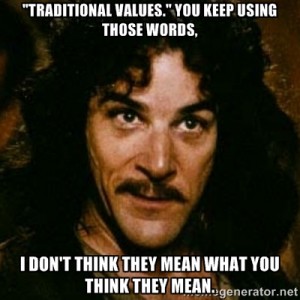
Have you heard this, or some version of this phrase? I sure have. What do “they” mean when they say this? Quite often there is no coherent answer when pressed for one. I know what I’m hearing behind those words, and it’s generally not positive loving things.
Are we talking the Pauline early church, the one where everyone shared all they owned with other believers, slavery was still common place, and women had no rights or voice (usually)?
Was it the church of the crusades time period, the one where millions were slaughtered for not believing?

Was it the medieval catholic church, the one where the church siphoned off all of their parishioners earnings to pay for grand buildings and get-out-of-purgatory indulgences?
Was it the church of the 1800’s with the great disappointment? Where we thought we had everything figured out, but it turned out we had nothing figured out?
My view is that when we hear this today, it seems to be a desire to return to the White American Christianity of the 80’s and 90’s. Where misogyny and racism were still just a little bit OK. Where the pressure from the general non-believing public to create a healthy separation between church and state was not nearly as strong. Where everything fit into a neat little box. Deconstruction was rare. People still regularly beat their kids. LGBTQ people were still mostly stuffed into the closet and couldn’t marry each other. The Christianity of many people’s childhoods.
After all, looking back through rose-colored glasses, the world seemed like such a better place back then. Most people (definitely not all) will remember their childhood as more care-free and fun than adulthood. They will remember how life was so much less complex. Clearly the reason for the state of the world today is because we have left that version of Christianity behind. (/sarcasm)
As we learn and grow, our faith should grow with us. It should be a living/breathing entity within us. In fact it cannot be anything else if it is to remain alive. Right, wrong, or indifferent, Christianity has been evolving and changing continuously since its inception. That is plain fact.
“Traditional Christianity” is a chameleon that takes the form of whatever the proponent wants to return to. It’s whatever point in time society in their view seemed to function the best, and they were the happiest.
I don’t want to return to traditional Christianity. God blessed us with very intelligent brains He wants us to use to improve our faith. For example, we know now that beating our kids is not conducive to long term obedience and happiness. We know it’s incredibly damaging to kids’ mental health. Thanks to psychology and simple observation we know this to be fact. Therefore we (the vast majority) have abandoned Proverbs 13:24 and understand there is a better way.
Today we can appreciate and take advantage of the growth in areas like agriculture, modern medicine, communication technology, nutrition, hygienic practices, and modern comforts. Why would we want to stick to a faith that is fixed to a place in time and not fixed to truth? To stick to a faith fixed to rigid dogma and not to our best current understanding of a loving God? Doesn’t that seem counterintuitive to growth?
In his book, the The Sin of Certainty: Why God Desires Our Trust More than our “Correct” Beliefs, Pete Enns discusses how in the 19th century alone, Christianity suffered numerous huge blows to its orthodoxy. Stemming from the fields of science and ethics, these questions left gaping wounds in the side of the evangelical church. In the knee-jerk reaction defense, we see 19th/20th century Christian Evangelicalism rejecting modernity in favor of strict traditional orthodoxy.
The church has been in turtle mode. It’s been reacting to these “attacks” and trying preserve and maintain the validity of the traditional conservative orthodoxy no matter what obstacle may be encountered. Its instinct has been “defend, defend, defend” at the expense of growth, change, and inclusion.
This rigid approach seems to go so far as to prioritize dogma over love. Anchoring down into a position of being “right” over allowing truth to be uncovered by questioning and growing in Christ. Putting ritual ahead of living a life in alignment with Jesus.
Alan Bean, executive editor of “Friends of Justice” and a member of the Baptist Church, wrote:
This kind of biblical interpretation explains, in large part, why Jesus doesn’t stand a chance in most of our churches. He is welcomed as a Savior but rejected as Lord.
Traditional Christianity is a figment of our imagination at best, and at worst is a rallying cry for an agenda that is almost always rooted in a desire to maintain some place of privilege and certainty in this world. A position that will only alienate others and further accelerate the decline of the church itself.
I’ve met this traditional Christianity, and I’m quite thrilled about spending the remainder of my life not following it.
Peace.
 Space For Doubt
Leave a comment