


“It’s hard to hear God’s voice, when you’ve already decided what you want Him to say”
As I delve deeper into theological history, and read more from various theologians and scholars, this phrase will often bounce back into my consciousness. How often do people approach “Bible study” with an idea of what they want to get out of it at the end, before they’ve even started? What bias do they hold, or even more directly, what specific belief must be maintained no matter the cost?
By no means am I claiming myself as unbiased, an impossible task for a human anyway. It’s more of what I am willing to give up in search of the truth.
For me, the short answer is nearly everything.
In a video hosted on “The Analytic Christian”, Christian scholar Dr. William Lane Craig is debating the historicity of Adam and Eve.
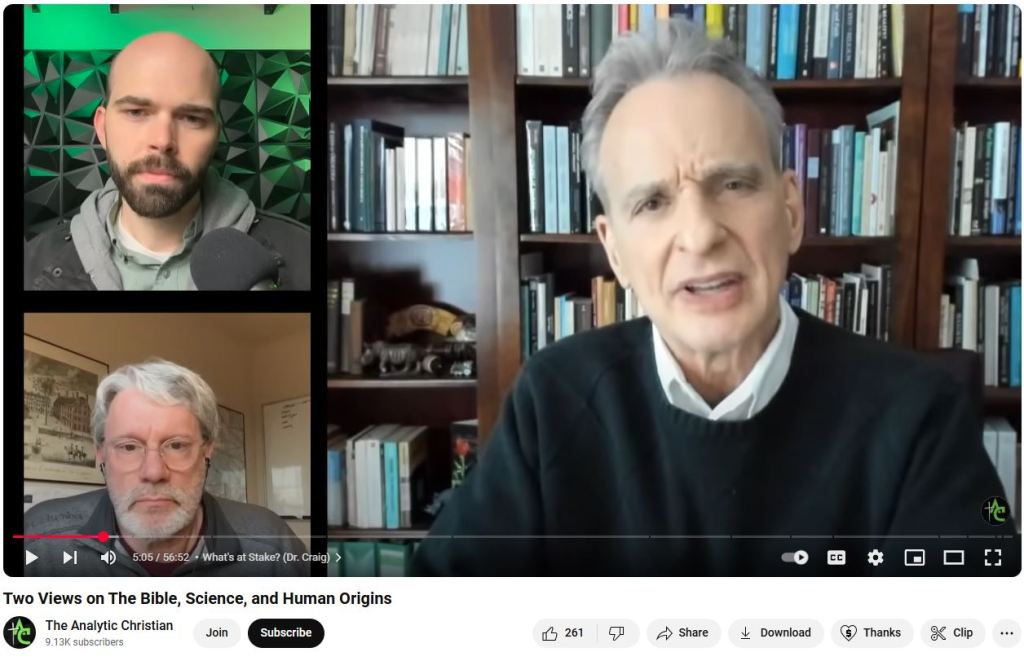
Dr. Craig, in his opening, essentially says that to alter this historicity brings an unacceptable level of downstream ramifications. He seems rigid in maintaining a belief that somehow the bible still has to be right, no matter the level of hermanutical gymnastics required and extra-biblical evidence ignored. He can’t seem to give up this belief.
What about another example?
In his YouTube Channel “Esoterica” Dr. Justin Sledge argues for an early polytheistic Israel, touting evidence in the way of archaeological findings.
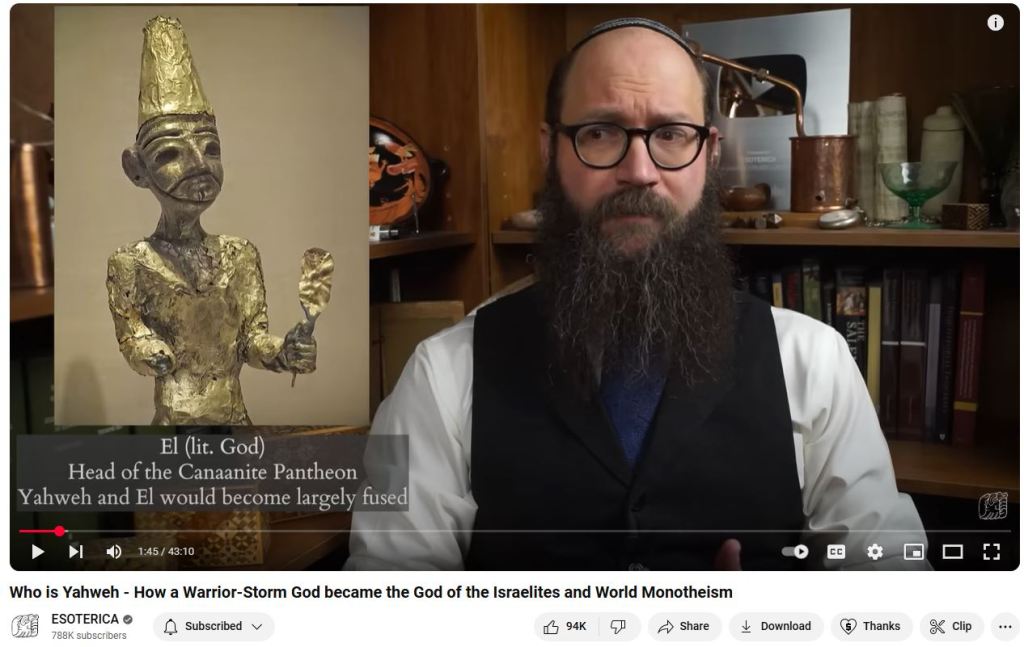
Now I happen to also believe that Israel did have some level of Henotheism at play in the earliest days, but the evidence Dr. Sledge uses doesn’t seem like a great foundation for the end conclusion of a top-down polytheistic structure.
His issue is that we have archaeological findings (inscriptions) of El and Asherah together. Others have YHWH and Asherah together.
This might seem convincing, but take a step back. Think about the big picture. The bible itself is strongly monotheistic (though it admittedly has some Henotheism present at times). There are many stories in the bible of Prophets and Kings clamping down and eliminating polytheistic behavior by the Israelites. Wouldn’t it stand to reason that some of this behavior would result in these same Israelites creating artifacts that DO seem to show a polytheistic culture?
It shouldn’t surprise us to find artifacts depicting YHWH or El with Asherah or Baal, when the bible is condemning essentially that. If it wasn’t occurring, there would be nothing to condemn. So sure, the evidence we see could indicate a polytheistic belief system from the top down. I would argue though that it is just as easily evidence of the behavior that the bible so vociferously attempts to eliminate.
Viewing this as a top-down polythestic culture presupposes onto the bible that the words in the bible itself must be inherently wrong/modified/written after the fact (which admittedly does happen at various times). In this instance, none of this evidence invalidates the concept that God and Israel’s leaders wanted Israel to be monotheistic. He can’t seem to reconcile the fact that these two things, the evidence and the bible, are not mutually exclusive. Both can coexist.
One thing I do not want the reader to take from this post is that I think I’m “better” or “more intelligent” than the two men in my above examples here. Far from it. I am much less educated on the topics at hand. My technical depth of the surrounding topics is nowhere near as broad. They have their reasons for presenting things they way they do. I’m simply trying to point out a bias where I see it.
This topic is important because there are plenty of other cases where one will encounter a bias. It happens all the time. People have the answer they want to arrive at in their head already when they go to “investigate” the scriptures. They then have to create a serious of complicated maneuvers, textual trickery, loose interpretation, willful ignorance of contraindicating evidence, and reading in what’s not there. They must do this all in order to get that square peg to fit inside the round hole they have. They create more problems by “solving” one than were there to begin with.
Often people are open to “change” in their current belief system only insofar as no real change is required in the end result. Any new textual interpretation or extra-biblical evidence accepted, must be such that it does not fundamentally change what they’ve historically believed. They are “open minded” only to the point where they encounter any sort of discomfort.
Out of the 13 official SDA baptismal vows, I no longer ascribe to 6. Out of the 28 fundamental beliefs, I have rejected in part, or totality, 16 of them. I had no struggle in giving up the literal historicity of many OT stories and accepting they are fictional narratives with a broader purpose. I had zero qualms with giving up the doctrine of biblical inerrancy.
There’s nothing I hold unabashed loyalty too, such that I wouldn’t give it up if I thought it to be false (if you’ve read my post on belief not being a choice, you’d know I wouldn’t have a choice in the matter anyway). Therefore when I read something, I’m not attempting to read it within the confines of a desired end result of maintaining my current SDA-adjacent faith.
The search for truth SHOULD work like that. If you find out something you have believed was in error, it is necessary to abandon that which is in error. You may have believed it for decades. Everyone you know may believe it. The bible may even seem to say it! Nevertheless, even the sum of ALL of those things cannot make error into truth.
I have and will continue to get things wrong. I have no intention of attempting to convince people to believe exactly what I believe. All I hope to do here is to raise awareness that if you are truly in search of the truth, there will be things you must give up to find and accept it. Until you are ready to say “I’m willing to accept that I may be wrong on some things with respect to my faith, and I’m willing to abandon those things where necessary.” your bible study and your “investigation of scripture” will be never be unburdened and free.
When your beliefs dictate your view of history/interpretation, you just wind up betraying both.
Peace
 Space For Doubt
Leave a comment