

I happen to be exactly 6ft tall without any shoes or socks on. This specific fact has opened my eyes to a world of desperate deception that I don’t think I would have appreciated otherwise.

The thing is most men want to be 6ft (at least) tall. In the eyes of men, many women, and in the media we see this often as the ideal height for a man. This desire to be tall is so profound that we have people like Ron Desantis who wore custom orthotic shoes during the debate season to appear taller than his ~5′-8″ frame would suggest. It’s so strong that during covid lockdowns, height correcting surgeries on men skyrocketed. Suddenly someone 5′-9″ could indeed become 6′ tall. (The downsides and risks are huge with this, so again….this is nuts. Not to mention all your gained height is in your thighs)
Over the last 20 years or so I have ran into many men who tell me they are 6ft tall, yet I can clearly tell I am taller than them. Once in a while I’ll even comment “well….that’s strange because I can see the top of your head and I am 6ft tall!” Despite this they ALWAYS doubled down. Sometimes they claim I must be taller than 6′. The truth is I’d love to be in the 6′-2″ to 6′-4″ height range, but I know I’m not. My desired height is not tied to my self worth in any way. Plus I know how eyeballs work, so you’ll never hear me say “I’m actually 6′-1”, or “Ya I’m about 6′-2”.
Just like men lying about their height, or women lying about their weight, any other made up fact doesn’t have any influence over the objective evidence we see with our own eyes. It changes absolutely nothing and only influences (negatively) one’s perceived credibility.
I know I’m about to ruffle some feathers and cause some to call me a heretic with this next bit. In a similar way that a 5′-10″ man claims to be 6′ tall out of desire, the Trinity is a concept fabricated by humankind well after the last scripture was written for the same reason, desire. It was created out of desire (some might call it necessity, which is the mother of invention😉), not evidence. Anyone not already familiar with the trinity would never arrive at that concept based on a plain reading of the bible alone.
This isn’t a new position and I’m not the first to push back on it’s validity. There is a whole sect of SDAs who have abandoned the trinity doctrine. Some other protestant denominations do not support the trinity. The vast majority of Jewish people do not believe in the trinity.
The human creation of the trinity was born out of a desire of the early church to explain how Jesus was both human and divine. This desire was so strong, that Latin manuscripts starting in the 5th century A.D. began to include references to the trinity not found in their Greek source texts. This actually happens many times with many different Latin manuscripts! This became known as the Johannine Comma, and the story is interesting. First let’s see what exactly the Johannine Comma is.
“For there are three that beare record [in heaven, the Father, the Word, and the Holy Ghost: and these three are one. And there are three that beare witnesse in earth], the Spirit, and the Water, and the Blood, and these three agree in one.” – John 5:7-8 KJV (1611 version)
Note the bolded and bracketed text. That is foreign text that is only later found in eight Greek manuscripts in what appears to be 16th century revisions (either noted in the margins or directly inserted). The earliest Greek manuscripts we have do not contain this.
A quick synopsis of the early part of this saga is that the church fathers needed (wanted) a way to reconcile the conflicts that arose by Jesus being both man and yet divine as presented in the New Testament. There was really not much for them to go off of scripturally at that time.
We see 3rd and 4th century descriptions of what would later become this addition, in correspondence and statements from early church fathers. This went on until finally, in the 5th century, we have our first Latin manuscript to contain this, the Codex Speculum.
They conveniently just began writing this in at this point. The idea was so ingrained and entrenched as the best and current accepted orthodoxy, that to NOT do so was heresy. Many of the subsequent Latin manuscripts thus had this addition.
We’ll fast forward now to the 16th century, when we find the event that led to its inclusion in some of our “modern” translations in use today.
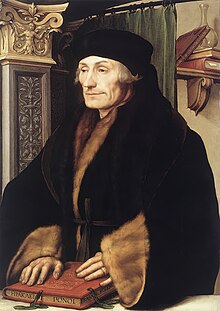
Erasmus of Rotterdam was a Dutch Christian humanist, Catholic priest and theologian, educationalist, satirist, and philosopher. In the 16th century, Erasmus was writing a Greek-Latin translation of the New Testament. (Think Spanish-English bible, where the text is side-by-side) His 1516 and 1519 editions faced criticism from some scholars because it lacked the Johannine Comma found in the Latin translations.
Erasmus was facing intense scrutiny and criticism of his scholarly work by Edward Lee, from the Roman camp, who argued the comma was necessary for silencing heretics. He said that the texts missing the comma had simply been corrupted by heretics. Another colleague of theirs, Lorenzo Valla did include the comma, despite not having it in his Greek source texts. The pressure was on.
Erasmus, claiming he had read all the Greek source texts, challenged Lee to show him any Greek manuscript that did have it. Confident that there would be none, this would thereby prove that Erasmus had indeed argued his position in good faith and that he hadn’t been opposing it’s inclusion due to any heretical views.
After some time, Lee and company did come up with a Greek manuscript that contained this comma, the Codex Montfortianus, They showed this to Erasmus, who then, tired of the constant criticism, begrudgingly included it in his third edition. Erasmus never believed this was a genuine text, and today scholars are in general agreement that it was indeed a forged manuscript. Commenting on that manuscript, Erasmus said:
“I therefore restored from this British codex what was said to be lacking in our editions, lest anyone should have any cause to blame me unjustly. However I suspect that this codex was adapted to agree with the manuscripts of the Latins.” – Erasmus
This change was incorporated into future texts based on the Textus Receptus, which became the primary source for the King James Version. At that point it got cemented into the English speaking world for centuries.
Critics however didn’t take this lying down. They were in abundance virtually from the jump on this modification, however none were in positions of authority or in number to effectively reverse the change. From Erasmus’ day to the present, scholars have pointed out the abundant evidence for this erroneous addition. The Comma however allows for a nearly two millennia long desired belief to be maintained, so at this point, to reverse course is impossible. Therefore the vast majority of protestant denominations, scholars, and theologians, have charted a new course where this error is acknowledged and removed from modern (non KJV or NKJV) translations. The outliers being some very hardcore fundamentalists who comprise the King James Only Movement, who maintain a rigid view that this is still correct.
Despite this new course, ironically, the trinity doctrine itself still finds majority support among protestant denominations. They acknowledge the prior error of adding in the foreign text, but they take the trinitarian understanding and read it back into texts that do legitimately exist. They have to use a lot of creative interpretation, intentional ignorance, and selective usage of biblical texts to arrive at a place where Trinitarianism can be supported by the actual scriptures.
The bible we have today, based on the best manuscripts we know of, does not in my opinion (and many others) well support the concept of the trinity. You could make the case that it doesn’t 100% rule it out, and I’d be inclined to agree, as we can’t ever be 100% certain of some divine thing that no human has seen or understood first-hand. Especially when it’s based on strictly human transcribed texts. I do feel that on balance, the evidence points to the trinity doctrine as false. The collective texts used for/against the trinity seem to align much better with logic/common sense under the assumption that it is false, than if it is true.
My next post will contain a detailed dive into the reasons why the Trinity Doctrine is not well supported scripturally. To combine it with the above would be too lengthy a post.
Peace
 Space For Doubt
Leave a reply to The Validity of the Trinity Doctrine – Space For Doubt Cancel reply