

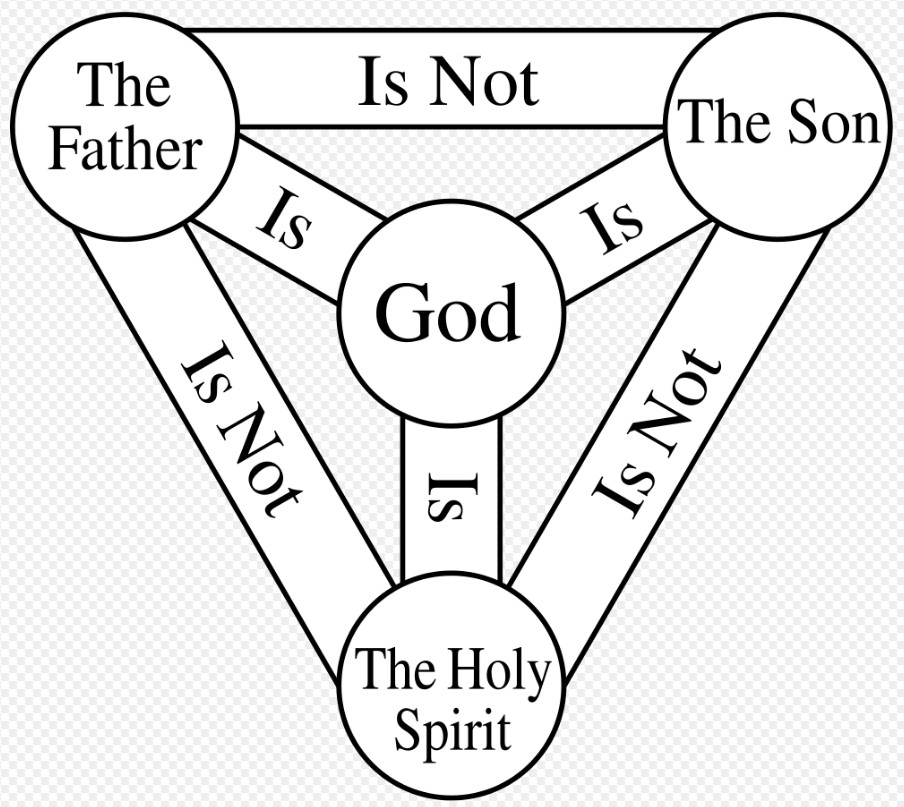
This post is long. Let’s dive right in. Just for a quick refresher, not that anyone isn’t aware, the trinity doctrine is as follows. There are three distinct entities that comprise a singular God, the Father, the Son, and the Holy Spirit. All three are said to be coequal and coeternal.
It’s a very confusing doctrine. How can three separate entities be one? It arose out of a human desire to try to reconcile the divinity of Jesus with his obvious human nature, while still holding space for God the Father and the Holy Spirit. I’ll cliff note Dr. Bart Ehrman on the origin of the trinity. Find the full article here (source). Or feel free to look at Wikipedia. This is a very well known and accepted history and can be found almost anywhere.
The movement toward a doctrine of the Trinity begins with the earliest Christian belief among Jesus’ strictly monotheistic followers that Jesus was in some sense God, but that God the Father was God, and yet there was only one God.
As…Christians thought about it more and more, they elevated what it meant to say that Jesus was God, developing “higher” Christological views…some Christians came to believe that Jesus became divine not at the resurrection but at his baptism; others thought it happened at the point of his conception; others thought that he had been divine before coming into the world. All these views are represented in the New Testament itself.
[Even] “higher” Christologies became popular [over time], including the idea that Christ actually was God the Father, in a different mode of existence.
By the early fourth century virtually every Christian on record believed that Jesus was God, that he was distinct from the Father, and yet there was only one God. [At] the Council of Nicaea in 325 CE,…one group of leading bishops, backing the teacher Arius of Alexandria, argued that Christ had been begotten as the Son by God the Father at some point in eternity past and was a subordinate deity who then had created the world and later became incarnate to bring salvation; the other side backed Alexander, the bishop of Alexandria, who argued that there never was a time when Christ did not exist – he was co-eternal and equal in every way with the Father…
Alexander’s side prevailed at the Council of Nicaea, though the debates raged on for decades. That, though, became the orthodox view.
While the debates about Christ were happening, lesser debates were going on about the Holy Spirit…It had long been thought by Christians that there was another divine force in the world, far greater than the angels, a representation of God himself in some way, yet not identical with either the Father or The Son.
The Spirit was originally understood to have come upon the Christian community in fulfillment of the prophecies of Scripture (esp. Joel 2). The New Testament itself highlights the importance of the Spirit of God as God’s presence among his people during Jesus’ absence, from Paul, to Acts, to the Gospel of John. The Spirit became increasingly important over time, as the return of Jesus in judgment was more and more delayed. Since the church was apparently to be here for a period of time, it was thought that God had not abandoned Jesus’ followers after he had left but had provided them with another divine presence in the person of the Spirit, who empowered the church to do its mission, supported them in their sufferings, and instructed them through the authority of both the Father and the Son.
Since the Spirit was also sent by the Father, it came to be thought that he must be equal with the Son who was equal with the Father.
By the fourth century it was understood that all three were equally God… they are “one” in their will, views, knowledge, power, eternality, and even essence – in every way equal. But not identical. – Bart Ehrman
That’s it. That’s how the current doctrine of the trinity came to be. You can call it biblical but the problem you face is the people of the bible did not hold that view. At least not provably so. You have to read that understanding back into the text to arrive there. The evidence is so lacking that, as I discuss in my preamble post (A History of the Johannine Comma’s Fabrication), at least a few early Christian fathers felt it necessary to add a verse to the bible to support their desired view.
Let’s take a look first at some verses that would seem to invalidate the trinity doctrine. Then we’ll take a look at some of the ones that support it.
For to which of the angels did God ever say,
“You are my Son,
today I have begotten you”? Or again,
“I will be to him a father,
and he shall be to me a son”? – Hebrews 1:5 (ESV)
Did Jesus begat Himself?
You heard me say to you, ‘I am going away, and I will come to you.’ If you loved me, you would have rejoiced, because I am going to the Father, for the Father is greater than I. – John 14:28 (ESV)
Is God greater than Jesus (who is also God)? How is that possible if they are “one?”
Jesus said to her, “Do not cling to me, for I have not yet ascended to the Father; but go to my brothers and say to them, ‘I am ascending to my Father and your Father, to my God and your God.’” – John 20:17 (ESV)
Does Jesus (also God) have a God? He specifically calls out the fact that He has a “God” (“my God”). Again, that wouldn’t make sense if they were “one.”
And this is eternal life, that they know you, the only true God, and Jesus Christ whom you have sent. – John 17:3 (ESV)
There is a clear distinction here between “the only true God” and “Jesus Christ whom you have sent.” This doesn’t make sense if they are “one” and are both “God.”
“But concerning that day and hour no one knows, not even the angels of heaven, nor the Son, but the Father only. – Matthew 24:36 (ESV)
No mention of the Holy Spirit here. Additionally if they are “one” do they not share common knowledge? How would Jesus not know? How could he not know?
All things have been handed over to me by my Father, and no one knows the Son except the Father, and no one knows the Father except the Son and anyone to whom the Son chooses to reveal him. – Matthew 11:27 (ESV)
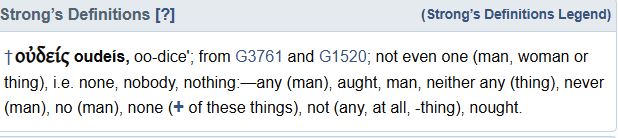
Here’s an interesting one. The word for “no one” is oudeis. This “no one” is not simply limited to just humans. It’s “absolutely nothing.” The Holy Spirit is definitely a something, and seems to be excluded from “knowing the father” here. A quite impossible task if the trinity is true.
But I want you to understand that the head of every man is Christ, the head of a wife is her husband, and the head of Christ is God. – 1 Corinthians 11:3 (ESV)
How can Jesus, who is supposed to be coequal with God the Father, also have God the Father as “head?” That just doesn’t make sense.
And Jesus said to him, “Why do you call me good? No one is good except God alone. – Mark 10:18 (ESV)
If Jesus is part of the triune God head, He would by default also be God and also be good. This again makes no sense if the trinity is true.
I think we have enough examples of conflicts. There are many more. I initially had twice this many but deleted half because the post is already too long. Let’s move on to verses that “support” the trinity. As a result of growing up SDA, I will use all of the SDA’s chosen verses that “support” the trinity to discuss here.
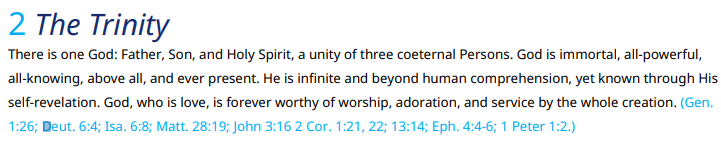
Then God said, “Let us make man in our image, after our likeness… – Gen 1:26 (ESV)
This is the cornerstone verse for trinitarians to support a triune Godhead existing pre-creation. However many scholars, such as Dr. Dan McClellan, Dr. Michael Heiser, and others, have argued this is a misinterpretation of what the original text meant. These are experts in ancient Hebrew language who have a technical depth far exceeding any average SDA pastor.
The “Us” and “Our” in the view of these scholars is that of a divine counsel. Not a trinity. Nowhere here can a trinity be obviously obtained. It is a numerically vague reference and doesn’t call out any other members of the plural entity by name. You have to read in something that’s not there. What is there then? Let’s see what Dr. Michael Heiser has to say on the matter.
Many Bible readers note the plural pronouns (us; our) with curiosity. They might suggest that the plurals refer to the Trinity, but technical research in Hebrew grammar and exegesis has shown that the Trinity is not a coherent explanation. Seeing the Trinity in Gen 1:26 is reading the New Testament back into the old Testament, something that isn’t a sound interpretive method for discerning what an Old Testament writer was thinking. Unlike the New Testament, the Old Testament has no Trinitarian phrases (e.g., “Father, Son, and Holy Spirit”; cf Matt 28:19-20). The triune godhead idea is never transparently expressed in the Old Testament. Since…other references to divine plurality involve divine beings who are lesser than Yahweh, we must be careful about attributing the language of divine plurality to the Trinity. Doing so will get us into theological trouble in other passages. – Dr. Michael Heiser
The bolded part is what is especially important to glean from this. We see a number of other instances of Divine plurality in the bible. To suddenly expect this instance to therefore be something other than what exists elsewhere is a strange take. It stinks of a predetermined answer in search of some evidence that allows for its existence to be valid.
“Hear, O Israel: The LORD our God, the LORD is one”. Deut 6:4 (ESV)
This is part of what’s known as the Shema prayer in Judaism. It’s a very complicated passage linguistically. (The Hebrew used is slightly ambiguous) Paul quotes the Shema in 1 Corinthians 8:6 with what could be called a slight elaboration of it. It’s rather odd the SDA doctrinal writers would reach back to this verse instead of the version in 1 Corinthians 8:6.

The word for “one” in the Hebrew here is echad, and can simply be translated as “the only” or just literally….”one.” As in a singular one. There is debate on this being translated as “a unity”, but this is not how the Jews viewed it. No Jew would have at that time, or today, understood this verse to support such a view.
Paul Sumner (masters of Arts in the Old Testament from Pepperdine University) sums up a lengthy exposition on this (Source) with the following.
There is no internal evidence in the Hebrew Bible that any generation of Israelites understood the Shema as a reference to a compound unity in the Godhead. – Paul Sumner
In short the decision to use this as a proof text for a trinity is perplexing.
And I heard the voice of the Lord saying, “Whom shall I send, and who will go for us?” Then I said, “Here I am! Send me.” – Isaiah 6:8 (ESV)
Again…a very strange choice here. Remember in Gen 1:26 how we saw there are other Divine pluralities with lesser beings? Here’s a case of that. Let’s backup and read what’s happening before this.
“In the year that King Uzziah died I saw the Lord sitting upon a throne, high and lifted up; and the train of his robe filled the temple. 2 Above him stood the seraphim. Each had six wings: with two he covered his face, and with two he covered his feet, and with two he flew. 3 And one called to another and said:
“Holy, holy, holy is the Lord of hosts;
the whole earth is full of his glory!4 And the foundations of the thresholds shook at the voice of him who called, and the house was filled with smoke. 5 And I said: “Woe is me! For I am lost; for I am a man of unclean lips, and I dwell in the midst of a people of unclean lips; for my eyes have seen the King, the Lord of hosts!” 6 Then one of the seraphim flew to me, having in his hand a burning coal that he had taken with tongs from the altar. 7 And he touched my mouth and said: “Behold, this has touched your lips; your guilt is taken away, and your sin atoned for.” 8 And I heard the voice of the Lord saying, “Whom shall I send, and who will go for us?” Then I said, “Here I am! Send me.” – Isaiah 6:1-8 (ESV)
Isaiah is having a vision where “The King, the Lord of hosts” is surrounded by seraphim, perhaps even a counsel of divine beings (his hosts?). Distinctly different entities. Thus when the Lord later says “who will go for us?” it makes all the sense in the world to interpret this as just that. To glean a trinity viewpoint here is again reading in meaning not present, and not natively supported.
Go therefore and make disciples of all nations, baptizing them in the name of the Father and of the Son and of the Holy Spirit, – Matthew 28:19
Now we’re finally getting somewhere! A verse that finally makes sense to use in support of the trinity. Well…kind of. It definitely declares three separate existing entities at least. What it doesn’t do is unify them into “one” or declare their coeternal or coequal status. Additionally there is some debate on the merit of this verse as the disciples didn’t appear to follow it afterwards.
Peter said to them, “Repent, and each of you be baptized in the name of Jesus Christ for the forgiveness of your sins; and you will receive the gift of the Holy Spirit. – Acts 2:38 NASB
And he ordered them to be baptized in the name of Jesus Christ. Then they asked him to stay on for a few days. – Acts 10:48 NASB
Or do you not know that all of us who have been baptized into Christ Jesus have been baptized into His death? – Rom 6:3 NASB
For all of you who were baptized into Christ have clothed yourselves with Christ. – Gal 3:27 NASB
The disciples appear to be baptizing people into the name of Jesus Christ only. There are a very minor fraction of scholars that doubt the historicity of this particular passage, but the evidence does seem to suggest it is authentic.
“For God so loved the world, that He gave His only Son, so that everyone who believes in Him will not perish, but have eternal life.” – John 3:16
Again, a weird verse to support the trinity. It seems like Jesus is just….you know…God’s son like the text says? A created being of God to occupy a special seat/purpose. And the Holy spirit is nowhere to be found. It does nothing to establish the coeternal and coequal status of a triune Godhead. By definition a father precedes a son. Nothing else is needed to rebut this, and once again I am left scratching my head as to why this is listed as a proof text.
“And it is God who establishes us with you in Christ, and has anointed us, and who has also put his seal on us and given us his Spirit in our hearts as a guarantee.” – 2nd Corinthians 1:21-22 (ESV)
God is distinct from Christ here. Contextually I see nothing from this chapter in support either. If anything, context does damage to this. Let’s look up just a few verses.
Blessed be the God and Father of our Lord Jesus Christ, the Father of mercies and God of all comfort, – 2nd Corinthians 1:3 (ESV)
God is called out as the “Father of our Lord Jesus Christ.” A father is a distinct entity from a son. Once again there is no mention of the Holy Spirit or a declaration or even implication of coequal/coeternal status.
The grace of the Lord Jesus Christ and the love of God and the fellowship of the Holy Spirit be with you all. – 2nd Corinthians 13:14 (ESV)
This has three entities, but again does nothing in support of the three-in-one conclusion. It would be no different than me saying the following as a “goodbye”. “May the police have a blind eye to your speeding, may the presence of guardian angels surround you, and may God’s wisdom influence you to make good decisions as you drive.“
Just because I reference three subjects doesn’t mean they are three-in-one. Paul knew the grace of Jesus and considered Jesus to be the Son of God. Why not exhort that the grace of such a divine being be with someone? This is doing no work to support the trinity doctrine.
“There is one body and one Spirit—just as you were called to the one hope that belongs to your call—one Lord, one faith, one baptism, one God and Father of all, who is over all and through all and in all.” – Ephesians 4:4-6 (ESV)
On the surface this kind of seems like…ya maybe we’ve got something here. It’s the bolded part here that throws a wrench in the gears. “All” here is the pâs.

This pâs means literally everything. Every possible thing, inanimate, human, divine, all of it. That would encompass the Holy Spirit and Jesus. This would therefore put God the Father over the Holy Spirit and Jesus. In the first chapter of Ephesians Paul (Or a different author…it probably wasn’t actually Paul who wrote Ephesians) refers to God as the father of Jesus.
It takes some hermanutical gymnastics to arrive at the trinity here as nothing native to the text allows for it.
“according to the foreknowledge of God the Father, in the sanctification of the Spirit, for obedience to Jesus Christ and for sprinkling with his blood:
May grace and peace be multiplied to you.” – 1 Peter 1:2
This does talk about three entities. What I can’t understand is….does anyone writing the SDA fundamental beliefs believe context matters? Literally in the very next verse we have:
3 Blessed be the God and Father of our Lord Jesus Christ! According to his great mercy, he has caused us to be born again to a living hope through the resurrection of Jesus Christ from the dead, – 1 Peter 1:3 (ESV)
So through Jesus, we become believers in “the” God. A God that raised him (Jesus) from the dead so that our faith and hope are in God. This presents a clear distinction between Jesus and God. Reading further we do have another interesting point.
19 but with the precious blood of Christ, like that of a lamb without blemish or spot. 20 He was foreknown before the foundation of the world but was made manifest in the last times for the sake of you 21 who through him are believers in God, who raised him from the dead and gave him glory, so that your faith and hope are in God. – 1 Peter 19-21 (ESV)
“He was foreknown before the foundation of the world.” This, to some, might point to eternality. However I petition why must it? Could God not have created Jesus at some point well prior to creating the earth and people? The Bible seems more in harmony with that sentiment than with a coeternal non-created, non-begotten Jesus. Consider that this was the competing view at the council of Nicea.
Concluding Thoughts
The bible is not univocal on many topics. A few verses can indeed seem to support a trinitarian view. However the argument against this, would be that the vast majority of verses that pertain to the Father-Son-Spirit concept, make no sense with that view.
On the flip side, the few verses that “support” a trinitarian view still can make sense without the trinity doctrine. Thus IMHO, it makes way more sense to reconcile this as an invalid concept.
It seems Arius of Alexandria had a more harmonious view here. One where Jesus is still divine, just created by God as a son (sort of like how virtually the entire bible suggests!). One where God sends His spirit (perhaps an angel?) out for inspiration. God is, after all, God. Who’s to say He cannot manifest His own spirit out into our realm, much in the way we imagine a telepathic person moving an object without touching it?
It is clear enough that Jesus predates the world, but nowhere is it clear that He is coequal or coeternal with God. Additionally the Holy Spirit is never held in equality with God but seems to serve at behest of God. It is not univocal that the Holy Spirit MUST differ from God the Father to the extent that it is a separate (but not?) being.
The vast majority of verses do not in any way, shape, or form, internally support a trinitarian doctrine. To consciously ignore that vast majority, and focus on the few that seem to maybe, kind-of-vaguely represent a trinity, is a wild take. The few verses that seem to support it are weak. So weak that (just to reiterate), a verse had to be added in support.
To accept the trinity doctrine as it exists feels like betraying logic for desire. To accept the trinity doctrine as it exists truly feels like one would be putting their dogma over the data.
Congratulations to you if you made it this far. This post was quite the learning experience for me. Take from it what you will. For me it represents yet another SDA fundamental belief that has fallen under close inspection. Yet with respect to the overall faith, I consider it of no importance.
Whether or not Jesus was a created divine being has no impact on the importance or magnitude of His sacrifice. It has no impact on the necessity of us choosing to model our lives after His. It has no impact on who our loving God is. It simply represents (in my opinion and many others) a more harmonious interpretation of the texts.
Peace.

 Space For Doubt
Leave a reply to magnificentcheerfullybe7b91a2ec Cancel reply