

You’ve probably heard the term apologist before. I don’t remember when I first heard it, but I thought it meant something along the lines of “A person who uses more in-depth scriptural interpretation to show how something in the bible is true, to convince non-believers of the veracity of the faith.”
While that definition is essentially true, I have come to understand the intentions behind many, if not most, apologists’ arguments are less than ideal.
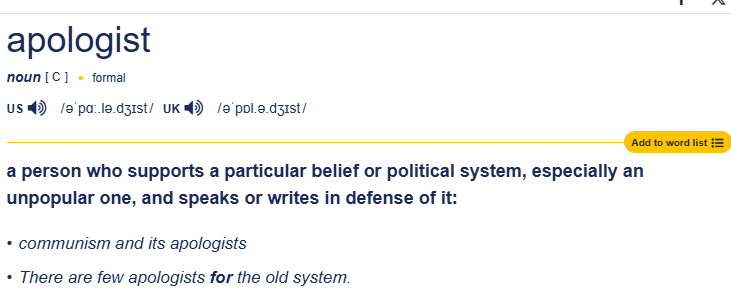
Until I really got to know religious apologist methodologies, I always assumed they were coming at their arguments from a place of good faith. These are the tools they implement.
- Tactical use of cherry picked scripture
- Textual slight-of-hand
- Foundationally flawed reasoning
- Unprovable (therefore impossible to disprove) hypothetical scenarios
Today, I am on the other side of that fence.
I think there are some good-faith apologists left out there…somewhere. I saw one on youtube recently who seemed in good faith, but he was not well reasoned or informed.
He truly thought it was likely that the water necessary for the flood was held above the earth in a shell that encompassed the whole globe. Just sort of floating above the entire planet. (that shell of water would be thick enough that sunlight wouldn’t be able to penetrate it, but hey….who’s counting right?) After all, a literal reading of Genesis might lead one to think that.
I want to be clear here that not all apologists’ arguments are false. What I am saying is that at least to my eyes, majority of apologists argue from positions of:
- Predetermined bent
- Lack of unbiased education
- Lack of reasoning skills
- Lack of intellectual curiosity
These far outnumber those acting in good faith, who have deep knowledge and experience.
Essentially the real-world definition and purpose of a religious apologist is this:
The main rhetorical goal of apologetics is not to convince people who don’t already agree, it’s not to generate an argument that is valid for critical Scholars. The main purpose of apologetics is to perform [a routine of] confidence and competence so that the people who already agree can be made to feel validated in that agreement. [Since these people’s] worldviews and their self-identities are so entangled with the dogmas they want to be convinced are true, the evidentiary bar is lying on the ground.
They do not require remarkably robust, sophisticated, or methodologically valid arguments. They just need to [gin up the tiniest sliver of “not impossible”] and be made to feel that the arguments are valid. Because they generally are not well informed about critical scholarship, you just have to simulate a valid argument. You don’t actually have to produce one.
Apologetics is primarily aimed at performing an argument that’s good enough to convince non-specialists who really really really want to be convinced, that their dogma is justified. [They then can live within that sliver of “not impossible,” despite that sliver not being birthed from a legitimate, likely, or even plausible set of evidence.] – Dr. Dan McClellan – Textual Scholar
Apologists seem to function less like evangelists to recruit new converts, and more like corporate retainment specialists.
Congregants who start showing the earliest signs of question or doubt, are met with apologist arguments to keep them pacified. Depending on their education, reasoning skills, and their desire to believe the held dogma, that may be all that is needed. Many times it is not. Profoundly more-so in the millennial and Gen Z populous.
People who are rigidly set into the dogmatic framework of their faith “no matter what” have no need for apologists. They will knowingly dismiss an error, even a large obvious error, simply out of desperation to believe what they wish to be true.
They think that somehow….they are being more faithful by doing this. I truly do not understand those people. At a fundamental level, my brain just doesn’t work that way. I suspect it never will.
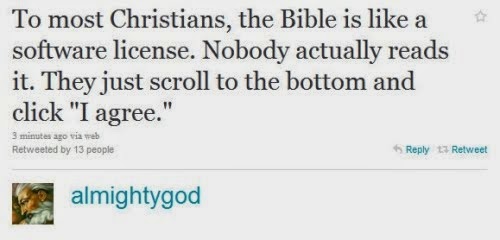
The vast majority of people do engage their bible on its terms. They read the bible, they might even “know” the bible, but they do not understand it or even have a willingness to understand it, on its own terms. To be able to quote from memory, passages of the bible, means absolutely nothing if you don’t understand those passages.
This common bible quote is a great example.
For I know the plans I have for you,” declares the Lord, “plans to prosper you and not to harm you, plans to give you hope and a future. – Jeremiah 29:11 NIV
This was written specifically for the people of Israel who were in exile in Babylon. Jeremiah was conveying a message of hope to them.
There is nothing contextual in nature, or in this text itself, that prescribes us license to apply this promise to ourselves today. Yet we see that time and time again today.
Imagine telling someone the Lord has plans not to harm them with this verse. Then the next day they are mugged and stabbed. Do you think they’re going to resonate with that verse? Or they find out they have cancer. Did that feel like a nice bit of “hope” there?
Stop it! Figure out a better and more logical way to be comforting.
- Maybe offer them a ride
- tell them that you care for them, because God loves all of His children and you feel called to model your life in this way
- Tell them this world is a terrible place and that bad things happen to good people
- Tell them that ultimately God wants their hearts’ and minds’ attention because He loves them
- Tell them that God will come back and make it all right at the end, but right now you’re going to help them find support in this material world.
If you’re ok with quoting the nice verses out of context, then be prepared for people to quote the not-so-nice verses out of context too. Oh wait…we don’t do that? Why not? Maybe because it’s OUT OF CONTEXT?!?! 😒
If you aren’t willing to let the bible mean something that you disagree with, then you’re not really concerned about the bible itself. You’re concerned with the bible being a proof text for what you want it to be, an authorization of your preferred dogma.
It’s so incredibly freeing to have a faith and trust in God that does not rely on apologist arguments for all the errors, falsities, internal disagreements, and morally bankrupt portions of the bible. I am free to explore the truth of who I believe to be a loving God in all matters, unbounded by a predetermined range of acceptable answers. I am free to hold this book we call the bible with gentle yet with diligent inspection, understanding it to be an inspired but very much human creation.
I just wish I had this epiphany a decade ago. My wife and I now are now on a mission to raise our kids with a faith they won’t have to heal from later. A faith built on openness, transparency, trust, and sound reasoning. A faith built on not just scriptural truths, but real world evidence based truth. Perhaps thirty years from now, my children will not have to, as Rachel Held-Evans so puts it, “get over the fact that your religious world view growing up, did not in fact, hold all the answers.“
Peace


Leave a Reply