

The timeline of composition and authorship of the gospels raise important-to-consider issues that should not be ignored. If one desires to understand their beliefs beyond a “It must be true as I learned it, because it must be true as I learned it” fallacy, then seeking to answer these questions seems reasonable.
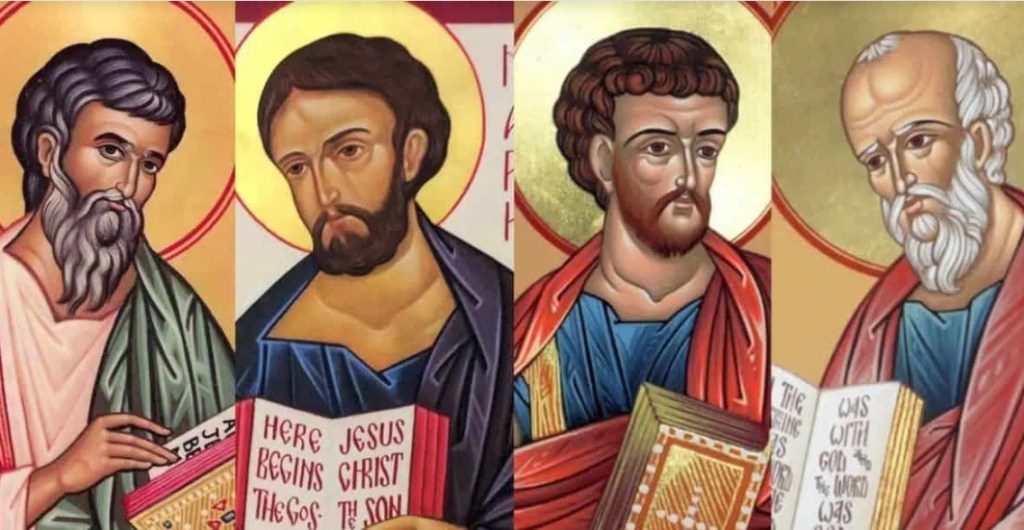
Let’s start by looking at a comparison of the gospels on the topic of just the resurrection of Jesus. (bullet points for brevity)
Mark:
- The two Marys head off to the tomb when the sun had risen.
- On their journey they discuss with each other “who will roll away the stone for us?”
- They get there and stone is already rolled away
- They entered the tomb and were alarmed (surprised) by a (single) young man sitting on the right side (inside) of the tomb.
- They were scared and told no one because they were afraid.
- [I’m ignoring Mark 16:9-20 because that was a later add inserted to harmonize this with the other gospels. This is noted in most English translations.]
Matthew:
- The two Marys arrive and at the tomb around dawn
- The earthquake and rolling away of the tomb are done in witness of the two Marys. Our translations can read slightly vague in English, but scholars like Dr. Dan McClellan describe this in greater detail in the Greek’s grammar.
- An (single) angel sits on the stone that had been rolled back
- The guards that were there trembled and became like dead men. (first mentioned of the guards)
- They ran to tell the disciples
- On the way to share the news, they meet Jesus. He bids them to continue their journey to tell the disciples
- (no one else visits the tomb)
Luke:
- The two Marys head to the tomb at dawn
- They too find the stone already rolled away
- This account has there being two men that stood by them (inside the tomb) in dazzling apparel
- They went and told all these things to the remaining eleven disciples (What with Judas being dead and all)
- The disciples didn’t believe them
- Peter did believe, and he ran to the tomb, finding it empty (save for some linens)
John:
- Only Mary Magdalene visits the tomb.
- It was still dark (the other gospels are at dawn)
- The stone is already rolled away (presumably based on the next part she also saw it was empty)
- She then immediately ran to notify Peter and John
- Peter and John run to the tomb and go inside
- Once John sees the linens, he believes.
- Peter and John go back home (seemingly unbothered to tell the others)
- In a bit of an unexplained concurrent (?) time-line, Mary Magdalene is once again present at the tomb.
- In the midst of her weeping she takes a peek inside and sees two angels sitting where Jesus had laid.
- They talk and she turns around to see Jesus.
- She mistakes Jesus for the gardener
- Jesus speaks her name and Mary then recognizes Him.
- Mary runs to tell the other disciples
There’s a lot of disagreement going on here.
The number and location of the angel(s) is different every single time. The events after Mary(s) discover the empty tomb are different every single time. I have to say, seeing Jesus would be a pretty big deal. I’m having a hard time seeing how that detail gets left out (looking at you Luke…the “historian”).
Apologists say things like “if there were two angels, there was one angel.” Right. Ok Bob. While that’s technically accurate, no one writes like that, either now or then. If your friend said he had one teenage kid, and you discovered years later he had two teenagers the whole time, you’d really have some questions right? Especially if he said “well….I did have one kid, but I also had two kids.”
Let’s make some sense of this in light of the Gospels’ history and authorship.
Matthew and Luke copy Mark heavily, much of the time word-for word. There is about as close to a unanimous agreement among scholars on this as anything in the history of religion ever. Even the most conservative of scholars hold this view. Additionally, they are likely sharing a lost-to-us-today source for additional parts of their book. Scholars have dubbed this the “Q” source.
In short, we know these following things to be true.
- No reliable sources attribute Mark or Luke as apostles. Luke states as much right out of the gate. This is well known, but many were taught growing up all four were apostles.
- There were forged gospels in circulation at the time of the NT writers. We see this in Galatians 1:6-9 with Paul admonishing and warning against these false gospels. We also know this just based on a little common sense.
- Some things got added into the NT gospels later on.
- Near unanimous agreement exists that Mark was first out of the publishing gate, followed by Matthew, Luke, and finally John.
- No records of communication exist between church fathers/leaders that indicate the existence of any of the gospels until the early 2nd century AD. (Don’t mistake this for thinking we simply don’t have written records for this time period. We certainly do.)
- Each gospel has a slightly different level of developed Christology.
- The majority of NT scholars agree that these books were written between ~65 AD and ~100 AD.
To help make sense of this, we need a different approach. Modern scholars have arrived at these concepts.
- The gospels were almost certainly written by people that lived in different times and places than the events they describe.
- They were written within different communities of people, based on other second or third hand information to compose their books.
- There were alterations after-the-fact.
- There was explicit copying and unidentified sources for their composition.
In that light, things can start to make sense. I don’t buy the “different stories from different perspectives, but still all eyewitnesses” gambit. In just this one resurrection story, the differences are quite dramatic. John is (especially in this bit) a particular mess. I guess in the end, Jesus is alive again right? So maybe that’s all that matters.
There exists fundamental issues with these books. No question. What do we do with that information? For the sake of “faith” and “unity” should these issues be swept under the rug, or painted up with bad apologetics? Or should we dig into it, and examine these books critically (queue Modern Critical Scholarship)? Would you not want to know the truth?
The truth is we really just don’t definitively know some things. Or at least there is not nearly univocal consensus on some things. The early church fathers unfortunately aren’t as much of a help as we’d like them to be. There are certain things which are unlikely and certain things which are likely.
- It is unlikely that Mark and Luke had any first-hand knowledge
- It is likely that at least the final composition (if not the book entirely) of John was completed by a different John. A common idea is that it was John the Presbyter. Even Pope Benedict the XVI in on record saying this in his book Jesus of Nazareth.
- It is unlikely that the apostle Matthew wrote Matthew (based on a number of reasons). An important one is why copy so much directly from Mark and Q literally word for word, if he was an eye-witness to the events?
- It is incredibly likely that each gospel’s formation was heavily influenced by the community in which it was written, and by the particular bent of the author. The equivalent analogy today would be if each author was part of a different denomination of Christianity.
- It is likely that the gospels were written with source material from first hand and second hand accounts.
The goal behind this article is not to dissuade one from the faith, but to show how valued the stories of Jesus were. They were so important that educated and literate people took up the mantle to write them down (as Jesus’ own disciples were probably not literate). It’s to convey, once again, the idea that the bible is not inerrant, and that’s ok. It’s to impart the idea that critical thinking and reasoning are not diametrically opposed to faith.
Peace.


Leave a Reply