

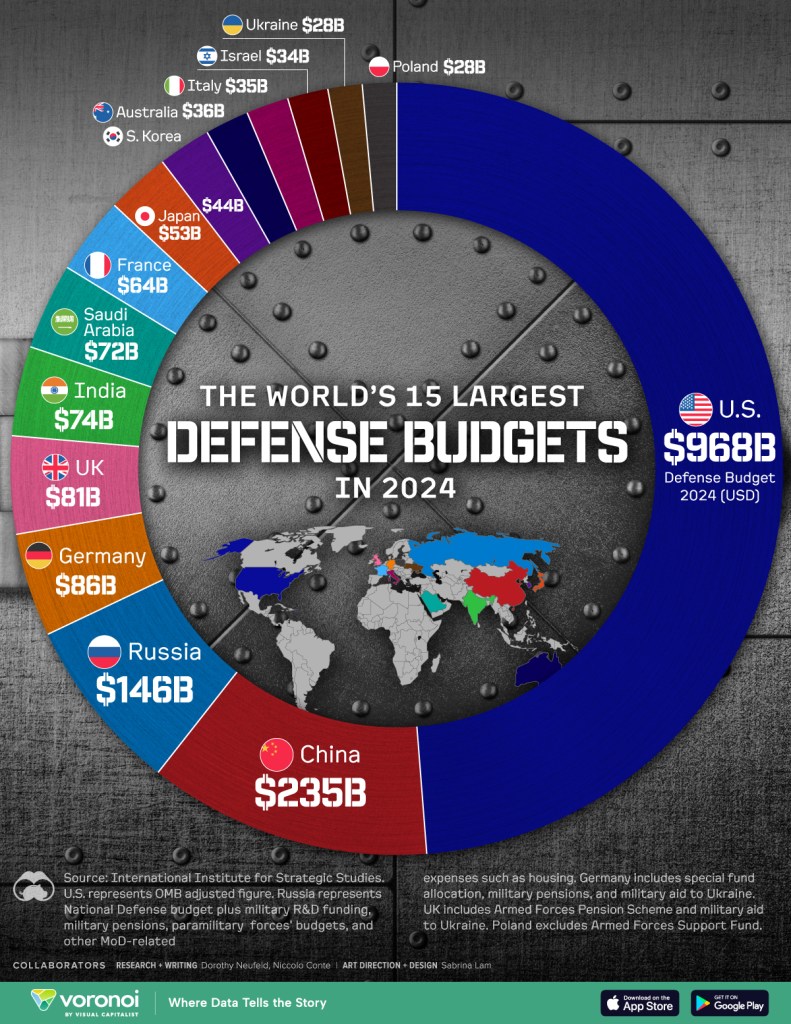
Take a look at the above graphic. The budget for the USA defense spending is nearly 1 trillion dollars. That’s a hard number to even mentally grasp. Even 1% of that money could change life as many know it.
It could fully fund school lunches in the U.S. Massive inroads could be made into ending the nutrition crisis. Think about what the downstream effects of that would be! Actually, no. You don’t have to think. We have the data. Every measure of a students life improves. (grades, behavioral issues, mental health, physical health, family stress levels, societal stigmas that prevent interaction and collaboration, etc)
The list of good we could do with that amount of money is as long as anyone would care to type. However, when these types of social programs are suggested or attempted, we are told “No, that’s too expensive. We don’t have the funding for that.”
We are not told this by the political party that “lacks God” (the left), who would have a more logical reason to boost defense spending. (no God = no protection….right?)
No, we are told this by the party that says God needs to be put back into schools. That the Ten Commandments should be hung in its halls. That Christian prayer must be implemented within its walls. That we must get back to “traditional Christianity” in our nation.
We are told we lack the money to act like Jesus, by the party that operates under the very banner of Christ.
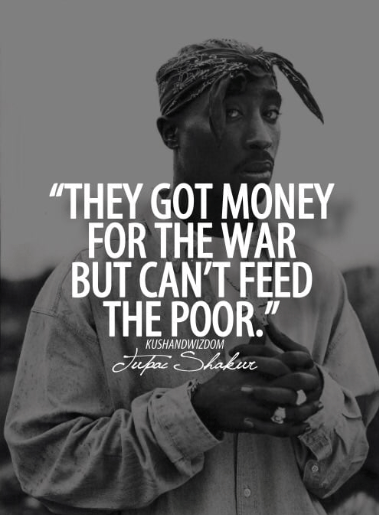
There’s always money for war, but never money for the poor (or marginalized, minority, foreigner, special needs, or simply unlucky folks). These are the people who Jesus cared for the most. It was these people who Jesus met face to face and helped solve their earthly needs. Jesus never called anyone to help fund war.
He didn’t say “my thoughts and prayers are with you.” He fed the 5,000.
He didn’t say “I pray for your healing.” He just healed the ones who needed it.
I see the cutbacks to foreign aid (that includes programs like ADRA!), and my soul grieves. I see the cutbacks to social programs that help reduce poverty, improve literacy rate, improve education, increase access to libraries and learning environments for the handicapped and special needs, and my soul grieves. I see the cutbacks to healthcare and mental health resources and my soul grieves.
I see the absolute callousness and apathy of those who voted into power the people who are doing this….and my soul grieves.
They say “the church should handle these things. It’s not the governments job.”
Oh really? Let’s unpack that thought a little.
Consider this. Up until a few hundred years ago, the church was functionally the sole authority in most countries. All tax and tithe dollars were effectively under its influence. Being God’s instrument on earth, the church had a duty to help the poor and widow. Did they do this?
Absolutely not.
But they at least had the resources that they could have!
Now fast-forward to today. The separation of Church and State (for now) is pretty distinct in the U.S.A. and most first world countries. The church has a relatively insignificant % of funds (compared to say 500 years ago) to help the poor and widow. They just don’t have the resources.
One can’t say “That’s the church’s job!” when that same church has nowhere near enough funds to even attempt such a thing. That stance is built on a false premise.
It stands to reason then, as Christians, we should petition the Government to help right? As Christians, would it not make sense to support policies for our government that help the poor and widows? As Christians shouldn’t it make sense to support helping the less fortunate access to healthcare and education? As Christians, out of anyone else, shouldn’t it make sense to NOT support increased military spending?
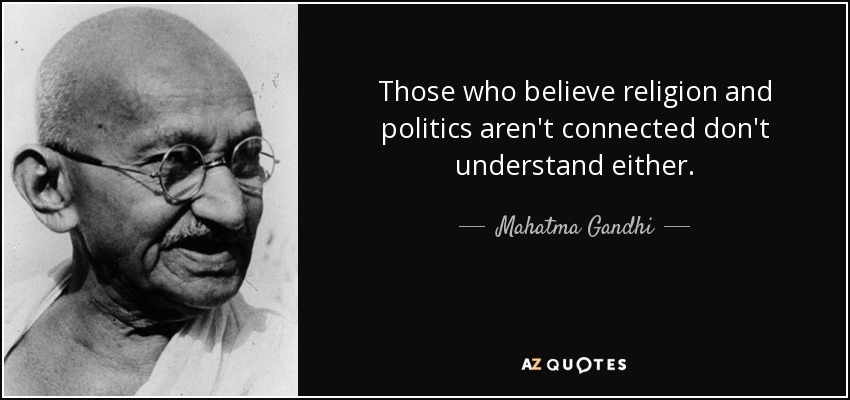
If one stubbornly clings to the position that their faith shouldn’t/doesn’t inform their politics, then they have subtly admitted two things.
1.) They are self-conscious of the the fact others likely notice in them a stark difference between the two. That is, people who watch them (in their minds) are likely observing a strange disconnect between what they profess as faith and the actions they take. They are grasping for a way to defuse that uncomfortable thought. They feel the cognitive dissonance, but are doing their best to justify it.
2.) That ultimately, it is indeed their politics that are informing their faith. Their actions prove it.
If one’s actions (votes, policy support, silence at oppression) all point in a direction other than their faith supposedly does, then there is a problem.
Our actions are how we are judged and perceived. One cannot say “well these are just the things I support, not what I believe.” That makes no sense. Our actions are the result of the “faith” we do or do not have.
Jesus has something to say on this matter.
“These people honor me with their lips, but their hearts are far from me.” – Matthew 15:8.
The Pharisees were full of hypocrisy. They were looking out for themselves and their interests. They were looking for a way to get out of God’s command to honor their parents by using tradition to weasel their way out of accountability.
Likewise, this verse is a broad statement that reflects onto the practice of one attempting to justify an unjustifiable action. It’s a hypocritical desire to split believing and doing into two mutually exclusive things whenever the overlap becomes an inconvenience.
If one professes a faith from their lips that is betrayed by their actions, it’s pretty clear that their faith is not in the drivers seat.
What seems to also happen a lot is this “kicking the can down the road” business. All of that helpful Jesus stuff is for heaven. It’s not for here and now in this faulty world. We can only be perfect in heaven, so why try now? Everything is too corrupt right? Better just get mine, everyone else be damned. As long as my gas is $0.25/gal cheaper, nothing else matters.
In Genesis, God tells Abraham this:
“and through your offspring all nations on earth will be blessed, because you have obeyed me.” – Genesis 22:18 NASB
This can reasonably be interpreted as a call to be that blessing here and now…for ALL nations. Hint: That’s the equivalent of saying “all non-Christians” or “all those who don’t look, act, believe, or sound like you” or “the foreigner.”
Does blessing all nations look like isolationism? Does it involve reducing or straight up ending foreign aid? Does starting an unnecessary trade war help the other nations be blessed?
In Mark, Jesus says this.
“The time is fulfilled, and the kingdom of God is at hand; repent and believe in the gospel.”- Mark 1:15 NASB
The Kingdom of God has arrived on the earth. His sovereignty doesn’t start at the second coming. That reign has already started. His entire ministry was calling us to be the Kingdom on this earth.
- Jesus doesn’t tell the parable of the good Samaritan to prepare us to be good neighbors in heaven. It’s here and now.
- Jesus, in Matthew 25:35-36 doesn’t give examples of how God (the King) commends those who cared for other’s earthly needs, for the sake of a desired heavenly behavior. That verse is talking about here and now.
- Jesus didn’t say in Luke 14:13 “But when you give a banquet, invite the poor, the crippled, the lame, the blind” for the sake of a heavenly banquet. He was talking about the here and now.
- Jesus didn’t say in Luke 3:11 to share your food and clothing with the less fortunate in heaven. It was for the here and now.
It’s just breathtakingly simple. Christianity has, by and large, lost the plot. Somewhere along the way, the prosperity gospel mixed with capitalism and political power. The resulting toxic coating covered up any trace of the real Jesus.
Now this toxic version of Christianity is wondering why so many are abandoning it. Why are so many in the world rejecting it. Why is gaining new converts so hard? (They call these things “persecution” BTW)
Wow. I wonder.
For those who feel like Christianity is dead, I resonate with you. But know this. There still exists a good chunk of Christianity that is appalled by what they see. They still hold Jesus up as Savior AND Lord. They operate on love and compassion. They do not believe in the sin of empathy.
I’ve seen them. I’ve talked to them. I’d like to think I’m one of them. They do not hang a badge on their vehicle, cling to an institutionalized religion’s identity, or preach from any big pulpit. Often they do not even claim the title of “Christian.”
There are also people so devastated by what Christianity has done, they retreat to the labels “Agnostic” or even “Atheist.” Yet, in them I usually find that love shines bright in their actions. That is, in my humble opinion, the working of God’s spirit in them.
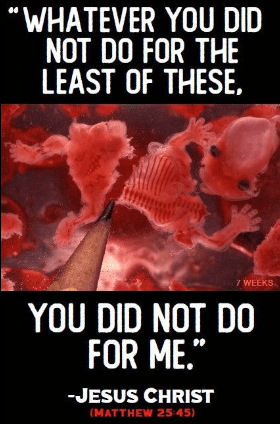
One day, God might ask “What did you do for the least of these people?” How would you answer? Did you have a history of actionable faith or faithless actions?
Peace
 Space For Doubt
Leave a comment