

Studying the Bible should be fun. It should be informative. It should be comical at times. It should absolutely be perplexing too. This story? It’s got all of it. It’s the story of the time that God *checks notes*…lost in battle?
What!?!? That can’t be right?
Well…if we’re fair with our interpretations then yes. Many scholars today believe that at least the writer of 2nd Kings believed that the Lord had lost in battle.
The backstory is that Israel has had the Moabites under vassalage (AKA they pay Israel tribute) for some time now. The King of Moab (Mesha) decided that he’d had enough of that, and rebelled against Israel.
King Jehoram of Israel went and got a posse together to get Mesha back in line. The armies of Israel, Judah, and Edom set out for Moab to correct this insubordination.
The armies set out for Moab, but run into a little water problem. After seven days of marching there was no water for their flocks or their soldiers. They were fearful they had been led to a slaughter. They consult with Elisha (who was apparently less than enthused about having to be there). Let’s see how that looks.
Elisha said to the king of Israel, “What have I to do with you? Go to your father’s prophets or to your mother’s.” But the king of Israel said to him, “No; it is the Lord who has summoned these three kings to hand them over to Moab.” 14 Elisha said, “As the Lord of hosts lives, whom I serve, were it not that I have regard for King Jehoshaphat of Judah, I would give you neither a look nor a glance. 15 But get me a musician.” And then, while the musician was playing, the hand of the Lord came on him. 16 And he said, “Thus says the Lord: I will make this wadi full of pools. 17 For thus says the Lord: You shall see neither wind nor rain, but the wadi shall be filled with water, so that you shall drink, you, your army,[a] and your animals. 18 This is only a trifle in the sight of the Lord, for he will also hand Moab over to you. 19 You shall conquer every fortified city and every choice city; every good tree you shall fell, all springs of water you shall stop up, and every good piece of land you shall ruin with stones.” 20 The next day, about the time of the morning offering, suddenly water began to flow from the direction of Edom until the country was filled with water. – 2nd Kings 3:13-20 NRSVUE
As everyone knows, you can’t just go prophesying without setting the mood first. Cue the music!
Elisha goes on to proclaim that they will have the water they need, and every fortified city will fall. Cool cool. Sounds good. This must have been some good music! (or was it?)
The Moabites, seemingly around sunrise, see that the pools of water that God provided look red (Presumably from the reflecting orangish-red sunlight?) Naturally, one’s first thought would be to think it’s red due to the opposing army slaughtering themselves overnight. I mean, honest mistake for sure. We’ve all been there right? Seeing our enemies laying in massive pools of blood?
The Moabites rush out of their fortifications under the assumption that they will face a defeated rag tag bunch. That assumption is wrong and Israel properly routs them. City after city fall. It’s a real scorched earth campaign of violence.
Verse 25 records a particularly unlikely feat.
“…on every good piece of land everyone threw a stone until it was covered;” – 2nd Kings 3:25 NRSVUE
Where are you getting all these rocks? That’s a lot of land to cover!

Here’s where the going gets tough. The Moabites retreat to their stronghold Kir-hareseth and the armies of Israel and its allies surround it. They lay siege to it.
King Mesha is desperate. In an attempt to save himself and his nation, he sacrifices his firstborn son on the wall of the city. This sacrifice was to the patron deity of Moab, Chemosh.
And then? Well…something strange happens.
“And great wrath came upon Israel, so they withdrew from him and returned to their own land.” – 2nd Kings 3:27 NRSVUE
This chapter and story, abruptly end with this verse. It appears by all evidence that Israel was defeated. Chemosh came to the rescue of its (he/she?) Moabite people.
Surely that cannot be! How can God lose in battle?
We see a very similar story in 2nd Kings 18-19 where Israel was under vassalage to Assyria. King Hezekiah rebels.
The new(ish) king of Assyria (Sennacherib) marches his army in to correct this breach of obedience. He likewise lays waste to the land, sends off Israel to exile, and pens up King Hezekiah in the Judean city of Jerusalem.
Things are looking pretty rough. People are tearing their clothes and wearing sackcloth. They are praying and pleading with God for deliverance.
Isaiah steps in and delivers a prophecy of deliverance from the Lord.
Overnight, the Angel of the Lord comes in and strikes down 185,000 Assyrians. Then the King of Assyria packs up and heads home, leaving Jerusalem unconquered.
Both stories have
- The reasoning for the tribulation is because they weren’t obeying their deity
- The remnant peoples holed up in a fortified city
- Their respective king pleading and praying for deliverance from their patron deity
- An ultimate deliverance at the end
- Neither is under vassalage any longer
We even have extra-biblical evidence for both of these events actually occurring.

From the Wikipedia page on the Mesha Steele:
Mesha tells how Chemosh, the god of Moab, had been angry with his people and had allowed them to be subjugated to the Kingdom of Israel, but at length, Chemosh returned and assisted Mesha to throw off the yoke of Israel and restore the lands of Moab.
From the Bible itself, in the King Hezekiah story, we see this:
“This happened because they did not obey the voice of the LORD their God, but violated His covenant, all that Moses the servant of the LORD had commanded; they would neither listen nor do it.” – 2nd Kings 18:12 NASB
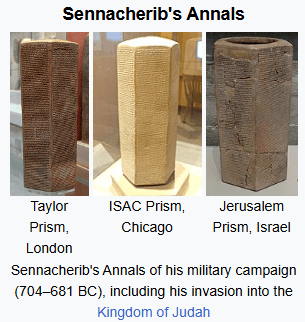
We have archaeological evidence confirming the Bible is accurate here. In Sennacherib’s Annals we see this:
As for Hezekiah, I shut him up like a caged bird in his royal city of Jerusalem. I then constructed a series of fortresses around him, and I did not allow anyone to come out of the city gates.
Notable here is the lack of Sennacherib’s conclusion of the story. A defeat of Hezekiah would be no doubt celebrated and recorded. A sudden massacre of his own troops? Well, it’s not too hard to see that bit getting left out of the record. The nation of Israel is also no longer recorded as paying tribute, so we can be pretty confident of the ending.
At this point I had to find out what some other commentaries have said on this passage. Many just skip over it, or skirt around it, as does EGW. It’s pretty hard to rationalize this in a monotheistic way, so obviously the best course of action is to just not talk about it. That strategy always works out so well!
There have been a few who have attempted to gin up some bonkers mental gymnastics to explain how this is actually a non-defeat of Israel in this story. Let’s see an example of that.
Benson Commentary on 2nd Kings 3:27:
[That] the king of Moab made this costly sacrifice of his eldest son; a deed which, it is plain from the text, was held in the greatest abhorrence by the Israelites.” — Dodd. For so, it seems, we are to understand the following words, which should be rendered, not, There was great indignation against Israel, but, There was great trouble, or repentance upon (in or among) Israel: that is, they were extremely grieved on account of this barbarous sacrifice, and wished they had not pushed on a war so far, which ended in such a horrid action.
This is an absurd take. This is an example of interpretation that is based in a dogmatic stance of how something must be, evidence be damned.
Israel, the people who had to keep being reminded how bad child sacrifice was, who regularly conducted genocides, who regularly fought scorched earth wars, was now suddenly grieved on account of a single child being sacrificed in a nation they were currently slaughtering?
That’s a non-starter. To go even further, these are the fighting troops seeing this, not the average citizen of Israel. The kid is also the enemy’s kid. Let’s be real. Israelite soldiers didn’t give two hoots about anything like that.
Here’s a better take and one that by far makes the most sense. Ellicott’s commentary on 2nd Kings 3:27
Why did Divine wrath fall upon Israel rather than upon Moab? upon the involuntary cause rather than the voluntary agents in this shocking rite? If the wrath of Jehovah be meant, we cannot tell. But, as the present writer understands the words of the text, they rather indicate that the object of the dreadful expiation was attained, and that the wrath of Chemosh fell upon the Hebrew alliance. It is certain that belief in the supremacy of Jehovah did not hinder ancient Israel from admitting the real existence and potency of foreign deities.
The plain fact is our Bibles shows us that the nation of Israel very much did believe other Gods existed. They absolutely feared them too.
You will never hear this topic discussed in a sermon, a Sabbath/Sunday school, or used in any official church documents for Biblical discussion. It’s an extremely unflattering story that degrades the world-wide might of the Lord (YHWH).
Even the author of 2nd Kings seems to desire to wrap up this story as quickly as possible. Next topic quickly please!
We’re left wondering why is this story here? Well it fits with the prevailing general thought of the time. A nation’s deity was only on home turf when inside their own land. On their own soil.
When Naaman was healed, he took dirt back with him, so he could worship the God of Israel on Israelite soil.
“If you will not,” said Naaman, “please let me, your servant, be given as much earth as a pair of mules can carry, for your servant will never again make burnt offerings and sacrifices to any other god but the Lord. – 2nd Kings 5:17 NIV
This idea of home territory fits with the early Bible writer’s take on Gods in Deuteronomy:
When the Most High (ʿelyôn) apportioned the nations,
when he divided humankind,
he fixed the boundaries of the peoples
according to the number of the gods;
the Lord’s (Yᵊhōvâ) own portion was his people,
Jacob his allotted share. – Deut 32:8-9 NRSVUE
It was understood that each deity operated within the bounds of their own jurisdiction. Any action taken outside of that was at their own peril.
In Deuteronomy, the most high (ʿelyôn) assigned each lower tier deity their allotment. The 2nd tier deity (at the time), the Lord (Yᵊhōvâ) received the nation of Israel (or Jacob) as His inheritance.
This Deuteronomy story is one of the oldest parts of the Bible (~900 BC) and comes before the merger of El (ʿelyôn) with YHWH (Yᵊhōvâ). Prior to this, El was seen as the overall high deity who oversaw a pantheon of lesser Gods, YHWH being one.
When the merger of El and YHWH was complete (maybe around 700 BC or so), it was unacceptable to have YHWH restricted to solely the nation of Israel.
As the Bible matured, the people’s understanding of the Lord’s realm expanded from the territory of Israel to the entire world.
It’s too bad this story isn’t discussed more. I get that it’s uncomfortable, but it gives us insight into the mindset of the people of the time. It’s also fun to ponder. I don’t have an answer on the big question of if the Lord was defeated on that day. People will demand NO. People will demand the non-existence of other Gods. However, neither of these stances are supported via scripture, and both exist only as dogmatic takes on how things MUST be.
I think the lesson I’m taking away from this is, make sure you get the right prophesying music. Don’t cheap out on your musicians. And if you’re in the middle of a war, maybe stopping to cover fields with rocks doesn’t pay off in long game.
This is the tricky part about the Bible. It contains things many don’t want to be literal which are, and things many want to be literal, but aren’t.
Peace
 Space For Doubt
Leave a comment