

We last left off with Egypt as a land laid waste, in pretty much every sense of the word. Let’s finish off this story.
Now it came about at midnight that the Lord struck all the firstborn in the land of Egypt, from the firstborn of Pharaoh who sat on his throne to the firstborn of the captive who was in the dungeon, and all the firstborn of cattle. – Exodus 12:29 NASB
The final plague hits hard. Now it’s literally hitting home for Pharaoh. His own firstborn child is dead. The cattle are targeted…again. These poor animals just can’t catch a break.
It seems one of this plague’s literary goals is to provide retribution for Pharaoh’s attack on the Hebrew babies back in Exodus chapter 1. We also see the origins of the Passover ceremony and feast of unleavened bread.
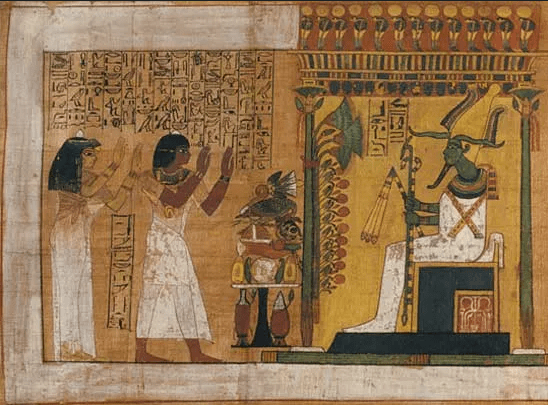
This plague is designed to hit at the divinity of pharaoh himself. In the book of the dead (Egyptian book), Pharaoh is described as being divine and having authority over earth and life. By killing all the first-born of people and animals, even Pharaoh’s own child, he is rendered powerless. The might of the Lord is proven.
If you go by a strict reading, the 2 million or so Israelites now head out, finally released by Pharaoh.
The Bonus “Plague”
It’s not long after their departure that Pharaoh seems to have had a change of heart. The Lord warns Moses of this.
And I will harden Pharaoh’s heart, and he will chase after them; and I will be honored through Pharaoh and all his army, and the Egyptians will know that I am the Lord. – Exodus 14:4 NASB
The words of the Lord come to pass and we see this happen:
So he had horses harnessed to his chariot and took his people with him; and he took six hundred select chariots, and all the other chariots of Egypt with officers over all of them. So the Lord hardened the heart of Pharaoh, king of Egypt, and he chased after the sons of Israel as the sons of Israel were going out boldly. Then the Egyptians chased after them with all the horses and chariots of Pharaoh, his horsemen and his army, and they overtook them camping by the sea, beside Pi-hahiroth, in front of Baal-zephon. – Exodus 14:6-9 NASB
Pay attention to the bolded sections of text above. Even if we discount the term “all” to mean only a “vast majority of,” it appears as though the bulk of the Egyptian army is pursuing this group of Israelites.
Of course we know what happens next.
The waters returned and covered the chariots and the horsemen, Pharaoh’s entire army that had gone into the sea after them; not even one of them remained. – Exodus 14:28 NASB
Aftermath and Evidence
So that’s it. That’s the last thing Egypt suffers. At this point we should recap the situation in Egypt.
- Their means of agricultural production are gone
- Their food supply has been eliminated
- Their army is decimated
- Their main labor force is gone
- Their land is a wasteland
- Their own population has taken a hit, with the death of every firstborn
Even one of these things happening would be a severe challenge. For all of them to happen within a few months, would be society ending. It would undeniably collapse the entire framework of the Egyptian civilization.
What do we see though in terms of archaeological evidence for this happening, at least as depicted in the Bible? Is there anything, records from other countries, records of food purchases, animal purchases, extra societal measures to increase food production or rebuild the military?
Unfortunately we have nothing. It was not even a blip on the radar. According to the records we do have, and we have them in plenty, Egypt just kept humming along as if nothing happened.
I previously wrote about a debated manuscript called the Ipuwer Papyrus that contained some vague mentions to a few things that could be construed as plagues. The issue here is that while the Papyrus dates to the correct time period (1250 BCE), the text it contains comes from much earlier (I.E. we see similar middle kingdom records with similar phrasing, language, and ideas). It was probably composed between 2300 BCE and 1750 BCE. Therefore it’s difficult to correlate this with the exodus, as the earliest theoretical date for the exodus is (at the oldest) ~1450 BCE.
No other surrounding nations took advantage of Egypt’s lack of military force to come and take over the fertile land. No other nations came to ransack all the riches of this kingdom while they were in this vulnerable state. No one reviewing the records we have today, would ever come the conclusion that anything ever happened.
Explanation
General scholarly consensus is that the Exodus narrative as we see it today was composed during or immediately after Israel’s Babylonian exile (6th century BCE). The people needed a feel good story to rally hope for a return to familiar norms after their exile, just as the story yields for the earlier Israelites from Egypt.
There is also significant support (scripturally and archaeologically) for the idea that this was a backstory created to merge the histories of two different people groups. Those who were native to the land of Canaan already, and those who did perhaps come from Egypt. I write about this more here.
The evidence we have confines this story, as told in the Bible, to the realm of Practically Impossible. Not just implausible, but it resolutely defies all logic, reason, and has no archaeological backing whatsoever.
That being said, the evidence we do have does not preclude there being a much smaller group having left, under much less dramatic of circumstances. There is some evidence that plausibly shows there was a Semitic group of people in Egypt at some point.
This is a long way of saying, that this story is likely the grandest of fish tales that grew mightily over the centuries. The form we have it in today, whilst good reading, is not in evidence. It’s a literally tale, with rhetorical goals, perhaps based on a small kernel of truth.
As we have seen in part 2 with the plants and hail, inerrancy apologists (See: some commentary writers) will go to great lengths to gin up implausible hypothetical scenarios. They display the obvious need to defang the tiger of impossibility just enough to allow it to be barely plausible. Once they hit the realm of barely plausible, that is good enough. In their minds, it is then not only plausible, not only likely, but factually certain.
Other Gods
What’s also interesting here is the performance, and the reception of that performance, of the Egyptian gods. If these gods were truly viewed as non existent gods by the exodus authors, you’d think that these same authors would have taken great joy in mocking the stupidity of the Egyptian’s for this. They would have joyfully called out how the Egyptians used fakery and slight of hand to achieve their feats.
This is not what happens though. The Egyptian gods, in the minds of the authors of exodus, show up. They are defeated of course, but they show up and actually have some potency. As I discussed in my article on the defeat of the Lord in battle, the Old Testament Hebrew culture was not one of strict monotheism, such that only one God existed. They fully believed other Gods existed. They believed each was relegated to his or her earthly apportioned realm. There is scriptural evidence (however uncomfortable that may be to us today) of this.
The Lord’s Behavior
I’m struck as frustrated by God’s actions here. It comes across as the actions of a megalomaniac.
- God goes into the entire narrative (before anything happens) by telling Moses this:
- “But I will harden Pharaoh’s heart, so that I may multiply My signs and My wonders in the land of Egypt.” – Exodus 7:3 NASB
- God is basically telling Moses, “Hey…I need you go risk your life to do this thing for me. But also that thing I’m asking you to do isn’t going to work the first nine times, because I’m going to ensure it doesn’t.”
- Moses: “Ok….well alrighty then.”
- Once God starts hardening Pharaoh’s heart, Pharaoh never gets a chance to comply and yield. Maybe without God hardening Pharaoh’s heart, we could have avoided the firstborn dying, avoided the death of so many animals, avoided the death of his army and all the families that would impact, etc.
- It’s like God is thinking “oh boy, he might actually yield here and I haven’t had time to show off all my tricks yet. I better harden his heart!”
I’ve read some apologist’s takes here. They comprise a great deal of fundamentally harmful theology. They are so flawed that I don’t want to get into depth on them here, as they deserve their own post on the matter. Essentially this text and Paul’s comment on it in Romans 9:14-16 have been turned into one of the largest theological debates we have.
Conclusion
With respect to the overall exodus story, I’m reminded here of an Instagram friend who recently posted the following:
- Person who is doubting and questioning aspects of faith: “I’m afraid to look too deeply into this. What if I find out something isn’t true?”
- Her: “Would you want to believe in something that isn’t true?”
This story is largely a literary vehicle for hope, unity-building “history,” and an example of how large the fish can grow over time. It reads as a truly human-crafted story, following very human tendencies and desires.
It’s beautifully written (mostly). There is a complex depth to it that resonates with me in terms of the literary goals of the story. It gives us a window into the minds of the Babylonian exiles and the severe anxiety and depression they were likely going through.
It seems reasonable to conclude there could be a kernel of truth here. Many legendary tales have little bits of truth here and there. nestled within the depths of the dramatized fancy bits.
However, as with the story of God’s defeat in the battle against Moab, we only get what we get with the Bible. We have to wrestle with it and negotiate with it. I certainly wouldn’t hang my theological hat of my understanding of God on how He treated Pharaoh here.
For me, that wrestling, negotiating, and interrogating is where the real enjoyment of Bible study is found. It’s found in reading the texts outside of a dogmatic stance, letting each author speak on their own terms, and not under the presumption that this whole book is somehow actually in agreement with itself. That the evidence somehow proves it is univocal on all the issues…is…well…not even a blip on the radar.
Happy Studying!
Peace
 Space For Doubt
Leave a comment