

Have you ever had something you could not have possibly cared less about, and then wound up eventually caring greatly about that exact thing?
The God of the Bible, if the text is to be assumed as univocal, certainly seems to do this. He wipes all of humanity out in a flood, then promises not do that again. He then decides not to wipe out all of Egypt which is I guess is progress? (I mean…if He did, there wouldn’t be anyone left to not write down any evidence of it happening. *shrugs*😅)
In the Exodus narrative God displays an extreme case of “couldn’t care less” about the livestock. All those animals? Ya…who cares. Doesn’t matter. God’s got some showing off to do, and no concern for animal life is going to stop this show! He’ll kill them twice, even three times if necessary.
It’s interesting, because at some point, a different writer had a much different take on God’s concern for the animals.
Let’s look at the story of Jonah.
Super fast cliff notes:
- Jonah is commanded by God to go preach to Nineveh due to its wickedness
- Jonah refuses and runs away, thinking he can escape God
- On his escape ship, a violent storm is encountered
- Jonah asks to be thrown overboard, as it will stop the storm
- Jonah is thrown overboard and swallowed by a giant fish
- In the belly of the fish, Jonah has a change of heart and prays for deliverance
- God commands the fish to spit Jonah up onto land and it does
- Jonah goes and preaches to Nineveh (seemingly excited to watch the firework show of destruction)
- Nineveh listens and repents
- God relents from His intentions
- Jonah is pissed and throws a temper tantrum twice
It’s here we now see God say this:
“And should I not have concern for the great city of Nineveh, in which there are more than a hundred and twenty thousand people who cannot tell their right hand from their left—and also many animals?” – Jonah 4:11 NIV
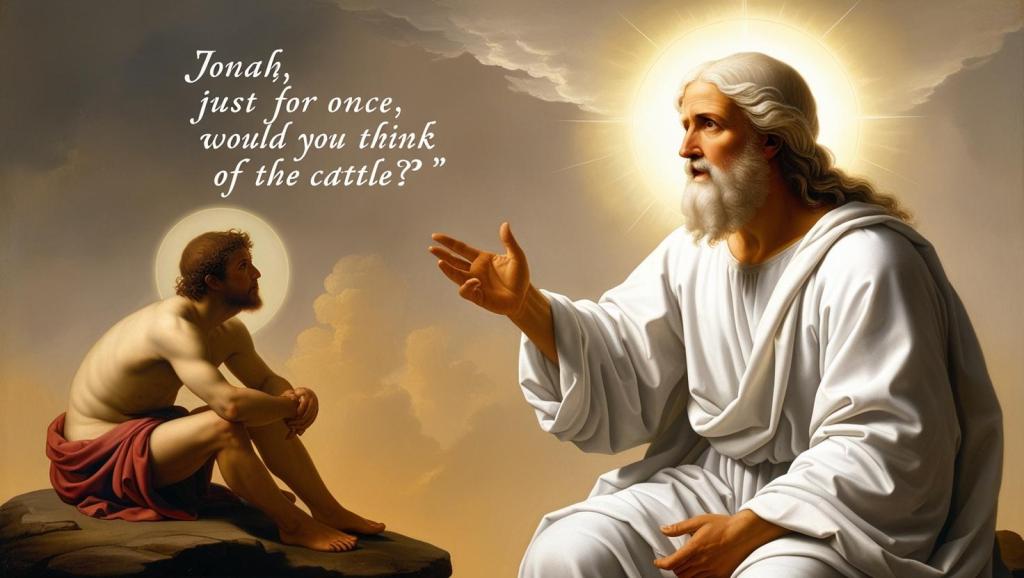
- God: “Jonah, have you not considered all those poor animals? I’m sure there’s no way I have a reputation for being cruel to animals right?”
- Jonah: “So…about that…”
Is this the same God? He seemingly has a lot of compassion on this people, due to their apparent idiocy. Those animals are pretty important too!
This sure doesn’t sound like the same God of the Exodus story. Did all of those Egyptian cattle do something to deserve their fate that we aren’t told about?
We can Biblically “prove” God is an unrighteous and cruel God. (Relax, it’s a thought exercise with a point. I’m not making that argument)
For every animal of the forest is mine, and the cattle on a thousand hills. – Psalm 50:10 NIV
The righteous care for the needs of their animals, but the kindest acts of the wicked are cruel.- Proverbs 12:10 NIV
God seemingly claims the cattle as His, yet by this logic, would be a cruel unrighteous owner.
Hail smashing the cattle, boils on the cattle, flies biting the cattle, plague killing the cattle??? Objectively those all seem pretty cruel. Most people would define a “need” of life at the very least, to be “not being un-alived” or “not being maimed by giant hailstones.”
Of course no one thinks this. This is a very literal and plain take, and that’s the entire point of this post.
God is imagined differently by different authors. The Bible does not speak with one harmonious voice. When people attempt to force it to do so, they have to come up with all sorts of strange and illogical arguments to explain away these disagreements.
There are literally hundreds of places in both the OT and NT, where God/Jesus/events/humans are described and attributed with starkly different language.
It would seem a reasonable take would be to stop thinking “His ways are above our ways” and rather start thinking “our thinking is not like our thinking.”
Like how the OT writers attributed chaos, destruction, calamity, and evil to God, but the NT writers attribute it to Satan/demons. Humanity’s own thinking was not like later humanity’s thinking.
Jonah is, by a definite super majority of scholars and even theologians, considered a fictional narrative with a story-telling purpose. The reasons are many and convincing (perhaps I’ll dive into that in another post).
The ancient people who wrote these stories didn’t have the same concept of journalistic history, or fiction/non-fiction as we do in modern times. For them, the point of the story remained the same, whether or not the events literally took place. Asking the text whether or not the story historically/factually took place, is not a question that the text is designed to answer.
At this point we have to reckon with two different stories, both of which are at best highly fictionalized accounts of some nugget of truth. Both contain very different character assessments of God.
“I the Lord do not change.” – Malachi 3:6 NIV
Yet, the Lord, who preexisted humanity by unknown eons, is said to “not change.” That would make the most sense intuitively to us. An all-powerful unchanging God fits better with our modern view of Him.
It seems like there’s three roads you can take on this journey.
Road 1: God doesn’t change. The Bible somehow is univocal in how it depicts God (and many other things). We should do our best to harmonize that seeming lack of univocality in the text, even if it often does not make sense. We should assume inerrancy.
Road 2: God Himself matures and changes, and thus His changing character in the text is explainable. (I mean…it’s not a totally crazy thought. He’s never interacted with humans before us. Maybe He’s got a little first-time-parent thing going on?)
Road 3: God allowed a lot of flexibility during the creation of this thing we call the Bible. He allowed different authors to write differently. He allowed stories to be told that don’t always paint Him in the best light. He left space for a need to seek Him for understanding. If it was so perfectly spelled out for us, why would we ever really need to seek Him out? He’d be a divine piggy bank and that’s it. (Which is ironically what He’s become to many…but I digress)
What these stories seem to do is show us the evolutionary track of the Old Testament writers’ understanding of God. They had a job to do, a story to tell. They had a people to convince, and had to implement some rhetorical goals in pursuit of that. Factual video-camera-like historical narrative was never a goal, let alone the most prioritized goal.
I think about some of the stories from my son’s audiobooks that we listen to at bedtime. There is one in particular, handed down to us from the Chumash Native Americans, that I look forward to hearing again and again.
A creation story of the Chumash People
Long ago before the two legs walked the land, there were all the animals. It was always day time and the animals had everything they needed or wanted; they never had to struggle for anything.
Over time the animals became greedy and started bickering and fighting over food and shelter even though there was plenty to go around. One day Bear and wolf got in a fight over a piece of fruit. Coyote thought wolf should get it and bobcat thought bear should have it. One by one all the animals picked sides and the fight was so big and so loud that it woke up Great Spirit.
Great Spirit looked down upon the animal’s selfishness and was displeased. As punishment for their deeds, The Great Spirit cast a shroud of darkness over the land. The animals became fearful. They had never known such darkness before. Out of fear, they sought out the greatest among them to tear down the shroud. Bear who was the wisest climbed to the top of the tallest tree on the tallest mountain and still couldn’t reach the shroud to pull it down. Wolf also climbed to the tallest peak and when he failed to pull down the dark he cried out in fear a deep mournful howl.
“I can do it,” said Hummingbird.
Bear snorted. “Go ahead, but if the best of us can’t do it, you surely can’t.”
Hummingbird nodded, then took to the sky. His wings were a blur as he furiously climbed. He passed the clouds and the highest point Hummingbird’s tiny beak penetrated the shroud. With no energy left, Hummingbird fell to the Earth. Once on the ground, he rested. Hummingbird looked to the sky. Amid the endless darkness, a single dot of light shined brightly where his beak had broken through the shroud. Still breathing heavily, Hummingbird took flight and shot once again towards the shroud. Hummingbird flew as fast and as high as he could. He was able to stick his beak through once more, before falling back to the Earth.
Hummingbird repeated his incredible flight, over and over again, each time piercing the shroud so that a pinpoint of light could shine through. He continued flying so many times that the other animals lost count. On Hummingbird’s last flight he flew so fast and so high that his whole head went through the shroud. Having spent the last of his energy, he fell to the Earth and drew his final breath.
Great Spirit was moved by the bravery and resolve of the hummingbird. His voice rang out for all to hear:
“Hear me. I placed the shroud as punishment for your selfish ways. But hummingbird has softened my heart. Therefore, I will lessen the punishment. But the shroud will remain to remind you what the hummingbird did here today.” And so it was done. Half of the time, the shroud was lifted, bringing the light back to the Earth. The other half was marked by the return of the darkness, now however there were countless pinpoints of light from where Hummingbird had poked his beak through. And looming in the night sky, a large, bright disk shone where the hummingbird’s head went through the shroud. And that is how night and day came into being.
It’s beautiful. It’s clearly not meant to be literal, but it conveys a purpose and a very deep and reverent meaning. When I imagine it being told, I am drawn into how the community must have felt. Imagine an elder retelling this on a chilly fall night, under a crisp clear sky, around the warm red glow of a dying campfire. You are a young child hearing this. Your imagination can capture all the vivid details.
Sometimes we have to explain things we don’t understand, in words that we do understand. Ideas that are beyond us, require re-understanding with ideas that are within our grasp. The world of astrophysics, relativity, and quantum mechanics are often explained in simple, and not always fully scientifically correct, analogies. Is God any less complex?
Yet, it’s the best way to get that information understood by everyone.
Understanding the Bible in this light keeps us from imposing frameworks that the text was never designed to operate within. Namely, inerrancy and factual-historicity.
You can find me on road #3. It’s a beautiful road that travels the most interesting lands. All of my fellow road #3 travelers are here, not because they were told they had to be by some authority, but because they sought it out. They want to be here.
Peace


Leave a Reply