

I’ve spent almost a year wrestling with this topic. It’s time to address the issues head on. I apologize in advance for the length, but this is actually quite short considering the subject. I urge the reader to get to the end before slapping the label of heretic on me, although perhaps that label is already there! 😂
Here we’ll be looking at the conceptual package. We’ll look at questions like:
- Can we even find it in scripture?
- Does it make sense in the broader context of the day?
- Does it make sense with reason?
- How did we wind up with it?
- Should we keep it?
- What happens if we abandon it? What are the ramifications?
One thing must be made abundantly clear. No one is arguing against the importance and necessity of Jesus and His sacrifice for us. That is, and always will, remain key to Christian faith.
Trinitarians today often make this doctrine out to be the crux of Christianity. To disagree is heresy. Is that deserved? Is that necessary? Let’s look at the evidence.
The Divine Name
Sometimes people think that those of Jesus’s time couldn’t accept He could do and say these things without Him being God. This is a faulty premise. Now they had a problem with Him specifically because of what He was preaching, but the authority problem itself had a viable solution.
The Hebrews and 1st century Christians already had a way to reconcile this problem before the trinity doctrine was created. That was simply by possessing the divine name.

When emissaries of their king would go deliver news, they would appear to be acting as king because they had the authority of the name of the king himself. They could order an attack or a withdraw. They could negotiate terms. They could do things that only a king had the authority to do, because his name was in them.
Likewise, we see in Exodus an example of this.
20 “I am going to send an angel in front of you, to guard you on the way and to bring you to the place that I have prepared. 21 Be attentive to him and listen to his voice; do not rebel against him, for he will not pardon your transgression, for my name is in him. – Exodus 23:20-21 NRSVUE
The angel of the Lord is acting as God, with the power to forgive (or not) sins. He possesses God’s name. Many trinitarians assume this must be Jesus, but that’s highly debated. They claim that having this name is permissible because Jesus = God. However, even if we assume they’re right in this debate, that the angel of the Lord is Jesus, there’s still a problem.
saw one like a human being
coming with the clouds of heaven.
And he came to the Ancient One
and was presented before him.
14 To him was given dominion
and glory and kingship,
that all peoples, nations, and languages
should serve him.
His dominion is an everlasting dominion
that shall not pass away,
and his kingship is one
that shall never be destroyed. – Daniel 7:14 NRSVUE
Jesus was given dominion. He did not inherently possess it.
Then Jesus came to them and said, “All authority in heaven and on earth has been given to me. – Matthew 28:18 NIV
Again, Jesus was given authority. If Jesus was fully God, wouldn’t He inherently possess this authority? And don’t think this was the “human” Jesus who only needed earthy authority, as it says here He was also given authority in heaven. Wouldn’t the pre-incarnate Jesus already possess this heavenly authority if He was God?
26 For as the Father has life in himself, so he has granted the Son also to have life in himself. 27 And he has given him authority to judge because he is the Son of Man. – John 5:26-27 NIV
The Father has given Jesus authority to judge. Jesus did not innately have this authority.
Jesus answered, “I have told you, and you do not believe. The works that I do in my Father’s name testify to me, – John 10:25 NRSVUE
Jesus is doing His works in His Father’s name, the divine name. He was given the divine name, and the authority that comes with it, and can thus do the works of God.
9Therefore God exalted him even more highly
and gave him the name
that is above every other name, – Phil 2:6 NRSVUE
Paul seems to have understood this idea too. In this verse, God acts in the superior role and gives that which only He can give, the name that is above every other name, the divine name.
The point is to make clear that emissaries acting in place of the authority from which they are sent, have the same power as that authority. That is the context of that time period, and that is how the people of that time period would have understood it. They didn’t need a trinity to explain this authority problem.
The trinity was a solution to harmonize church opinions, and influenced by Greek Platonic ideas.
The Three “Co”-Necessities
As trinitarians understand it today, God the Father, God the Son, and God the Holy Spirit are all co-equal, co-eternal, and co-omniscient.
For reference,
- Co-equal is just that. All three are of equal importance. None is greater than any other.
- Co-eternal means all three have existed forever together, from the start of time itself.
- Co-omniscient means that all three possess equal knowledge of all things. Nothing can be a secret for just one member.
This is quite problematic, as these concepts are not found in scripture. In fact, the scriptures argue strongly against this conceptual framework.

You heard me say to you, ‘I am going away, and I am coming to you.’ If you loved me, you would rejoice that I am going to the Father, because the Father is greater than I. – John 14:28 NRSVUE
My Father, who has given them to me, is greater than all; no one can snatch them out of my Father’s hand. – John 10:29 NIV
Not only did the Father have to give something to Jesus, He is also greater than Jesus. In fact, the Father is greater than all. This means the Father is also greater than the unmentioned holy spirit. How can that work with co-equality?
But about that day and hour no one knows, neither the angels of heaven, nor the Son, but only the Father. – Matthew 24:36 NRSVUE
Jesus is describing the divine beings in heaven and says none know the time of His return except the Father. How does that work with co-omniscience? (The holy spirit again gets no mention but also apparently does not know.)
So Jesus said, “When you have lifted up the Son of Man, then you will realize that I am he and that I do nothing on my own, but I speak these things as the Father instructed me. – John 8:28 NRSVUE
Jesus had to be instructed by the Father, as He can do nothing on His own. Co-omniscience is a tough sell when Jesus is having to be taught something. Don’t think this is just the earthly Jesus being unaware of the goings-on in heaven either.
18 He said to them, “I watched Satan fall from heaven like a flash of lightning. – Luke 10:18 NRSVUE
In Luke Jesus recounts a heavenly event that happened prior to His earthly arrival, Satan’s fall from heaven. This event tells us two things. 1.) Jesus watched Satan fall. An observer’s view if you will. As in He personally had nothing to do with it (I.E. God kicked out Satan, not Jesus) and 2.) Jesus was fully aware of and had the ability to recall the heavenly workings in His earthly body.
Jesus also has his own unique will.
Father, if you are willing, remove this cup from me, yet not my will but yours be done.” -Luke 22:42 NRSVUE
for I have come down from heaven not to do my own will but the will of him who sent me. – John 6:38 NRSVUE
God and Jesus appear to have two separate wills. It appears this will was present with Jesus in heaven prior to His earthly arrival. Having a different divine will is not allowed, and prior to coming to earth, Jesus would have had no earthly body’s will.
13 In the sight of God, who gives life to everything, and of Christ Jesus, who while testifying before Pontius Pilate made the good confession, I charge you 14 to keep this command without spot or blame until the appearing of our Lord Jesus Christ, 15 which God will bring about in his own time—God, the blessed and only Ruler, the King of kings and Lord of lords, 16 who alone is immortal and who lives in unapproachable light, whom no one has seen or can see. To him be honor and might forever. Amen. – 1 Timothy 6:13-16 NIV
This passage can vary in some translations, but regardless of translation, the underlying language is understood by many textual scholars as the following. God alone is immortal, God is differentiated from Jesus, and God gives life to Jesus. Understandably this poses a problem for co-eternality.
26 For as the Father has life in himself, so he has granted the Son also to have life in himself. 27 And he has given him authority to judge because he is the Son of Man. – John 5:26-27 NIV
Just as the living Father sent me and I live because of the Father, so the one who feeds on me will live because of me. – John 6:57 NRSVUE
Jesus was granted life by the Father.
23 He said to them, “You will indeed drink my cup, but to sit at my right hand and at my left, this is not mine to grant, but it is for those for whom it has been prepared by my Father.” – Matthew 20:23 NRSVUE
Jesus did not have authority to grant who would sit next to Him. It appears only the Father had that authority. That really doesn’t make sense if they are co-equal.

I think we’ve covered enough. There are many other verses we could look at that speak against the “co”-necessities. These concepts are simply not supportable via scripture without some some creative doctrinal inventions. (and boy let me tell you, those exist in VOLUMES)
That makes sense though, as trinity doctrine wasn’t created to solve a scriptural problem per se, but to harmonize how different churches were wrestling with who Jesus was. It seems reasonable then, that some of the concepts adopted also wouldn’t be found in scripture.
On one hand, their society was was bathed in Greek philosophical thought that contained these ideas about being, person, essence, etc. On the other hand, there were internal conflicts with their different takes on the level of Jesus’ divinity.
As these two schools of thought collided, they felt pressured to conclude that Jesus had to literally also be the supreme God, that they (and the holy spirit) shared this same essence. That was their solution under the influence of other Greek philosophical concepts. They did not arrive here based on scripture alone, the one thing that should have guided them.
As Bible scholars John McClintock and James Strong explain: “Towards the end of the 1st century, and during the 2d, many learned men came over both from Judaism and paganism to Christianity. These brought with them into the Christian schools of theology their Platonic ideas and phraseology.”
Thus, as debate swelled over the nature of God in the fourth century leading to the Councils of Nicaea and Constantinople, it was no longer a debate between biblical truth and error. Both sides in the debate had been seriously compromised by their acceptance of unbiblical philosophical ideas.
Many of the church leaders who formulated the doctrine of the Trinity were steeped in Greek and Platonic philosophy, and this influenced their religious views and teaching. The language they used in describing and defining the Trinity is, in fact, taken directly from Platonic and Greek philosophy. The word trinity itself is neither biblical nor Christian. Rather, the Platonic term trias, from the word for three, was Latinized as trinitas—the latter giving us the English word trinity.
“The doctrines of the Logos [i.e., the “Word,” a designation for Christ in John 1] and the Trinity received their shape from Greek Fathers, who . . . were much influenced, directly or indirectly, by the Platonic philosophy . . . That errors and corruptions crept into the Church from this source can not be denied” – (The New Schaff-Herzog Encyclopedia of Religious Knowledge, Samuel Macauley Jackson, editor, 1911, Vol. 9, p. 91).
I’ll remind the reader here, that the scriptures were so lacking in support for the trinity’s concept of consubstantial existence, and the co-necessities, that its proponents later inserted a fraudulent text into the Bible. We know this today as the Johannine Comma, and it is only found in the KJV and NKJV Bibles in 1 John 5:7. You won’t find it in any other modern English translation (that I’m aware of). This is NOT original to the Bible, with its first appearance coming roughly 400 years after the Bible’s completion. See my post on this issue here.
Almost all modern mainstream trinitarians acknowledge this is fraudulent material, and will abstain from using it as a proof-text for the trinity. There are no scholars anywhere that hold this text as legitimate, and this fact is completely accepted and non-controversial.
That doesn’t stop the SDA church though, as they use that on their Instagram account all the time to support the trinity. See the Feb and May posts below.

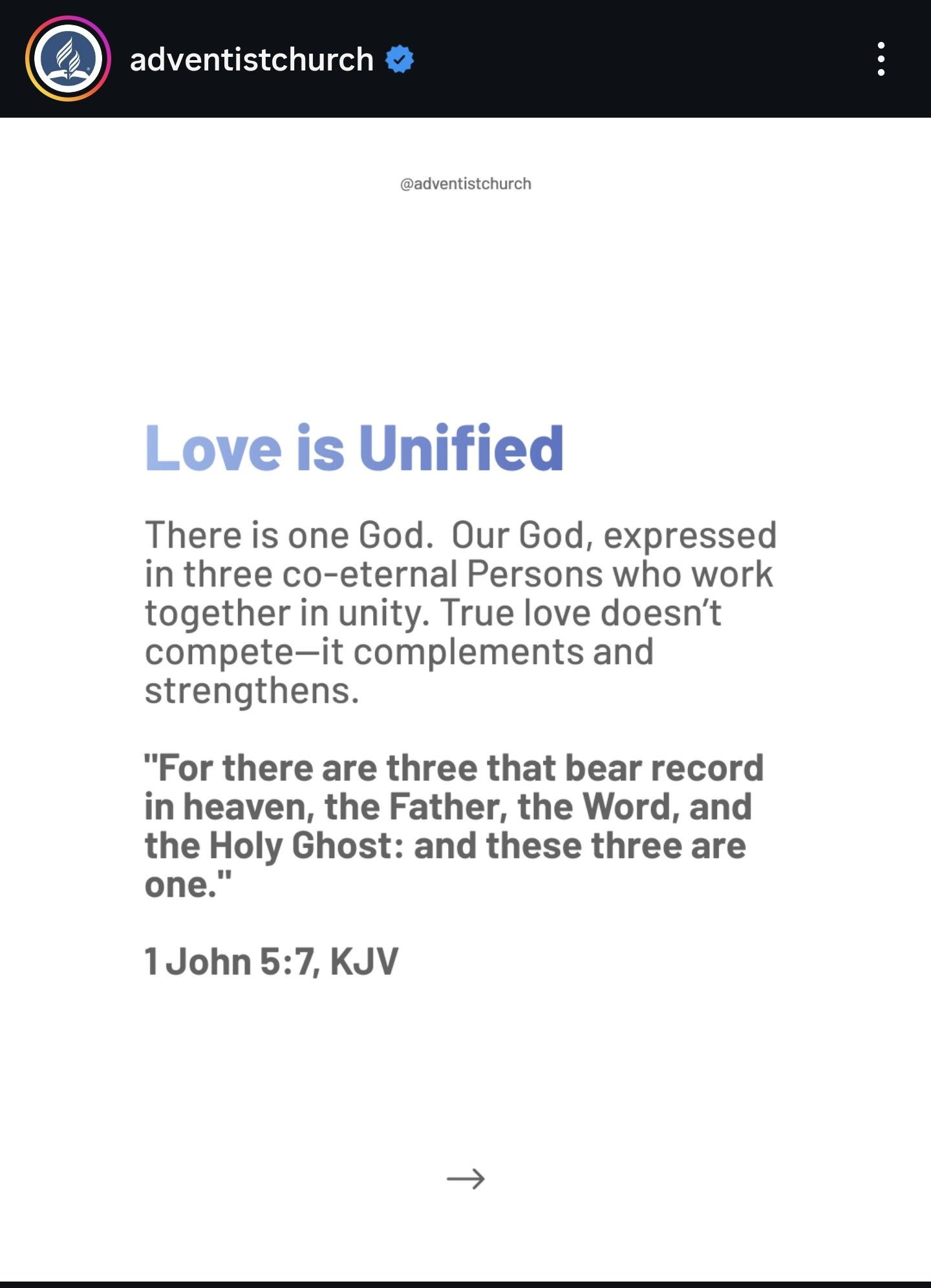
The thing is, they’re aware of this. They know this is fraudulent, as they do not use it as a proof-text for the trinity in their fundamental beliefs statement. This would be the single best proof-text for the trinity in the entire Bible, and if they thought they could use it, they would do so here.
Who Is the Holy Spirit Then?
This is an interesting question. The Bible is actually not that clear on this. It’s so unclear in fact, that there isn’t really a good reason to be forced into the conclusion that it is a separate person/entity. Some think that the holy spirit is the active force of God in the world. (But not a separate entity) Others think it is Jesus ministering in a spiritual form. Others feel it is a separate entity that serves at the behest of God.
Christ has a name. God has a name. The holy spirit? It never gets named in the Bible. Not being given a name in that historical time period is actually a pretty big deal. On top of that, it gets little comparative airtime or development.
The debate during the formation of what would become the trinity doctrine started as just arguments about God and Jesus. The holy spirit wasn’t brought into the discussion until later, and was just sort of lumped in with significantly less thought/discussion.
In New Testament contemporary Greek philosophy, three (3) was considered a perfect number, associated with harmony, wisdom, and understanding. There’s no doubt some pressure to arrive at a socially preferred numerical value had a play in this result of three persons.
Who was Jesus?
Jesus came to die for our sins. Under the umbrella of the trinity doctrine, Jesus’s story would look like this.
God would be giving God as a sacrifice to God (only 1/3 of Him “dying” but not really…God can’t die remember?) for our sins to save us from God, and then raising God back to life and bringing God back into heaven with God. God will then eventually inform God (because God doesn’t know) at the appropriate time, that God is now allowed to bring us back to God, and then God will come and do exactly that. Then us and God can live together with God forever in heaven.
That seems very perplexing and convoluted.

The Bible overwhelmingly (99%) speaks a subordination relationship of Jesus to the Father (both functionally and ontologically). This includes both prior to His birth on earth and after His resurrection. It seems like there’s good evidence for the following:
- He was God’s primal manifestation, coinciding with the start of time itself, being made like God, and through whom God created all things. (John 1:1, John 17:5, Col 1:15-17, Rev 3:14)
- He was granted authority in Heaven by the eternal God (Matthew 28:18)
- He was sent to earth by God (John 3:16)
- He was given earthly authority by God and acted in the divine name (Matthew 9:6)
- He was raised back to life by God (Romans 6:4)
- He now reigns eternally in heaven with the authority given Him by God (Daniel 7:14)
- He has been given authority to judge and forgive sins by God (logical extension of Matthew 9:6)
- He is the intercessor between us and God (Hebrews 7:25)
Let’s look at the story of Jesus again, but with Jesus not being God.
Jesus, God’s only begotten son, was sent to earth by God. He acted with the power of God since He was given the authority of the divine name. He did the Father’s will while on earth, despite His own conflicting will. He truly died for our sins (not inherently immortal without God sustaining Him), thus fulfilling the need for a perfect blameless sacrifice. God raised Him back to life, and brought Him back to heaven. At the appropriate time, God will tell Jesus to return to earth and bring us back to heaven to live with Him.
This take not only makes much more sense, but it is also biblically harmonious.
“For God so loved the world that he gave his only Son, so that everyone who believes in him may not perish but may have eternal life. – John 3:16 NRSVUE
The Mystery
Trinitarian apologists make quite the leap with defensive arguments for why their doctrine doesn’t make sense. They want to obscure the nonsense by way of a “this is all mysterious and unknowable” smoke-screen.
Take Dr. Stephen Bauer who says this:
Like the second commandment, the Trinity doctrine reveals a God who is too complex to define or understand fully. Our minds cannot grasp how we have one God, who is three persons, each fully Deity without being one-third of a God, yet They are not three Gods. If you think you can explain that satisfactorily, plainly you do not know whereof you speak. While we can be sure about those aspects of God that are revealed, we cannot claim to comprehend their meaning fully.
Like the second commandment, the Trinity doctrine calls us humbly to acknowledge that God must be received as revealed even though our minds are left with baffling mysteries that cannot be explained. The Trinity doctrine reminds us of God’s right to define Himself without having to make Himself fully comprehensible. In this way, we are more likely to acknowledge His sovereignty and respect it. The incomprehensible dimension of the doctrine validates its authenticity. – Stephen Bauer
In this article he placates the believer in their likely confusion over the trinity by claiming “The incomprehensible dimension of the doctrine validates its authenticity.”
I’m sorry, excuse me? Something is more valid because it is less comprehensible? In what universe do you live? Would you treat literally anything else in life with that logic?

It is reasonable to think that a doctrine should have a foundation built on something that makes sense. How can you build a doctrine around something that doesn’t? Better question…why would you build a doctrine that doesn’t?
The answer of course is, if you were just using scriptures as your basis, you wouldn’t. This is simply an appeal to mystery. It’s an appeal, that if accepted, no longer permits questioning the doctrine’s validity, as its authority now rests on “an unexplainable mystery.”
Trinitarian apologists often say without this doctrine God will lose His mystery. Attempting to define Him, is attempting to remove this mystery. He rightly deserves to remain mysterious.
Guess what the trinity doctrine also is? It’s a way to define God.
God will most assuredly remain mysterious no matter what we in our human capacity are able to understand about Him. A mouse can rightly deduce I have two arms and two legs, but no matter how much the mouse in his capacity can learn about me and my behavior, my thought process will always remain a mystery to it.
Other Miscellaneous Problems with the Trinity
1.) The trinity is clearly not something the Bible’s authors ever understood to be a thing.
If the trinity was inherently understood by these authors, why did it take nearly 500 years for it to reach its full articulation as we understand it today? Why did it take 300 years for the basic components to even be formulated? Why wasn’t it ever mentioned scripturally in even somewhat clear terms? Simply put, the Jewish culture of the day would be abhorred at the idea of the trinity. Jews today still do not believe in the trinity.
2.) Some trinitiarian scholars today (Ex. Dr. Aaron Higashi) admit the trinity is not found scripturally. Many other renowned atheist scholars also point out that the concept of three consubstantial persons is nowhere to be found. (They have no stake in the game as far as believing in trinitarianism or unitarianism, so it’s worth hearing from them in strictly biblical scholarly terms.)
Aaron’s belief in the trinity is based more in the appeal of its philosophy than scripture, as he states “I just don’t think it is found either in whole or any significant part in scripture. No Biblical author has any idea what it is, nor are they attempting to communicate it.”
If people want to claim something like progressive revelation or “present truth” revealing that knowledge, or as a faith based on the philosophical appeal of the idea, then that seems reasonable.
3.) Jesus prays to God, He says only the Father is good, He calls His father “my God,” He calls God greater than Himself, He says He is dependent on God to live, He says the Father alone possesses at least some secret knowledge, He says He is dependent on God for knowledge, and He affirms the theology of a very non-trinitarian Jewish scribe.
In Mark 12:28-34, a teacher of the law came and questioned Jesus. In his reply to Jesus’s answer, the man identifies God as “Him,” one singular God. This man also says “There is no other but Him.” Again singular. Verse 34 says “When Jesus saw that he had answered wisely, he said to him, “You are not far from the kingdom of God.” The man had answered wisely. He had answered that God was singular and was the only God. Jesus goes on to say this teacher is not far from the kingdom of God.
4.) Paul in 1st Corinthians clearly delineated Jesus as NOT God and does not hold Him as equal to God.
yet for us there is one God, the Father, from whom are all things and for whom we exist, and one Lord, Jesus Christ, through whom are all things and through whom we exist. – 1 Corinthians 8:6 NRSVUE
“…then the Son himself will also be subjected to the one who put all things in subjection under him.. ” 1 Corinthians 15:28 NRSVUE
5.) Jesus was God’s manifestation. He is specifically differentiated from God. This was the pre-incarnate Jesus, who existed before Abraham*, and who had Glory with the Father before the main earthly acts of creation began.
He is the image of the invisible God, the firstborn of all creation, – Col 1:15 NRSVUE
‘The words of the Amen, the faithful and true witness, the beginning of God’s creation. – Rev 3:14 RSV
“So now, Father, glorify me in your own presence with the glory that I had in your presence before the world existed.” – John 17:5 NRSVUE
*Note: On the topic of John 8:58 “Before Abraham was, I Am” – Professor of Religious Studies, Dr. Jason BeDuhn in his book “Truth in Translation: Accuracy and Bias of the New Testament” shows how the verse of John 8:58 is usually translated under the trinitarian bias and allure of the KJV style. This verse is NOT a call-back to the “I AM” statement in Exodus with Moses. One is in Hebrew and the other is in Greek. Jesus spoke Aramaic. We are seeing an author writing in Greek, translating Jesus’s Aramaic words. There is no direct comparison. Regardless, a non-biased proper English translation of John 8:58 would simply be “I was in existence before Abraham was ever born.” It has nothing to do with equating Himself to be God and does nothing to establish His eternal pre-existence. The people wanted to stone Him for His perceived elevation above the revered Abraham.
6.) No Jews who converted to faith early on, ever challenged the trinity.
Error 404: Records not found
7.) There was no controversy in the 1st century around the trinity. It would take a little time for the learned Greek coverts’ philosophical ideas to start influencing church thought.
Error 404: Records not found
8.) The trinity is not something that a person ignorant of both the bible and the doctrine would ever derive on their own from just the Bible. That is simply the honest reality. You have to already have the trinity in mind and read it back into the texts.
What Happens If I Don’t Believe It?
Here’s the (not) crux of the matter. If you come to the same conclusion as many others, that the trinity is not a valid doctrine to hold, there are probably going to be two things that will happen.

First off, you will be scorned by trinitarians as a heretic. What is unfortunate with this doctrine, is that the shouts of persecution the initial pro-trinity crowd levied against the opposition still echo loudly even today.
During the development and ratification of this doctrine, many who disagreed were exiled, with the might of the Roman Empire eventually enforcing it. Many have been executed over their disagreement.
Don’t think this persecution stopped during more recent days either. The Maryland Toleration Act of 1649 (In the U.S.A.) was supposed to offer freedom of religion for those who believe in the trinity. And I guess…it did? But it also imposed the death sentence for anyone who denied the doctrine or the divinity of any of its members. It was permanently repealed within a few decades.
The second thing that will happen is….wait for it…..NOTHING. No other biblical teaching depends on this doctrine.
Let that sink in for a minute.
Salvation by faith? Still intact.
Jesus as our intercessor? Still intact.
Jesus returning to save us? Still intact.
A perfect and blameless sacrifice in Jesus? Still intact.
There’s literally nothing that matters to our our salvation (the key area) that depends on this doctrine. Yet, the Nicene creed makes it out to seem like one must believe this in order to be a Christian. This is a false dilemma fallacy implemented to pressure people into adopting the identity politics and dogmas of the crowd.
Conclusion
There are a few (single digits) verses that can vaguely be construed to reference something sort of trinity adjacent, albeit often leaving out the holy spirit, never describing the co-necessities, and never claiming the three are one in any way. These few verses also have completely viable non-trinity explanations AND at least two are the result of pro-trinitarian biases during the translation process. (see my previous post on the trinity here)
SDAs initially rejected the trinity doctrine (Ellen White too). In 1846 James White dismissed the trinity as “the old unscriptural trinitarian creed.” He later got on board the bandwagon. Do you think it was the scriptures he used to evaluate this doctrine as “unscriptural” that changed? Hardly. Social pressures, group think, and an appeal to philosophy won the day. [UPDATE 6/21/25 – I was incorrect here. James White never got on board with the trinity. My sincere apology for the misinformation (and my apologies to you James)]
A non-trinitarian viewpoint, a view of God where neither Jesus or the holy spirit (if it’s an entity at all) are also literally the same supreme God, is arguably more compatible with scripture.
My view is that Jesus did not lie or mislead. He spoke plainly and definitively about His relationship with God. We can trust His word. We can also trust the vast majority of scripture vs selectively appealing to a few verses to build an entire doctrine out of. If anything else, that would seem like the more logical path to go down.
To have faith in and follow Jesus does not require a belief in the trinity. Traditional Christianity might have set an arbitrary line in the sand that defines it as such, but that’s all it is. Arbitrary. Christians got along just fine for ~300 years without the trinity doctrine.
Believe in the trinity if you want. But understand that those who reject it do so out of reason and not demonic influence or disbelief in Jesus or the importance of His sacrifice. Leave that persecution mindset in the past where it belongs.
Peace
6/17/25 UPDATE: Additional thoughts
Despite my use of SDA examples, you can find similar examples of pro-trinity arguments in other denominations. I just happen to only know the SDA ones. This is not an SDA exclusive issue and my intent was never to specifically demean or denigrate the SDA church. My goal is to call out scriptural misinformation in whatever form or vehicle in which it arrives. The Johannine Comma is scriptural misinformation.
There are many Christian denominations who have abandoned the trinity, and throughout history there has always been pushback (Hence the exiling and executing of those people). This isn’t a new or revolutionary take. It’s just probably an idea many aren’t familiar with because they were raised to think this fundamental doctrine was so perfect and true, that it was above questioning.


 Space For Doubt
Leave a reply to Author Cancel reply