

It has been brought to my attention that James White never actually got on board with the trinity at all. I relied on a source without fact checking. 100% my fault. It just sounded like something that was probably true. (With the understanding that the SDA church currently believes in the trinity) I have updated the initial post with the corrected information.
Trinity Problems
Lack of Biblical Doctrinal Existence
The lack of scriptural clarity is an unsolvable issue with this doctrine, and will always be a thorn in its side.
As Dr. Aaron Higashi said,
“I just don’t think the doctrine is found either in whole or in any significant part in the Bible. No biblical author has any idea what it is, nor are they attempting to communicate it.”
And
“None of the terms used to describe the trinity are [in scripture], either exactly or in synonymous forms, nor has the philosophy been invented yet that’s used to explain those terms…Jesus and God being divine or united is also insufficient for the trinity.”
Dr. Justin Sledge (doctorates in, and professor of, religious studies and philosophy) describes it bluntly:
“There’s just no doctrine of the trinity without pagan Platonism.”
None of the Bible’s books convey this doctrine in any substantive way. It’s worth keeping in mind that these NT authors had decades of Holy-Spirit-led continued understanding prior to composing their books. This would’ve been a great time for the Holy Spirit to reveal this…what with the inspired Bible being brought to completion and all. *shrugs*
It’s hard to imagine a plausible scenario where all these authors just forgot to mention that Jesus is literally one in the same being with the Father and Holy Spirit. It’d be like a car salesmen forgetting to tell the customer that this car they’re interested in is actually a semi-truck.

Heck Matthew is writing in hindsight (as they all are), and doesn’t even flinch at the crowd marveling that God would give authority to men to forgive sins. If he thought Jesus was really God, this would be a great time to clarify this big detail. However as I’ve noted previously, this was understandable via the transferability (and consequent power) of the divine name. There was no need for a trinity or equality statement to understand how this could work. The Holy Spirit apparently felt no need to correct his understanding here either.
Luke most definitely preaches Jesus as not God. He also in no way preaches the trinity.
20 You know that I have not hesitated to preach anything that would be helpful to you but have taught you publicly and from house to house. 21 I have declared to both Jews and Greeks that they must turn to God in repentance and have faith in our Lord Jesus. – Acts 20:19-21 NIV
For I have not hesitated to proclaim to you the whole will of God. – Acts 20:27 NIV
Apparently God’s will does not encompass us understanding Him to be a trinity, as Luke doesn’t teach that. (hint: neither does any other book)
Paul, at least in his undisputed letters, never considers Jesus to be God. I’d argue that even in the likely forged letters, that the author also never considers Jesus to actually be literally the God.
In Romans, a book completed roughly 2/3 of the way through Paul’s ministry, we find some definitive statements that show Paul did not consider Jesus to be God.
9 Much more surely, therefore, since we have now been justified by his blood, will we be saved through him from the wrath of God.[a] 10 For if while we were enemies we were reconciled to God through the death of his Son, much more surely, having been reconciled, will we be saved by his life. – Romans 5:9-10 NRSVUE
32 He who did not withhold his own Son but gave him up for all of us, how will he not with him also give us everything else? 33 Who will bring any charge against God’s elect? It is God who justifies. 34 Who is to condemn? It is Christ who died, or rather, who was raised, who is also at the right hand of God, who also intercedes for us. – Romans 8:32-34 NRSVUE
Paul in the above two verses could not be any more clear that Jesus is not the eternal unbegotten infinite God. We were reconciled to God through His son, not reconciled to God through God. Jesus is excluded from the category of God, and is placed in the highest position of authority relative to God.
Don’t think this is just Romans either. He echoes the same idea in 1st Corinthians.
yet for us there is one God, the Father, from whom are all things and for whom we exist, and one Lord, Jesus Christ, through whom are all things and through whom we exist. – 1 Corinthians 8:6 NRSVUE
“…then the Son himself will also be subjected to the one who put all things in subjection under him.. ” 1 Corinthians 15:28 NRSVUE
All signs point to Paul, our earliest published apostle, as not being aware of a trinity nor believing that Jesus was of the same being as the Father.
Certainly John conveys thoughts of Christ’s divinity that exceed Mark, Matthew, Luke, Paul, and Peter. However what he doesn’t do is convey a clear idea of homoousia (one in the same substance), or include the Holy Spirit as a separate and equal entity within the same. Despite John’s elevation of Christ as divine (divine does not mean literally capital “G” God), the book as a whole is still very compliant with an unequal relationship between Jesus and God.
17 Jesus said to her, “Do not touch me, because I have not yet ascended to the Father. But go to my brothers and say to them, ‘I am ascending to my Father and your Father, to my God and your God.’ ” – John 20:17 NRSVUE
John certainly appears to make space between the almighty eternal capital “G” God and Jesus. After all, how can a God have a God? I know the hermeneutical gymnastics developed to get around this (part of the immensely complex trinity doctrine), but I don’t buy it.
There are credible arguments that propose John the apostle was actually not responsible for the final form of this gospel. Many scholars have noted this. There’s a number of compelling reasons for this and I will get into that in another post. Even Pope Benedict the XVI in his book “Jesus of Nazareth” has proposed this idea of a final composition by another later author using John’s source material.
“At any rate, there seem to be grounds for ascribing to “Presbyter John” an essential role in the definitive shaping of the Gospel [of John], though he must always have regarded himself as the trustee of the tradition he had received from the son of Zebedee.” – Pope Benedict XVI
Note that while there is compelling evidence that John was indeed composed from more than one source, disagreement exists on who this other later source was. Presbyter John is just one theory. I’ll write a separate post on this someday.
It wouldn’t be too surprising then, to understand that this final form of John might convey ideas not promoted or understood by his earlier peers (or even the original John himself). As Jesus’s return was increasingly delayed, and His divinity was elevated more and more in certain congregations, the result we have today makes sense. John, at times, appears to contradict John.
One good example of the late nature of this composition is the phrase found here:
28 Thomas answered him, “My Lord and my God!” – John 20:28 NRSVUE
Roman Emperor Domitian (81-96 CE) demanded to be called “Dominus et Deus” (Lord and God). What we’re seeing here is probably a revisionist addition/alteration to the apostles testimony, in order to stick a fork in the eye of the Roman authorites.
I resonate with Dr. Bart Ehrman in his book “Misquoting Jesus” in that John likely contains sayings attributed to Jesus that may not be authentic, and ideas of the same nature.
For example, many scholars have noted the prologue of John 1:1-18 and chapter 21 specifically as likely later modifications.
Another possible example of this is where Jesus gets in hot water with the pharisees for calling God His Father. John remarks how this statement supposedly made Jesus equal to God in the pharisees’ eyes. However, this story strikes me as odd. Jesus regularly and publicly calls God His Father in other gospels to no ill effect and with no equivalent outcry. Matthew and Luke both regularly add commentary to stories, so it’s not like they’re just conveying the comment-free facts. Additionally, no one would ever assume a correlation of equality by the person calling themselves “son” to a “father.” By very nature, a son was not equal to a father in that, and every other society since.
John’s gospel is doing something different here, and the question is why? (and more importantly when!) The final composition probably comes together in the early 2nd century, perhaps as much as 80 years after the death of Jesus. Plenty of time for the inclinations and thoughts of men to overrule and muddy the waters of Jesus’s actual words.
I’m not saying we should disregard John, but it is worth keeping in mind the late nature, debate around, and marked difference of John. It would be wise to be careful in adopting a theology constructed mostly on a Johannine foundation. Especially so if it’s a theology that seems at disagreement with some parts of John itself and the rest of the NT authors. 0
NOTE: The mere presence of potentially miss-attributed work shouldn’t surprise us. Within even theologically conservative circles, it is widely understood that a few Pauline letters were not written/dictated by Paul.
Under the assumption that the trinity is real, God was fine with keeping this information from the disciples during the entirety of the Bible’s authorship. He was fine with letting hundreds of years of quasi-DaVinci-code breaking and pagan philosophical ideas shape our view of Him.
Or, you’d have to say that God did actually convey this clearly (somewhere not in the Bible), it was well understood by the Holy-Spirit-led authors, and yet this objectively important insight was just not important enough to convey to their readers. It was also apparently immediately forgotten about, as it took centuries of tortured debate to bring it back into existence. 🤷

It doesn’t seem like either of those are logical explanations. Neither of those two scenarios make much sense.
Necessary for Salvation?
Did Jesus say to His disciples, the very same disciples who heard Him say “No one knows the day or the hour except the Father” and “I do nothing on my own, but I speak these things as the Father instructed me,” that in order to be saved they must believe that He and the Father are the same omniscient being? Would that ring true to them?
Did Jesus say to His disciples, who witnessed the Holy Spirit being parceled out into tongues of fire, “you must believe that the Holy Spirit and I are the same being” in order to be saved?” Is that a thought that would’ve landed with them?
Did Jesus say to the crowds, the same crowds who He told “I have been given all authority in heaven and earth” that they must believe He, the Father God, and the Holy Spirit are ontologically equal and one being? Would that make sense to them, and how they understood authority to work?
Did Jesus tell the people who heard Him say “I have come down from heaven not to do my own will, but the will of him who sent me” that to be saved, they needed to understand that Jesus and the Father did in fact have the same will and were the same being? How would that sound to their ears?
Did Jesus expect the people He told “The Father is greater than all” to understand that He and the Father were one being, both equal, both co-eternal, both co-omniscient? Would that sound logical to them?
Absolutely no to all of these things, and clearly not to the authors of the texts either. We are seeing them write in hindsight, decades after the resurrection, with no thoughts like this. It begs credulity to think they would not all emphatically proclaim these things if they understood them to be so. The fact that the Holy Spirit did not guide them into this, is just again, a really strange result right?
For me, simply because scripture is actually not clear at all, and this completely fails the logic test, there’s no compelling reasons to cling to it. It was never made a critical issue until the church itself made it one….a few hundred years later and under suspect circumstances.
What about Jesus? Well…let’s check in to see what Jesus said was important.
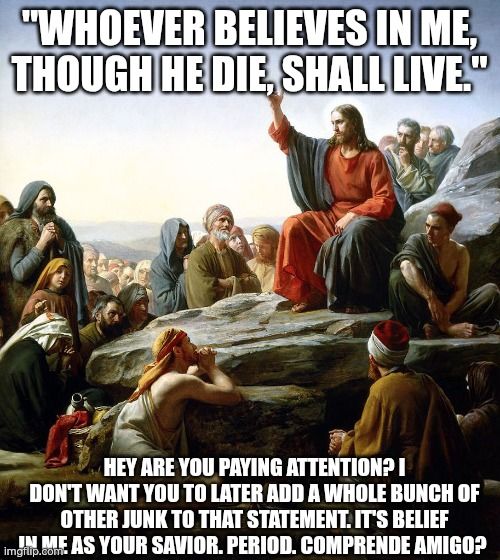
Jesus simply said to his followers the following:
“Therefore, everyone who confesses me before people, I will also confess him before my Father, who is in heaven.” Matthew 10:32 NASB
“He who has believed and has been baptized shall be saved” Mark 16:16 NASB
I am the way and the truth and the life. No one comes to the Father except through me.” John 14:27 NASB
“And you will be hated by all because my name, but it is the one who has endured to the end who will be saved.” Matthew 10:22 NASB
John 10:9 “I am the gate; whoever enters through me will be saved.” John 10:9 ESV
John 11:25 “I am the resurrection and the life. Whoever believes in me, though he die, yet shall he live.” John 11:25 ESV
Other miscellaneous issues:
1.) God made us in His image right? Male and Female. Additionally the whole Father and Son thing helps us understand God and Jesus right? But…the trinity? How can we model a relationship on that? Is that where polyamory comes in? (I jest)
2.) The trinity puts a limit on God. It forces the assumption of this lofty heavenly God that needs another person (Holy Spirit) to interact with our lowly world. God is infinite, and exists outside of time and space. I’m pretty sure He can interact in any way He chooses with anything He wishes. He doesn’t need another person’s help. He doesn’t need a multiplicity to overcome the challenges of a world He created.
3.) The story of God giving the world His only son becomes a perplexing mess.
4.) The Holy Spirit is almost always left out of the debates here. 95% of the debate is around the relationship of God and Jesus. The Holy Spirit was always an afterthought, and is utterly baffling as to how that is demanded to be a separate, distinct, and equal person of the Godhead.
Somehow people also think that by “proving” Jesus was God, that they’ve proved the trinity. That is simply nonsensical. All you’ve done is debatably proved A=B. Where’s C? Does C just auto-populate like some excel table of data when A and B are filled in? The Holy Spirit feels like the third wheel to a power couple.
5.) You simply can’t arrive at the trinity with a trinity-naive plain reading of the Bible. You have to read the trinity back into texts where it is not native, and painstakingly construct this theology with a smattering of disconnected texts.
6.) It seems like every trinitarian verse falls apart on closer inspection, and with a historical context-critical mindset applied.
7.) Since the trinity has to be constructed from many disconnected and unrelated texts, a necessary requirement is the presumption that every author was writing with the trinity in mind. Somehow they are all attempting to convey the same idea such that the desired interpretation is now the required interpretation. The Bible is NOT univocal on just about every issue. Authors writing hundreds of years apart are most definitely not operating with the same mindsets.
Attempts to read the trinity into some OT texts are beyond the pale of logic. Just let it rest guys. 10 verses that are only 10% right, don’t add up to a 100% correct trinity. You just have 10 desperate attempts to see the trinity because you can’t really find it anywhere. 🤷
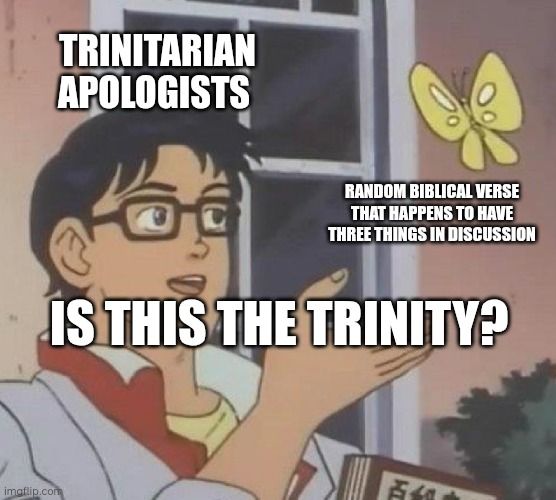
It’s like any time there’s three things being discussed anywhere, a trinitarian pops up and says “hey…you guys talking about that trinity?” (I hear that in a Brooklyn accent for some reason)
OT Author: “No bro, we’re talking about three ingredients to make bread. WTF is a trinity?”
You only undermine your case by reading it into places it very much does not belong! It belies the frailty and unevidenced nature of this doctrine.
Trinitarian Proof-Text Examinations
I’ve tried to use trinitarian theologians as sources wherever possible, for a very important reason. Even among trinitarians there is widespread disagreement on what constitutes evidence for this doctrine. That is….quite a perplexing predicament to be in🤔. Doesn’t that scream “red flag!” to you that maybe, just maybe, this doctrine has roots elsewhere?
Then God said, “Let us make mankind in our image, in our likeness… – Gen 1:26 NIV
Here is what most scholars, even some trinitarian scholars, consider to be a very lacking proof-text. Yet it is constantly used.
The late renowned scholar Dr. Michael Heiser (trinitarian) writes:
“Many Bible readers note the plural pronouns (us; our) with curiosity. They might suggest that the plurals refer to the Trinity, but technical research in Hebrew grammar and exegesis has shown that the Trinity is not a coherent explanation. Seeing the Trinity in Gen 1:26 is reading the New Testament back into the old Testament, something that isn’t a sound interpretive method for discerning what an Old Testament writer was thinking. Unlike the New Testament, the Old Testament has no Trinitarian phrases (e.g., “Father, Son, and Holy Spirit”; cf Matt 28:19-20). The triune godhead idea is never transparently expressed in the Old Testament. Since…other references to divine plurality involve divine beings who are lesser than Yahweh, we must be careful about attributing the language of divine plurality to the Trinity. Doing so will get us into theological trouble in other passages.”
Furthermore, this verse does nothing to establish the co-equality, co-eternality, or co-omniscience of this supposed trinity, let alone suggest, much less demand, a statement of “in-the-same substance.” It does nothing to establish the integer value of “us” as three.
This passage is simply referring to the divine council. This is a concept referred to in other portions of scripture with very clear non-trinity persons in reference.
Hear, O Israel: The Lord is our God, the Lord alone – Deut 6:4 NRSVUE
I use the NRSVUE as it contains less inherent trinitarian bias, and in this version, you can see the plain meaning of the verse. The Lord alone is the God of Israel. However, in many KJV related versions it says “The Lord our God is one.”
Paul Sumner (masters of Arts in the Old Testament from Pepperdine University) sums up a lengthy exposition on this (Source) with the following:
“There is no internal evidence in the Hebrew Bible that any generation of Israelites understood the Shema as a reference to a compound unity in the Godhead.” [The Shema is the name given to this short prayer]
It is irrational to conclude that Jesus meant a plural entity in Matthew when quoting Deut 6:4 in speaking to an aggressively monotheistic audience of Jews. This same audience would surely misunderstand His words if He intended this to mean a plural entity, and He provides no additional elaboration. He does not infer Himself as part of this “one” or mentions the Holy Spirit. He does not infer anything of co-eternality or co-omniscience. There’s really nothing here.
John 20:28 – “My Lord and My God”
In the book, “Concessions of Trinitarians”, German scholar Micahelis (a trinitarian) postulated this:
“I do not affirm that Thomas passed all at once from the extreme of doubt to the highest degree of faith, and acknowledged Christ to be the true God. This appears to me too much for the then existing knowledge of the disciples; and we have no intimation that they recognized the divine nature of Christ before the outpouring of the Holy Spirit. I am therefore inclined to understand this expression, which broke out in the height of his astonishment, in a figurative sense, denoting only “whom I shall ever reverence in the highest degree”…Or a person raised from the dead might be regarded as a divinity; for the word God is not always used in the strict doctrinal sense.”
Thomas was saying “god” here (lowercase “g”) as we have numerous accounts of where angels and even humans were referenced as though they were God.
He was probably expressing his amazement and encouragement in the faith at the sight of the resurrected Jesus. This would let this verse fall well inline with the rest of scripture and make sense with Thomas as a Character.
Finally, we again lack the Holy Spirit, an equation of oneness, or any of the co-necessities, so derivation of this doctrine is not feasible.
Then I heard the voice of the Lord saying, “Whom shall I send, and who will go for us?” And I said, “Here am I; send me!” – Isaiah 6:8 NRSVUE
A very strange choice for a proof-text, yet it is used regularly. This is simply the heavenly council and an argument for the trinity here becomes theologically problematic, as clear non-trinity members are in reference within this broader passage. It doesn’t mention oneness in essence, any of the co-necessities, or describe the number of “us” either. It’s a tortured argument to find oneself in. (See Michael Heiser’s reasoning on Gen 1:26)
Go therefore and make disciples of all nations, baptizing them in the name of the Father and of the Son and of the Holy Spirit – Matthew 28:19 NRSVUE
This is probably one of the stronger verses for the trinity in a way. I mean it has three things listed right? Sure. Are they declared one in the same substance? Are they declared co-equal, co-eternal, or co-omniscient? Are they all called God? All no.
The disciples must have thought this of little importance as well, as in the four examples of baptism we have after this, the disciples are not following this directive. They are simply baptizing in the name of Jesus.
Some say the Greek “name” being singular is indicative of a three-in-one God, but this is poor exegesis, with the desired conclusion driving the interpretation. Name as a singular reference can refer to multiple things that are not one in the same. We have a few instances in the Bible where a singular “name” refers to multiple humans.
It’s also plainly evident within the rest of Matthew’s verses that he understood no such doctrine or relationship. I think people often overlook context like this to suit their desired view.
Finally, some say being baptized into something, must necessarily mean that thing is God. However in 1 Cor 10:2, the Israelites were baptized into Moses, who was most decidedly not God.
Ultimately this provides no firm foundation to build a doctrine around, even if it has some curb appeal.
2 who have been chosen and destined by God the Father and sanctified by the Spirit to be obedient to Jesus Christ and to be sprinkled with his blood:
May grace and peace be yours in abundance. – 1 Peter 1:2
This does talk about three entities…debatably. (Spirit here can be easily interpreted as a non-entity) it doesn’t talk about them being one, or having the co-necessities, etc.
What I can’t understand is why people choose this. Doesn’t context matter? Literally in the very next verse we have:
“Blessed be the God and Father of our Lord Jesus Christ!” – 1 Peter 1:3
Peter says Jesus has a God and Father. That is quite clearly excluding Jesus from both of these categories. (This isn’t to say Peter doesn’t recognize Him as divine in some way, just not the God)
In verses 1 and 2, Peter is simply giving a greeting and describing three independent things. Like if I said, “may the winds be at your back, your cup full, and your spirits high.” That’s just a phrase and in no way is me equating all of them as equal. Clearly in the context of the rest of Peter’s writings this is obvious.
But if I do them, even though you do not believe me, believe the works, so that you may know and understand that the Father is in me and I am in the Father.” – John 10:38 NRSVUE
This is only speculatively supportive in isolation, as elsewhere in John 14:20 it says “In that day you will know that I am in my Father, and you in me, and I in you.” This John 10:38 verse drives no trinitarian concept unless one demands it.
Heinrich Meyer’s commentary on the New Testament (himself being a trinitarian) makes clear that one should not equate this “in” as the essential trinitarian oneness, as contextually that is problematic. It should therefore be interpreted as a dynamic and reciprocal fellowship style relationship, as would be sustained in human relationships. This same phenomenon happens previously with John 10:30. Here, Jesus and God are called “one” and the disciples are called to be one “in the same way” as God and Jesus. Eventually, Jesus, God, and the disciples are all called “one.” Contextually it is problematic to derive a one-in-the-same substance trinity from this.
There’s no Holy Spirit here and no mention of the co-necessities. There’s just nothing really to build a doctrine out of.
who, though he existed in the form of God,
did not regard equality with God
as something to be grasped, – Phi 2:6 NRSVUE
In this verse when it says “existed in the form of God” might lead one to think that Paul thought Jesus was actually God. But that’s not what this is saying (and if that was Paul’s intention, he would’ve just said it!)
Morphe, the Greek word for form, is describing the outward appearance or characteristics of something. That is what our lexical data for this word provides us with. Historical usage also backs this up. Paul is saying that Jesus was in a divine form, like a god. He represented God’s will and desires for us. He was not attempting to say that Jesus was actually God.
Professor and scholar David Fredrickson, in his commentary on Philippians, remarks this would be more appropriately translated as “In the form of a god.”
We know this just by reading a little bit further.
9Therefore God exalted him even more highly
and gave him the name
that is above every other name,
10 so that at the name given to Jesus
every knee should bend,
in heaven and on earth and under the earth,
11 and every tongue should confess
that Jesus Christ is Lord,
to the glory of God the Father.- Phil 2:9-11 NRSVUE
This shows us three things.
1.) Jesus is being exalted and given something by God. This is a subordinate role in this relationship. The only one who has authority to bestow the “name above every other name,” is the being above every other being, God.
2.) Paul is aware of the significance of this bestowing of the divine name, even if he perhaps misunderstands the timing of it. In other texts, Jesus was given this name prior to coming to earth. Paul came to understand who Jesus was post-resurrection, and therefore likely thought it was at the resurrection where God bestowed that name upon Him.
3.) God is specifically differentiated from Jesus here and is the one exalting His son. God is also the one ultimately receiving the glory.
To assume Paul is attempting to call Jesus God here, is to ignore literally all of Paul’s other writing, as that context clearly conflicts with this idea.
Conclusion
This doesn’t comprise all the texts that people use to support the trinity, but we certainly covered some of the greatest hits.
I’ve run out of desire to explore this concept any further. It’s clearly not a requirement for salvation. That’s really all I care about…not what some people conjured up over a 400+ year span.
It’s genuinely OK to accept not knowing how it all works. One can plausibly understand how things most likely don’t work, while still not understanding exactly how things do work. Does that make sense? I don’t know exactly how God relates to Jesus. I know what the vast majority of scripture suggests as a relationship dynamic, but how exactly that “works?” One can make a reasonable guess, but I do know for myself that on balance, the trinity does not fall under the umbrella of “reasonable.”
Here’s some more James White to close us out.
But as these, and every other requirement peculiar to the gospel, are all embraced in the faith of Jesus, it is evident that the commandments of God are not the sayings of Christ and his apostles. To assert that the sayings of the Son and his apostles are the commandments of the Father, is as wide from the truth as the old trinitarian absurdity that Jesus Christ is the very and Eternal God. (James White, August 5, 1852, Review & Herald, vol. 3, no. 7, page 52, par. 42)
As fundamental errors, we might class with this counterfeit sabbath other errors which Protestants have brought away from the Catholic church, such as sprinkling for baptism, the trinity, the consciousness of the dead and eternal life in misery. (James White, September 12, 1854, Review & Herald, vol. 6, no. 5, page 36, par. 8)
The greatest fault we can find in the Reformation is, the Reformers stopped reforming. Had they gone on, and onward, till they had left the last vestige of Papacy behind, such as natural immortality, sprinkling, the trinity, and Sunday- keeping, the church would now be free from her unscriptural errors.”(James White, February 7, 1856, Review & Herald, vol. 7, no. 19, page 148, par. 26)
Peace
 Space For Doubt
Leave a reply to Biblical Mythbusting: A Repository of Greatest Hits – Space For Doubt Cancel reply