

The last two months have been less-than-inspiratory. In fact it’s been a theologically tough time. The radio silence on this platform is evidence of exactly that. (Well…that and two kids + a busy phase of life making free time non-existent!)
It’s become clear that the very foundation of the primary theological evidence we have today (Authorship, accuracy, and inspiration of the Bible) is significantly less robust than one may wish it to be.
That lead me into thinking about inspiration and canonization.
What does inspiration mean?
Really stop and think about it. Let’s explore the range of what inspiration could mean.
- Does it mean that God is putting vague ideas into an author’s mind? Then this same author had to come up with their own language to describe it?
- Does it mean the author had a good idea on their own, but then the God gave them the motivation and words to write it down?
- Does it mean God is literally taking physical control of the mind/body so that the pen composes text that is completely 100% divine with no human input?
- Does it mean that the author was sometimes truly unaware of the symbolic or even literal meaning their writing conveyed? And that this information was kept a secret until future generations “figured it out?”
- Does it mean an author was given a thought and language with which to write, but was not kept from adding their own flourish and details?
We could explore possible levels of “inspiration” to no end. Maybe it’s some combination of all-of-the-above? Are all authors inspired to the same level? (If that’s true….then we’ve got a LOT of issues)
What about canonization?
This is another interesting topic to delve into. Many don’t know the history of how the books of the Bible became canon. They think it was this mysterious and succinct divinely led process. In reality it was a highly debated (for centuries) process of deciding what to include/exclude. There are even branches of the church that still disagree on what’s canon. I should probably write more on the canonization process later, as that deserves its own post. A cliff note version of my take is, it doesn’t appear to have had much in the way of divine fingerprints.
In light of a developed canon, the question then arises of what do we do if we find via manuscript discoveries that something in our Bibles today wasn’t actually part of the original text? After all it is canonized. (Ex. The ending of Mark*) Do we remove it?
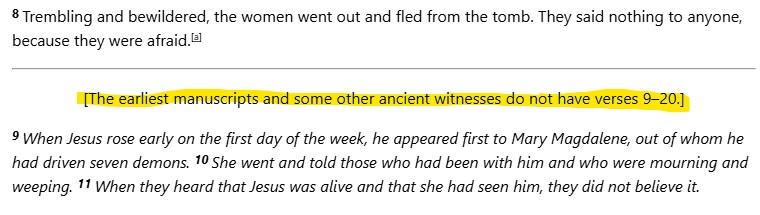
*Our oldest manuscripts have Mark ending at 16:8. It appears later in the mid-2nd century that several new endings to Mark were composed. The primary one being what is found in our Bibles today. The evidence is pretty strong for this later alteration and has widespread acceptance.
What about the reverse scenario? What if we find (Ex. Psalm 151a and 151b)* a text that was indeed part of the original, but got lost temporarily and was NOT canonized. Do we go back and include it?
*A dead sea scroll discovery has provided two additional short psalms (today called 151a and 151b) that were mashed together as Psalm 151 in some copies of the Septuagint. It is missing in the Masoretic Text that our modern Bibles are based on.
What about texts that left out a whole paragraph of the original story, likely due to a simple scribal mistake? Do we go back and insert it to help the story make sense, or do we go with “welp….God inspired this half-baked story as we have it, and those extra verses aren’t important!” (Ex. Dead Sea Scroll 4QSama and the story of Nahash*)
*In 1 Samuel 11:1-11, we see an abrupt change to this unknown and unexplained character, Nahash. We aren’t given any background to what’s going on. However in the Dead Sea Scroll 4QSama, the story has several verses worth of introductory information to Nahash and help explain what’s going on in this story.
What about verses that, in our oldest manuscript evidence, vary significantly from what is in the Masoretic Text (MT) our modern Bibles are based on? (See Deut 32:8-9*). The meaning greatly changed from our oldest source. Is it only the canonized version that is “authoritative?” What does that say about inspiration then? Was the original author not inspired but the later redactor of that passage was? Did God make a mistake in the first version and had to correct Himself?
*I’ve written about this before on this blog, but the original version found in the Septuagint and Dead Sea scrolls portrays a very polytheistic theology. El, the most high, sits at the head of a council of gods. YHWH was a 2nd tier god to whom El granted the inheritance of Jacob as His people.
El and YHWH were viewed as two separate deities for quite some time before they were merged together. YHWH superseded El as the supreme God of Israel. Later scribes attempted to harmonize this history and altered this verse in the Masoretic Text to reflect their new henotheistic theology.
For my SDA friends, how does that land with Ellen White and her visions? Are some of her early visions (that contradict either later visions or written statements)* incorrect? In other words, did God make a mistake in that early vision? Was that early vision just purely hallucinatory in nature and not revelatory? After all it turned out to be “wrong.” How do you reconcile that? Could not God have just went ahead and given her the correct vision from the jump?
Seriously…think critically about that. Does that sound like God or does that sound like human fallibility? Does that sound like the Holy Spirit or the imagination of a mind saddled with a traumatic brain injury?
*Just one easy example: EGW originally rejected the doctrine of the trinity. (as did all other SDA founders) Much later in life she eventually was swayed into believing in it. However her early visions contained scenes of heavenly interaction incompatible with a trinitarian doctrinal view. Are these visions wrong? You can’t have it both ways. Either you believe in the trinity or you believe Ellen White’s visions were all inspired. Have fun squaring that circle.
The more one learns about how the Bible was composed, the more light is shed on the process of translation and canonization, the more informed one is on authorship of the Biblical books, the more reason there is to have significant doubts on just what is inspired. Textual scholarly majorities (and usually super majorities) have a few interesting conclusions on the Bible.
- The Pentateuch was not written by any historical Moses, and is composed by at least four authors, but likely redacted and changed by dozens more over the centuries
- The Davidic story arc is filled with redactions and rewrites by later authors out of loyalty to his lineage
- Isaiah is written by at least two authors in two very different time periods
- Daniel is written by at least two authors in two very different time periods
- Half of the Pauline letters are almost certainly not written by Paul
- Ironically the very book that contains the proof text for the modern concept of inerrancy, comes from a book most scholars view as a forgery (2 Timothy 3:16)
- Peter did not write 1st and 2nd Peter
- None of the gospels are eyewitness accounts, and are anonymously written
- John the apostle did not write the gospel of John, or 1/2/3 John, or Revelation
- Hebrews wasn’t written by Paul
An example of unlikely authorship
Let’s look more closely at Peter and John. In Acts 4:13, Luke writes the following:
“Now as they observed the confidence of Peter and John, and understood that they were uneducated and untrained men, they were amazed, and began to recognize them as having been with Jesus.” Acts 4:13 NASB20
Something interesting is being said here, and is masked by our English translations. Let’s look at the original Greek.
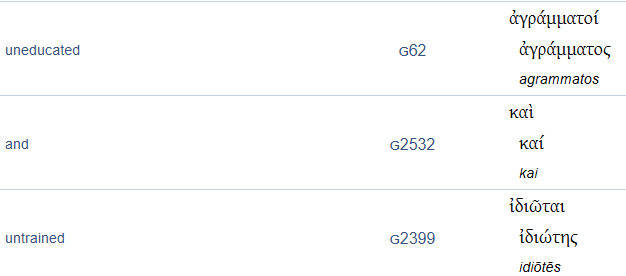
Let’s look at the meaning of the Greek words rendered “uneducated” and “untrained” in English.
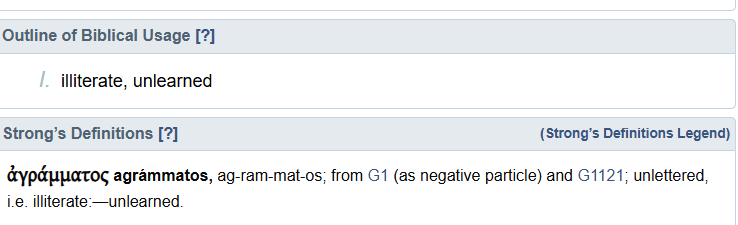
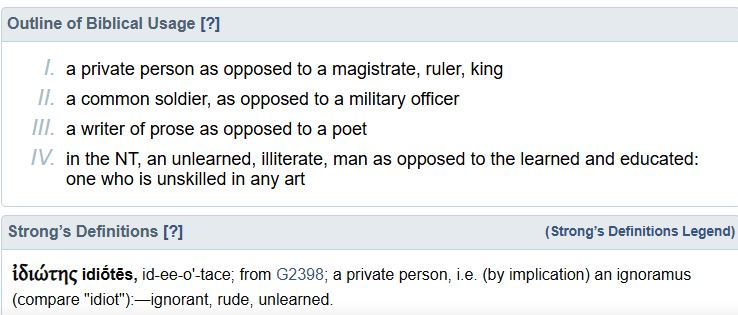
Luke is throwing some shade on the apostles Peter and John. He’s literally saying these guys don’t know their words. I.E. they are illiterate. They cannot read or write. They are also…well…called idiots! We get our modern word “idiot” from this Greek word. They clearly had confidence, personal knowledge, and spoke with conviction, as this resulted in them being recognized as having been with Jesus. Nevertheless, they are identified as illiterate and uneducated by the elders, teachers, high priest, and others listening.
Knowing about the illiteracy and ignorance of John is important because the gospel of John is written in very high level Greek. Both in terms of complex literary devices/ideas/poetic imagery, but also in the very vocabulary itself. This book isn’t the everyday Greek language equivalent of your neighbor Bob’s email to the city complaining about construction around his house. This is post-doctorate level writing by an accomplished well-educated, reasoned, and proficient writer.
Many want to claim “well…it doesn’t matter because these apostles just dictated their testimony to a scribe who was writing for them.”
That doesn’t really pass the smell test either.
What you’d be claiming is essentially this: An uneducated hillbilly dictated Shakespeare to a scribe. Sorry. That’s not how that works. A scribe hired for that purpose is just writing down exactly what you’re saying.
Someone who’s an idiot, who cannot read or write, and who is uneducated, is not going to convey the developed ideas and literary fluency found in Shakespeare. Likewise the apostle John (if Luke is to be believed) is not going to be dictating the high level literary koine Greek found in this gospel. If your answer is “well the Holy Spirit can do anything” then I guess we’ve abandoned the need to let the Bible speak on its own terms. Instead we’ve adopted the post-biblical idea of gospel attribution as fact and ignored any evidence to the contrary. We’ve let “faith” (See also: dogma) absolve us of any duty to seek objective truth.
A scribe is not going to take a basic phrase, and spice it up with nuance, context, metaphor, and poetic imagery. That’s not how that process has ever worked in all of recorded history. A scribe doesn’t upgrade backwoods Joe’s speech to accomplished academic status, especially when in all likelihood, that same scribe themselves probably lacked the ability to write at such a high level.
Through critical scholarship and historical context/evidence, more than half the NT is, at the very least, not written by the people it is claimed to be written by. I’m not saying the information is inherently bad or false without examination, but how should one handle the concept of forgery?
Do you say “Ok, well this isn’t written by that author, but we can still trust it.” Doesn’t that seem…..odd? If it’s not written by who we “trust,” and was written in many cases as much a century after tradition holds (or several centuries in the case of Daniel), then what are we doing here?

We’ve moved the goal posts of textual authority from trust in the authors, to trust in the canonization process. After all if God was leading the process we can trust it to have included everything correctly…right?
We’ve effectively claimed that God didn’t mind authors writing forgeries, and indeed used them to convey His intended message. These writings were then captured during this torturous canonization process. There were dozens of other works that were excluded during this process. Some of these were viewed by 1st century Jews as inspired scripture (see the book of Enoch). Jude literally quotes Enoch, yet that book was eventually rejected. (For what it’s worth SDAs, EGW routinely dips into rejected apocryphal writings for her source material *shrugs*)
This topic makes me think of certain post-biblical doctrines like the trinity or the SDA eschatological views. It’s quite evident that neither of those two things were understood by any author of any book of the Bible. Yet the claim by fundamentalists is often “well the Holy Spirit led them to write things that they themselves didn’t even understand.”

So this Holy Spirit can influence the author of a biblical book to convey symbolic or literal meaning that the author themselves didn’t understand? Yet this same Holy Spirit:
- Left out chunks of original scripture (texts that help someone understand a story)
- Allowed later fraudulent additions to the texts (prior to canonization)
- Allowed clear and obvious errors
- Allowed clear and obvious internal disagreements
- Allowed embellishment and sometimes even whole-cloth forgery
- Left out explaining things like the trinity to the apostles, which seems like quite the oversight if you ask me. (Ok maybe don’t ask me as I don’t believe in it…so that lack of explanation actually does make sense to me 😉)
Are we living in the same reality?
It’s amazing how the Bible, in all its ambiguity, always results in matching up with one’s preferred dogmas. All the thousands of denominations of Christianity each claim scriptural authority behind their doctrines, yet undeniably there are massive differences in those doctrines. Yet they are all based on the same Bible.
When you demand that the texts are all uniformly inspired to an “inerrant” level, and a framework of univocality is imposed on the text, you no longer care about what the authors were actually trying to say. You only care about what YOU demand they say.
More dangerously, when a book as notoriously unclear as the Bible is taken as inerrant and univocal, it sets up your preferred institutionalized religion as the arbiter of the authoritative meaning of that unclear text. In short these doctrines are actually just a power-structure preserving technique rooted in the desire to maintain adherence and obedience.
When people stumble onto (intentionally or not) evidence that undermine those doctrines (inspiration, inerrancy & univocality), they may ask “How does any of this make sense?”
Unfortunately what usually happens at first is a tsunami of bad apologetics thrown their way. This may satisfy some. For those who see through that, and still demand a proper explanation, the answer is often (paraphrasing) “Shut up. Doesn’t matter. Get on board with our orthodoxy or get lost.” And to be clear they often mean this literally. Many believe you’re “lost” and do not have salvation if you go poking around like this. This is only evidence of your “lack of faith.”
When all along the quest has been for truth, is it any wonder that those who question can be rubbed raw and turn completely away from the faith in the face of attitudes such as that?
An approach to viewing scripture as unequally inspired (or even uninspired) and not inerrant doesn’t immediately invalidate everything you believe. It just means you need to think critically about what the text is saying. Does it make sense with a loving God? Does it make sense with reason, with logic, with the historical/societal context? On a more basic level, does it even make sense with the rest of the Bible as a whole? Is it even relevant at all? Are we historicizing myth? Are we mythicizing history?
The big upside to this, is that you can simply take a breath and relax when you come across clearly altered/added/missing information or something truly heinous. You can say, “Well that was a weird thing I just read. I don’t think God had any hand in that bit.” Then you can simply move on with your life. You don’t need to invent a whole slew of tortured arguments attempting to harmonize what you’re reading with internal biblical disagreements, errors, illogical stories/statements, etc.
The downside is, it truly requires you to think critically. Deeply. Intensely. It requires coloring outside the lines and being willing to engage in scholarship, debate, and research. It will require giving up some things….but I can promise you what you gain is far better.
Here’s to moving on with life.
Peace


Leave a Reply