

Something also felt off about only having two posts addressing the trinity🙃. Here’s the completion of the hat-trick. After this one I’m done. I promise! 😉
A quick note. I’ve made a lot more space recently for the trinity. It is one of the possible ways to define God, and I get the appeal. I don’t believe this theology is toxic or harmful in any way. People should be free to believe what they want. I personally can only believe what the evidence reveals as a reasonable conclusion, and for me, the trinity is not that.
Troubling Trinity
Stick with me on this one. It’s going to seem a little silly, but we’re going to walk through the trinity’s mechanics.
The trinity has three “Whos” in one “It” and the 2nd Who has two natures. Prior to the incarnation this 2nd Who only possessed one nature. The three Whos talk to each other, but they don’t need to talk to each other…but they do talk to each other.
They all have the same knowledge, but yet somehow also don’t have the same knowledge (Matt 24:36). They confer and discuss things, yet have the “same” will, desires, and omniscience. Scripture says the 2nd Who had a will that differed from the 1st Who prior to coming to earth (John 6:38), but let’s not get caught up in disagreement so soon!

The 2nd Who, with the two natures, is now permanently stuck in a physical form. On the cross, only the human nature of the 2nd Who died, and His divine nature kept on living (as God cannot die…1 Tim 6:16). This human nature, which scripture says conflicts with the divine nature (Luke 22:42), was actually always in perfect harmony with the divine nature (just ignore that scriptural conflict too I guess). This 2nd Who was resurrected with a new “glorified” physical body, now permanently containing both the human and divine natures. However, now this human nature is in complete harmony with the divine nature. (Even though it always was…but now it’s like…double extra super harmonious or something)
The physical body of the 2nd Who is now perfected, while still bearing the imperfection of the scars of the crucifixion for some reason (John 20:27). As if that’s something still necessary. Was there this fear that one would get to heaven, meet the heavenly trio, notice Jesus’s hands and feet lacking scars and go “Hey just a minute. I don’t see any scars! You fooled me! Send me to hell!”
All three Whos are all theoretically equal but functionally not. The 3rd Who serves the 1st and 2nd Whos, and the 2nd Who is both subservient to the 1st Who and supervisory to the 3rd Who. (But don’t worry, a new theology was invented to explain this was a voluntary subservience and not an inherent natural one. After all, how can you be inferior or superior to yourself right?)
The Whos can’t exist without each other, have perfect unison, and identical wills, but also for some reason take different voluntary roles of submission and/or authority. Despite this, in theory, any particular Who is capable of fulfilling the role of any other Who, yet they functionally don’t (and can’t)…what with the whole physical body thing and all. The 1st Who is still the authority in charge (John 10:29, 1st Corinthians 15:28), but don’t let yourself think they aren’t all in charge!
The entire “It” (Supposedly comprised of the three Whos) would kill any human who sees It (Exodus 33:20), yet the 2nd and 3rd Whos can be present and visible, and the humans will survive. This is a perplexing situation as all three Whos are supposed to be part of It. Trinitarians love to claim that “God” in the Old Testament is the trinity. Unless that is inconvenient….like here. Then it’s of course not, and obviously only the 1st Who that is the killing-on-site Who. Yet this 1st Who doesn’t have a physical form to see…but apparently has a face? There’s good news though, as we can see the 3rd Who (also no body) and not die. Yet all of the Whos have the same powers and authority.

Is that confusing enough yet? That’s the trinity folks. We could keep going. This doctrine is almost unendingly complex……

It doesn’t make sense because it’s not built on sense. It’s built to harmonize the entire Bible, replete with many disagreeing ideas, into a single agreeing united voice.
The doctrine is built on the assumption that each author is perfectly and equally inspired. It’s built on the assumption that each author was writing with the trinity in mind. It’s built from Greek philosophical thought and ideas. These ideas were the conclusion sent in search of a scriptural argument, and then expanded to make that argument work, no matter how illogical the argument was. Many new theological and philosophical inventions are needed to harmonize the many scriptural issues created by these assumptions.
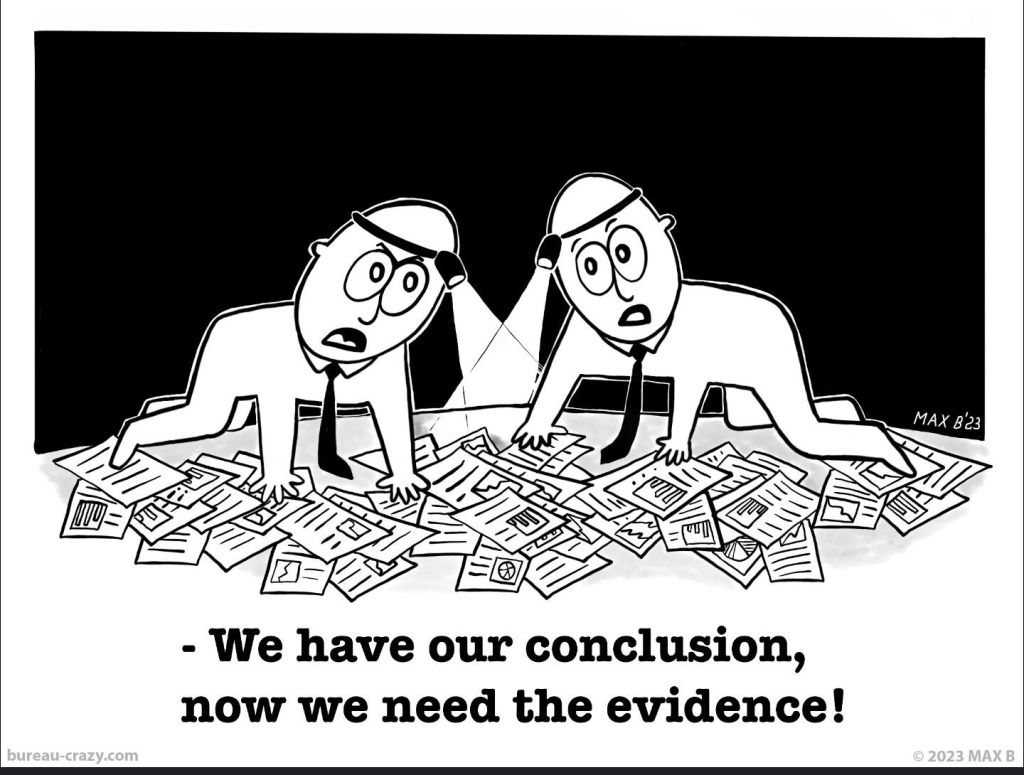
The idea of three persons in one being was developed somewhat earlyish in the doctrine’s history (Late 4th century-ish CE), yet problem after problem was encountered. Each time they came to a scriptural dilemma created by their doctrine, they built ever more complicated Rube-Goldberg-like theologies in order to keep this Macgyvered ship afloat. To this day, there exists fringe debate around yet additional doctrinal developments to smooth over the remaining rough edges.
Basically, about 1800 years ago, people got confused. They refused to ask logic and reason for directions and instead turned towards Greek philosophy and poor assumptions for answers. They scoured the Bible and amassed a collection of disconnected texts, that when smashed together and taken out of context, could be a patchwork foundation that “revealed” these Greek ideas as natively present. They then defended to the death (literally) that doctrine.
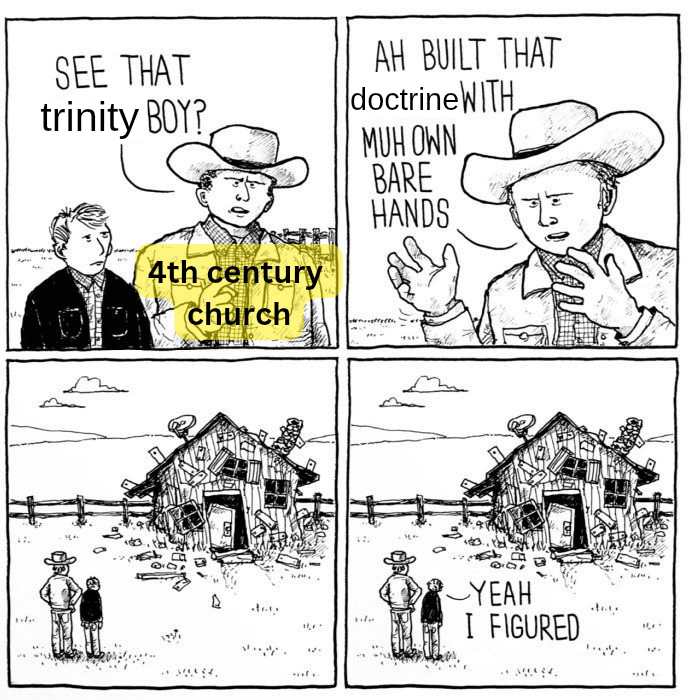
Today people get doctorate degrees in defense of this man-made framework. They stake everything on defending this human invention. They deem heretical anything that isn’t their currently defined dogma. For posterity, let’s be clear that this dogma changed a few times over history. Therefore, what was considered heretical changed numerous times too. (This moving target of what is considered heretical has been a real challenge for the heretics. They could, on accident, find themselves in the accepted orthodoxy camp. I kid…but it’s not a totally wrong historical view!)
It’s bizarre. And all of this confusion is wrapped up in the shiny banner of “mystery.” Best just not question it they say, as that would be an attempt to peel back the mystery of God. And that friends, is not allowed. Apparently the only way for God to remain mysterious is for Him to be declared a trinity, and for us to not question it. [Insert sarcastic TV Infomercial voice] There’s no other way for Him to be mysterious! [End sarcasm]

I think what really grinds my gears about this doctrine is the bad apologetics. The apology bros fist bump each other and say “Look at our new (out of context) reinterpretation of a clearly monotheistic old testament text that reveals the trinity!” (Narrator: “It actually didn’t do that at all.”)
In truth, deep down inside, the apology bros also don’t really understand it. There’s these hesitant side glances saying “are we ok with this not making sense?” Hence so many proclaiming “it’s a mystery!” and “If you think you understand it, you don’t!” These are simply self-reassuring comfort statements made by the confused.
If they can all hype each other up enough on the topic, they can be comforted in their puzzlement as they’re part of the in-crowd. The in-crowd has the majority on this, so that must mean they’re right. Just ignore the fallacies, the paradoxes, the puzzlement. It’s ok to not understand because it’s a mystery. It’s what’s been done for over a millennia, and we can’t change it now!
Paradox Party!
Let’s talk about two thorny issues. The idea of the atonement sacrifice and temptation.
First off, as a parent, if my child commits a grievance against me, I can simply forgive them. I don’t need a sacrifice to do that, but let’s put that moral issue aside for now. That deserves further and more in-depth discussion in another article.
With the trinity, God is literally sacrificing Himself, to Himself, to save us from Himself. And that sacrifice isn’t even real. I don’t mean that to sound sacrilegious, but seriously…think about it. God can’t die. (God alone is immortal – 1st Timothy 6:16) Sure Christ’s “human” nature could die I suppose, but He never truly died if He was God. The sacrifice meant nothing if God didn’t really die right? It was just a show. Like Ultron in the Marvel Universe, He just uploaded Himself to the cloud, and then downloaded Himself back into His shiny new(ish) body.
What’s the point in that? That’s like me giving my money to myself to pay a fine you owe me (as you can’t pay). It was never a sacrifice on my part. That money originated and stayed within my control the entire time. The sacrifice here would be me forgiving your debt and not gaining the financial increase of collecting the fine. That’s a sacrifice. Or…and hear me out here….a truly third party (not literally God) was the sacrifice. Perhaps a Son of God might do? I feel like I might’ve read that somewhere…. 😅
God also cannot be tempted. Sure, Jesus had His human nature and that was what suffered temptation right? But if the human nature was always subject to His divine nature (which is perfect and untemptable), then was it really ever a temptation in the first place? (God cannot be tempted – James 1:13)
Imagine I, as a stronger and more authoritative person than my son, keep my son from actually acting on any temptation he encounters by my continual presence by His side. If I minister to him and keep him shielded from the temptation by my will, then how does it make sense that he would have ever been capable of falling into temptation in the first place? The human nature must have the ability to overrule the divine nature, otherwise temptation is no temptation at all.
Yet in the trinity doctrine, Jesus’s human nature is always subservient to the divine nature. It cannot over-rule the divine nature. Therefore temptation is impossible. To sin would be impossible. This remains yet another logical contradiction of this doctrine. (“One who has been tempted in every way, just as we are” – Hebrews 4:15) Last time I checked, I didn’t have a divine will that kept me from sinning or from being tempted. *shrugs*
Three fundamental issues.
1.) If the trinity was true, it wouldn’t need 500+ years to reach a mostly completed doctrine. It wouldn’t take another 1200+ years to continue fleshing out the minutia of doctrinal details, with some remaining unclear and unresolved today. During the research of my articles on the trinity, I found several disagreements on how the trinity works among trinitarian theologians of different denominations! I abandoned an analogy I wanted to use because it didn’t work with some versions of the trinity that are out there. This doctrine is so complex, that some of these deep-in-the-weeds doctrinal minutia vary between denominations of Christianity.
If the authors of the Bible understood the trinity and thought it was true…..IT. WOULD. BE. OBVIOUS. They would emphatically proclaim it. They would celebrate it. They would talk lovingly about the “beauty” of it. They would go on and on about how Jesus was actually God. All of them would. It would be the most exciting thing for them to talk about.
Yet, they don’t. They are under no such understanding. They speak no such thing. In many places they declare quite plainly that this is not the case. They are a strict monotheistic audience. (well…technically they were monolatrous, but that’s another discussion)

2.) If the trinity was true, and the Bible was indeed “clear” and the evidence “overwhelming,” then people would not need to fabricate a verse later around the end of the 4th century to support the doctrine (Google: Johannine Comma). This would’ve been right in the thick of the debate and would be a very convenient verse to have suddenly appear.

These terms “clear” and “overwhelming” are often used by trinitarian apologists in describing the scriptural evidence for this doctrine. Please note how trinitarian textual scholars almost never speak like this (from what I’ve seen). We’re talking trinitarian apologists (theologians) here, not critical textual scholars. The textual scholars will usually admit the lack of foundational scriptural evidence available, and thus present a much smaller quantity of supportive evidence.
In reality these words (clear and overwhelming) are just a front to prime one to see things through that specific dogmatic lens of thought. It’s a tacit confession that actually the text is not clear and the evidence is far from overwhelming. You’ve heard the phrase “every accusation is a confession?” That’s kind of what’s going on here.
When we bought our new house in Nebraska (coming from Tennessee), it was advertised by the owner as them loving “all the storage space.” (Actual language from the realtor’s flyer). In reality that house had far less storage space than our TN house despite having more square feet. Our new house, for the size, actually has relatively little storage space compared to many other houses we’ve seen and lived in. However, the ad was written to prime your thoughts going in that the house did indeed have a lot of storage space. It was mental manipulation to help offset the polar opposite reality.
This is how the trinity is. Apologists hype up all these verses for scriptural support, but then disagree with each other on which proof-texts are actually supportive (see my 2nd Trinity post for more on that bizarre phenomenon). Virtually every text quickly falls apart upon even a cursory fair contextual inspection.
3.) “God is not a God of confusion” (1 Corinthians 14:33). This doctrine is full of logical fallacies, paradoxes, irrational statements, illogical conclusions, all wrapped up into a “mystery.” That doesn’t sound like God. That sounds like men twisting around and messing with things they should have left alone. That sounds like mental gymnastics to force things that are unclear, into being clear, except somehow they just made it worse.
Why the hesitancy to abandon this belief then?
From my earliest formative memories around religion (growing up SDA), I felt deep in my gut some incredible unease with four things. 1.) Young Earth Creationism, 2.) Ellen White, 3.) Scriptural Inerrancy and 4.) The trinity. I didn’t have evidence for why, I just knew something was….off. Looking back I wasn’t even raised with conflicting information that might have instigated those doubts. No, just generally typical conservative SDA beliefs with no exposure to alternate ideas, yet those four things specifically always raised giant red flags in my mind. I couldn’t articulate why until this deconstruction journey, when I began really pulling back the curtain to see what was behind it.
The hesitancy to question, or even abandon the trinity is something I’ve been thinking about for a long, long time. Why this incredible pull, to the point of blind unassailable allegiance? It’s not clear there is any one perfect answer, but there are a few plausible answers I’ve heard.
1.) The fear of committing idolatry. Ironically, unitarians accuse trinitarians of being idolatrous and vice versa. (I’m guessing binitarians might have something to say about both of these groups, but I haven’t researched that at all) Unitarians say three-in-one is a distinction without a difference, and essentially amounts to idolatry. Trinitarians say worshiping Jesus without believing He’s God is also idolatry. Both of these are false in my view.
Idolatry is worshiping something else in place of God, as your new God. Worship is something that applies to God, yes, but also to Kings or other authorities. To worship is, essentially, to ‘honor and respect’. Jesus is a King. So worship of Jesus is not only OK but appropriate. This a common theme of Paul’s, to acknowledge and praise the power/authority/mission of Jesus Christ as Lord, but to defer all glory ultimately to God (even if that glory to God is through the conduit that is Jesus). People in the bible worshiped their kings all the time to no ill effect. (They just weren’t worshiping them as if they were literally God)
In any case, it appears one can’t get through life without being called idolatrous by someone at some point. I’m sure some Christians have accused atheists of making science their God, thus being idolatrous (or some similar wacky accusation).
2.) Abandoning such a long-held tradition runs against what is considered “faith.” We could unpack that in many ways, but it’s safe to say that something being believed by most (but not all…hence the persecution) for a long time, is not a guarantee of correctness. (See: All of human history)
3.) In many people’s minds, this somehow would denigrate or deny Jesus some necessary authority. That is not true of course, because He is still a divine figure. The angel Gabriel had authority and respect of humans. Just because you’re not literally the very eternal, omniscient, and uncreated God, doesn’t mean you’re not divine, authoritative, or powerful.
4.) Some will say Jesus’s sacrifice wasn’t valid if He’s not God. Oh really? That’s an interesting take, as the earliest Christians (and initial SDAs plus several Christian denominations today) somehow still believe(d) this sacrifice was valid, yet did not believe Jesus was the very eternal unbegotten God. Why did humans invalidate Jesus’s sacrifice when viewed through any other non-trinity lens? You can’t come to this sacrifice nullification conclusion via scripture. This one is solely a human-created boogeyman to force doctrinal alignment.
5.) The 4th century (and onwards) church used the weight of empire and intense persecution to enforce the doctrine. This heavy hand of enforcement still echoes loudly today in the rhetoric used. The identity politics associated with this particular doctrine are incredibly strong. To align with anything else comes at a considerable potential cost.
In the end
I resonate with much of the original SDA view of God/Jesus/Holy Spirit. Not because I think they are especially inspired or because it was how I was raised (it wasn’t), but simply because I think it makes the most sense with scripture and reason. However, on some days, I often find myself looking understandably upon the simple elagance of the deist (a whole different ballgame there…I know). My journey has taken me into the universalism camp, where I don’t think God gets offended by much. He has a lot of grace for us all.
I do firmly believe though, that at the end of the day, God is NOT an author of confusion. That title belongs to man alone. What does that mean for the level of inspiration of the bible and its internal disagreements, or the theologies developed from the same? What does that mean for the trinity?
I’m grateful to live in a time where each person can decide that for themselves, without the fear of death if you choose “wrong.”
Peace
 Space For Doubt
Leave a reply to Annual Blog Reviews – Space For Doubt Cancel reply