

Imagine your child is a student at a local school. It’s a large and diverse school, but the only one in the area.
This school has no rules, at least none that are enforced anyway. The kids hit each other, destroy school property regularly, and some have even died. It’s a real train wreck.
You go to a parent teacher conference in hopes of correcting this. The principal declines to attend. In fact you’ve never actually seen him. You only know he supposedly exists. You are told “Don’t worry. He is in control.” of the situation by the rest of the school’s administration.

Would you respond with “That sounds right. I believe that“?
It stands to reason you’d probably not have much in agreement on that. You’d take matters into your own hands, take your kid out and move, involve law enforcement, or some other escalatory action.
You’d hold that administration accountable to more than just nice comforting statements.
There would be pressure on them to change this terrible reality with immediate and definite action. You wouldn’t accept the excuse of “The principal is in control.” You wouldn’t tell another parent “I believe the principal is in control, thus don’t worry. He’s got it all handled. We can keep sending our kids here…no worries.“

As our society gets more polarized and descends into what I can only call end-stage capitalism, this common statement is haunting us all. Many churches are saying phrases like “let go and let God” or “trust God’s plan” or “Follow God’s leading” or “God is in control, don’t worry.”
Tell me, and explain it to me like I’m five, how does that work any differently than what a Christian might already be doing or believing?
You pray? Check.
You trust God? Most of the time…yes.
You try to make good choices? Yep.
You consult with other wise people? You bet.
What else is someone supposed to be doing or believing?

Anytime I hear someone say these phrases, I try to pin them down to explaining in detail how this works. You know what I always get as a response? A deer stuck in the headlights face of confusion, as they’ve never thought about what that practically means. They can’t articulate anything beyond general 30,000ft-level vague language.

What does “Let God take control” or “God is in control” mean here and now? Does it mean not trusting your gut? Does it mean not making any decisions until you feel “moved” or “called?” Does it mean ignoring your feelings or pretending everything is fine? Does it mean not taking actionable steps to improve your life or those around you on your own initiative and intelligence? Does it mean nothing bad will happen, and everything that does happen is God’s will?
Use actionable, real, definite language.
You have some anxiety? Ya we all do. That doesn’t mean you’re not trusting God. That means you’re human. Trust in God does not equate with zero anxiety. That’s a disastrous belief that will only result in trauma. Your future therapy bill will directly correlate to how deep you believed in this.
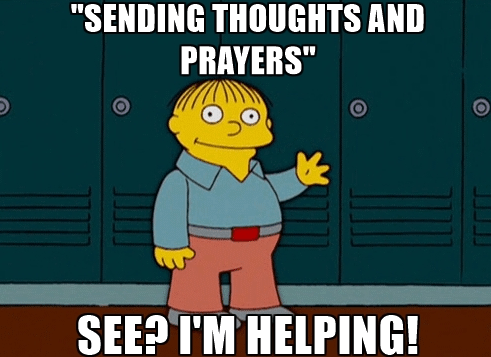
As such, to tell someone struggling to just “trust God is in control“ is about as helpful as the “thoughts and prayers” crowd is to reducing school shootings.
Imagine you created a universe where you were in control of everything as a loving deity. Is our current world anything like what yours looks like? This world of pain and suffering? Does that check the box of “Yep. Looks good to me!“

When we have a book as unclear and misinterpreted as the Bible used as a life guide, and the general assumption that a heavenly deity is “in control” (yet almost never reveals itself in clear direct ways), the only method for interpreting divine will remains the church. And that matters. That sets up the church to be the arbiter of truth against the indiscernible gray of life. It also sets up God to viewed as a “failure” by everyone who believed that statement.
A Few Examples
Example 1: The church has a project requiring a fairly demanding role be filled by a youth volunteer. The pool of potential volunteers is small.
Joe is a young lad who is shy and does not feel called in any way. In fact, he finds that particular type of work anxiety inducing and very uncomfortable, yet he continues to be assailed by “encouragement” from other church members to volunteer for that role anyway.
He is told to “let go of your worries and let God take control” by the church pastor. While not directly telling Joe to take the role, the pastor is implying that Joe should take the role, ignore his anxiety, and let God “use” him. Joe does, and while outwardly he puts on a smile, inwardly he hates it. He regrets it and feels used*. (*Based on a real life example. Details slightly altered and name changed)
Example 2: Sarah is struggling with doubts about the doctrines she is being pressed to believe. She is told “Don’t trust what the world tells you. Trust God’s will on this.”
Did Sarah hear God speak? Did Sarah feel God talking to her? Were Sarah’s doctrinal doubts actually based on her contextually examining the scriptures alongside her own logic/reason and thus finding this doctrinal position lacking?
The church is attempting to force alignment with its own preferred dogma, regardless of how much (or little) truth it possesses. It is saying to Sarah “Trust that we are right,” which is not the same as “trust that God is right.”
Not every case is about power dynamics of course. Some are to avoid accountability, and some are just damaging theology.
Example 3: Ashley is increasingly frustrated and saddened with how the church is responding to the national events unfolding. She sees her church fail to use its position to advocate for the people Jesus advocated for. She confronts the pastor on this and is told “God is in control Ashley. This is a broken world, and we can’t fix everything. When we get to heaven, everything will be made right.”
This is just the church avoiding accountability in this life. They are abdicating their responsibility to look like Jesus under the banner of “God is in control and all will be made right…later.” Ashley is tired of the double speak. She knows as well as anyone, that this is simply the church being afraid to piss off a large portion of its members. It’s a real stick-our-heads-in-the-sand affair, and for Ashley, that’s all it took. She left the church.* She still loves God but no longer attends or tithes. (*Based on a real life example. Details slightly altered and name changed)
Example 4: Greg, a high school senior, is struggling with choosing a major*. He’s told “trust that God has a plan” and “trust God’s timing.” (all versions of “God is in control“) Yet weeks go by and he’s still uncertain. He has had no revelation. No “sign.” He never felt the spirit move in his heart. Should he just keep delaying his decision? (*Based on a real-life example. Name changed.)
For Greg, this was the straw that broke the camels back. He was fed this line his entire life, and yet again, God didn’t speak. He grows distant to the church and becomes disillusioned with anyone he hears speak like this. His life experience tells him that if God does have a plan, He never cared enough to inform Greg of it.
Addressing The Counter-Argument
At this point some readers are probably saying “Well look at Job. God allowed bad stuff to happen to him so we should just accept our lot in life as the unquestionable will of God.”

Thanks but I’ll pass. I don’t think that’s an appropriate take-away from this story for several reasons.
1.) Job DID push back against God and was ultimately vindicated by God. He didn’t just “accept” it and stay quiet.
2.) God actually never addresses Job’s issues with Him. God skirts around directly answering Job’s line of questioning and just reprimands Job somewhat for daring to question Him. He never acknowledges Job was right and that all of this calamity was indeed undeserved and unfair. The scholar and theologian, Pete Enns, has a really good podcast highlighting this that I would encourage everyone to listen to.
3.) If you want to believe that the accuser in this story is the NT personified evil being of Satan, then guess what? You have to accept that God is in control of Satan and gives him permission to do all the terrible things he does. God becomes an accomplice to Satan’s crimes against humanity. God is completely fine with murdering a bunch of innocent people (and animals) to prove a point.
4.) This story is a great example of wisdom literature, largely prose/poetry, and almost certainly not a factual historical account. (Though Job himself might have been a real historical person who was known for his righteousness, as mentioned in Ezekial 14:20) The story though, is almost certainly a whole-cloth fabrication written in at least two time periods. One right after the exile from Babylon, with some story elements added in the 4th-3rd centuries BCE. (based on linguistic analysis)
Some readers may still push back saying “doesn’t this impugn God’s sovereignty?” My answer is no. Please go look up the definition of sovereign. A ruler with absolute sovereignty does not imply or require direct control over every minutia of every facet of life. It just means they are the unquestionable highest authority in charge.
An earthly king, considered absolutely sovereign within his kingdom, is not in direct control of his knights in battle. Yes he can order a charge or retreat, but is he in direct control over precisely where the arrows land? Where the sword hits on the enemy armor? Where the horse hooves trod?
A Statement For Thee But Not For Me
In a world of real-life experiences as a guide, is it any wonder why this statement is so toxic? If “God is in control” then this *gestures broadly at everything terrible in world* makes it seem like He’s a pathetic excuse for a God.
If God was in control of everything, God becomes an accessory to every crime ever committed. God is “in control” of Satan and all his evil scheming. God is “in control” of that earthquake that killed thousands. God is “in control” of that disease outbreak that resulted in hundreds of dead children. God is “in control” of forming that baby with genetic defects that died the day after being born.
Note how “God is in control” is only trotted out when an individual is going through pain, fear, or suffering. It’s an emotional Band-Aid statement employed to reassure and comfort.
Does the church say to themselves “God is in control. We don’t need to worry.” when it comes to wanting to raise money for a pet project? No, they do something about it.
Does the church say “God is in control” when it comes to evangelizing? No, they go and do something about it.
Does the church not lock their doors at night because “God is in control“? No, they lock their doors, because they know deep down God is not in control of human thieves.

In doing research on this topic, I came across another blog where the author was wrestling with this topic. They proposed the phrase “God is in charge, but not in control.“
I rather like that.
It’s not completely without issue, however it seems more palatable. I could be in charge of all the engineers at my company, but I wouldn’t be in control of the minutia of their daily jobs. That’s up to their own free will and capability.
The crux of the blog post was that clearly God is not in control of the events that humans have brought about. God can’t interfere with human free will. He lets humanity suffer the consequences of their own decisions. Ultimately, He will bring history to a close and send His son to gather us back to Him. Until that time we are left with doing our best to imitate the life Jesus lived, and to facilitate progress in bringing the world towards a place that looks more like what we expect to see in heaven. We are to be God’s kingdom on this earth….and fight like hell to make that happen.
Jesus was a radical social justice warrior, and He intended us to follow in His footsteps in that regard. Jesus didn’t tell the sick and poor, “God is in control.” He healed the sick and fed the poor.
A Quest To Do Better
Let’s move away from this at best not helpful, and at worst, toxic theology.
- Trust your gut
- Don’t stop making decisions
- Use your worldly resources to best of your ability
- Seek out wiser people than yourself
- Use real data to evaluate things (Real data always speaks)
- Don’t wait around for a sign from God
- Don’t let someone or some organization off the hook of accountability in this world, just because all will be made well in the next
- Don’t let someone con you into doing something you truly fear/hate doing
- Don’t allow someone or some institution to be the interpreter of God’s will for you
- Don’t allow someone or some institution to fill in as the authority on “the truth” that only God can provide
God doesn’t want us to abdicate decision making to Him. If He did, He’d certainly answer consistently and clearly.
God doesn’t want us to claim everything is somehow “His will.” If God is supposed to be a God of love, what does this claim make Him out to be?
Would you be so bold as to go back in time and tell someone in a WWII concentration camp “don’t worry, God is in control“? Everyone they know has been murdered. They are beaten daily. They have been used for medical experiments. Yet somehow they are to believe this all happened under the control of God? What kind of God is that?

In the jail of the Mauthausen concentration camp, a last message from a hopeless inmate reads the following:
“If there is a God, He will have to beg my forgiveness.” – Unknown
Don’t be the reason for someone to reject God. Don’t be the reason someone needs therapy for religious trauma later in life. Don’t perpetuate this myth that everything that happens is “the will of God” and therefore all part of “God’s plan“, and that “God is in control.“
The least helpful thing you can do for someone struggling is to tell them “Don’t worry, God is in control.”
Spend five minutes and really think critically about this. Think critically about the world you live in and how you want people to view God through the lens of your words and actions.
Peace


Leave a Reply