

The last few weeks have been full of intensive Bible study. (The fruits of that will bear soon in a few articles I’m working on)
I cracked a smile at one point, realizing that when the church says to “study your Bible,” is that really what they want?
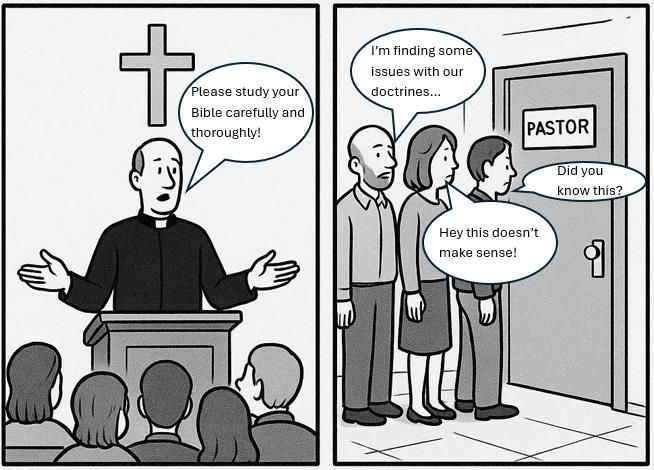
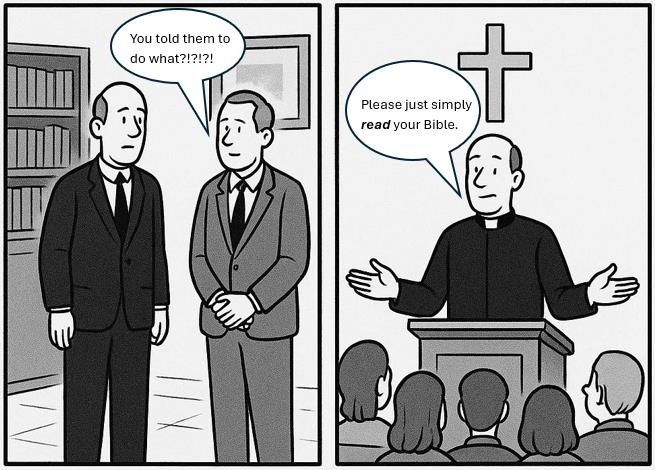
Growing up in a conservative church, there was never an air of open and free discussion.
Hard questions were usually met with answers along the lines of “You just need to have faith” or “God just did it that way.” More commonly it was just understood that you didn’t question.

Children are smarter than we think. They might not know the real answer, or care enough to explore at the time, but they know when something doesn’t pass the smell test.
The church raised a generation that took a whiff of their wares and thought “Ya….that seems suspicious. I’m busy with kid stuff right now, but those “answers” are being filed away for later review.”
When I hear someone from the pulpit say “study your Bible,” I chuckle a bit inside.

You provided no compelling answers to the hard questions Millennials and Gen Z asked, if they even felt able to ask them in the first place.
You educated them to a greater extent than any generation in history, and despite your halfhearted efforts, they were exposed to extensive conflicting knowledge.
You taught them over and over about the Jesus of the Bible, yet you functionally abandoned the Jesus of the Bible by silent complicity. You wouldn’t dare offend the majority of your congregation by taking a stand against political issues on which Jesus would have taken a stand.
When your children grew into adults that embraced the values Jesus championed, they were called socialist/communist/(insert choice verbiage here). They were accused of the “sin of empathy.” You kept your head in the sand.
You failed to understand the impact on these generations of having immediate and unfiltered access to all the fields of science.
Then, after all of that, you ask them to study their Bible?
You should be careful what you ask for church. A careful and critical study of the Bible is probably the last thing you actually want your members to do.
What is ironic, is one of the leading causes of lost faith in aspiring theologians is….wait for it…going to seminary! 😅 It turns out knowing more tends to allow one to recognize error more easily. Go figure.
What does the church mean when they say “Study the Bible“?
Do:
- Read the Bible daily
- This is repeated enough that it comes across almost like a Talisman that will somehow be the thing that protects them from the big bad Satan.
- Memorize the Bible
- It was ingrained in our heads that we’d wind up in a prison cell someday, persecuted for our faith, and not allowed to have Bibles. That’s why we needed to memorize them. It was just another invented boogeyman.
- Place the commandments on the wall of your house
- Because a list of rules posted on a wall works so well for kids and teenagers. (it doesn’t work so great for adults either)
- Let us tell you everything you should accept as Biblical truth
Don’t:
- Study the Bible too carefully
- Analyze our doctrines with that same rigorous level of study
- Compare our doctrines to other denomination’s interpretations of these passages
- Let modern scholarship or *gasp* science, influence your understanding of Biblical historicity or doctrinal stances
- Let the non-literal interpretations of some of the earliest church fathers influence your acceptance of our modern literal readings
- Look into the true authorship of canonized scripture
- Look into the canonization process itself
- Look into the scholarship on the history and chronology of the Bible’s creation
Sometimes Do/Sometimes Don’t
- Please do use archaeological evidence to promote the accuracy of the Bible’s stories. Unless of course, the evidence doesn’t support it, in which case please don’t. Give us a chance to explain why in those cases, it’s not real evidence. Our default answer is that it was a decoy planted by Satan to deceive the faithful. We also might just ignore it and pretend like it doesn’t exist.
- Please do use your rational thinking mind, as long as your mind agrees with what we’re saying. If it doesn’t, then please don’t. Clearly Satan is leading you astray, and you shouldn’t listen to yourself anymore. Haven’t you heard that “The heart is deceitful above all things?” Let us tell you what is appropriate to think.
Questions To Ask
To truly study the Bible, one really needs to possess a love for learning, for boundary breaking, and for doing 90% of your reading OUTSIDE the Bible.
Here’s some questions to work through to get a real sense of context
- What type of activity was happening in the world around the author?
- Who is the attributed author? Examine both traditional and modern academic views
- Did the author have any reason to hate or love any one particular nation or groups in the story/passage?
- What’s the backstory leading up to any particular biblical account?
- Does the original Greek or Hebrew convey additional meaning that is lost during the translation process?
- Does the author use any phrases or references that alert us to the time it was written?
- Does the author use any phrases or references that are borrowed from earlier sources? (Especially non-canonical sources?) If so, how were those phrases or references understood in those earlier sources?
- How would their audience have understood this passage?
- Are there notable editorial seams in the text where significant redaction or story conflation happened?
- Does the author agree with themselves? If not, this may indicate a later author’s contribution.
- Does the author agree with other Biblical authors?
- Is archaeological evidence supportive, contradictory, or silent on the matter?
- Does it come across as logical, reasonable, and plausible?
- Does it read more like poetry, hyperbole, myth, parable, or as an etiology?
- Is today’s interpretation a result of later post-biblical changes to accepted orthodoxy? I.E. Is it being twisted to mean something it was never intended to?
Only a minority of the above information above can be properly established from the Bible itself.
We also have to keep in mind that when attempting to examine something’s truth claim, we can’t use that same thing to serve as the arbiter of the truth we are looking to validate. That’s just circular reasoning of “it’s true because it’s true.” We’ve actually determined nothing.
Where To Find Answers
A great place to start with any study is the commentaries available via Blue Letter Bible. They have many that span the range of biblical viewpoints. See if they are in general agreement, and if not, what is the disagreement?
YouTube offers a great next step. Find some non-denominational scholars and see what they might have to say on it. Try to avoid any scholar who has to agree to a statement of faith to receive a paycheck, or at least de-weight that input. (If a doctrine is so true, clear, and biblical, then relax. It’ll be proved out true in the end. No need to fret. If it’s not…do you want to keep believing in something that isn’t true?)
If the passage/story has some plausible archaeological evidence that may exist, look into that too. YouTube is your friend again here. There are a number of channels that do a great job of presenting the evidence for/against biblical accounts.
The next place to turn to would be discussion from educated communities on the topic. Forums like reddit, hermanutics.stackexchange, and others, provide a rich depth of knowledge. It’s here you’ll find people with knowledge that exceeds what is easily accessible with Google on your own.
The last realm of discernment is to apply common sense and reason. Find the most likely explanation. Many times things are technically possible, but incredibly unlikely. Find the explanation with the least “incredibly unlikely” hiding in the baggage. Find the one that requires the fewest hypothetical assumptions, guesses, and conflicts.
Just memorizing the Bible doesn’t cut it. Being able to recite passages from memory is no more indicative of full biblical understanding than my memorization of a few Greek and Hebrew words conveys my literacy in those languages (It doesn’t, and I’m not 😅).
Some of the most incorrect and harmful theology has been implemented by people who’ve had significant portions of the Bible memorized, yet totally missed the mark on correct interpretation.
We Did What You Asked
One time I was asked “Do you think you know more than a pastor?”
My answer was: “No. I know different things than the average pastor. I’ve allowed myself to explore topics they would never entertain. I’ve read scholarship they’ve never seen, or would even want to see. In the face of hard questions, I’ve allowed the pool of acceptable answers to not be predetermined.”
In short, I studied my Bible. Through many different lenses. I did what you asked church.
*A chorus of deconstructed Christians today chants*
“We did what you asked!”

You threw down the challenge, and we said “bet.”
Methinks you just don’t like the result.
Peace
 Space For Doubt
Leave a comment