

NOTE: Going forward, this article will serve as the repository for all past, present, and future biblical mythbusting articles. It will be a “living” article in that it will grow over time. If there was any article to bookmark, this would probably be the one! 😉

This week I’ve had the “pleasure” of listening to some abysmal apologetics. It seemed like a good time to write down a cliff-notes guide to mythbusting some of the most common and searched for Biblical topics.
I’ll evaluate them using a letter grade system adopted from the one used by the United Bible Scholars in developing their translations of the Bible.
The Bible is never found in-the-wild (anciently) as a full Bible. It exists as thousands of independent source texts. Even copies of the same text don’t always agree (In fact they almost never perfectly agree). Therefore, it is a very serious and tough job for critical biblical scholars to piece together these manuscripts into one full and complete translation.
There are tens of thousands of choices to make during the translation process. Each choice is evaluated on how confident the committee is on where they have landed and each is given a letter grade.
You may be wondering why anyone would chose a translation that would receive a D?

Fair question. We’d get into some dull minutia to fully describe it, but essentially scholars just don’t know sometimes. The manuscript evidence can be mixed. The choices are all plausible. The outcomes are not particularly weighty. Basically they just do their best with the evidence they have, while admitting their lack of confidence in the choice.
This should inspire confidence though, and not anxiety, as it means these people are doing their best to be transparent and honest. Even the most educated and experienced people don’t always know, and that’s ok. The letter grades are shown below:
A – The Committee is confident in this reconstruction of the text.
B – The Committee is fairly confident in this reconstruction of the text.
C – The Committee is doubtful about this reconstruction of the text.
D – The Committee is extremely doubtful about this reconstruction of the text.
The above ranking system will be reframed somewhat to describe the level of certainty in the position that modern scholarship takes on the topics below:
A – As certain as we can get in this life
This category is where the evidence is overwhelming and prolific. There’s no credible path to see it any other way. There are multiple “smoking guns” proving these topics to be true. (This isn’t to say people don’t disagree, as often dogma dictates what is “allowed” to be true for many people.)
B – It’s pretty likely. It best fits the evidence and agrees with common sense
Here the topics have very strong evidence, and it makes logical sense. There may not be a key “smoking gun” per se, but any other explanation pales in comparison. There may be additional insights to learn over time that could refine the position, but the general idea is almost certainly correct.
C – More likely than not, but lacks enough evidence to be confident
Here we have a category where the evidence certainly points in a specific direction, but perhaps there isn’t much of it. It may be more of a logical/reasoning based evaluation. The other competing theories don’t work quite as well.
D – One of multiple viable theories. Consensus is mixed.
Here we have a rough idea of what might make sense, and perhaps a few scraps of coincidental evidence, but nothing firm. It’s an idea with merit, but perhaps one of many that could explain things just as well.
These ratings will be applied to the below topics to assess how certain the academic community is on these topics, to the best of my (non-academically trained) understanding.
My understanding comes from researching the works of those very academics. I’ll denote (C) for those who identify as Christian, (J) for Judaism converts, and (A) for atheist. These views have near unanimous support among the scholars listed below to extent that I could find information. Sometimes a scholar or two doesn’t talk about that particular topic as that is outside of their realm of expertise.
Scholars used:
- Dr. Pete Enns (C)
- Dr. Brian Doak (C?)
- Dr. C.J. Cornthwaite (C)
- Dr. Dan McClellan (C? He’s a Mormon)
- Dr. John J. Collins (C)
- Dr. James Tabor (J)
- Dr. Robyn Walsh (C?)
- Dr. Aaron Higashi (C)
- Dr. Heath Dewrell (C)
- Dr. Bart Ehrman (A)
- Dr. Joshua Bowen (A)
- Dr. Paula Fredricksen (J)
- Pastor John Hamer – Masters Degree (C)

Biblical Mythbusting’s Greatest Hits
Category A
- Genesis and Exodus are largely myth
- They serve as a corpus of different etiologies. No question or doubt on that whatsoever. Out of the above list of scholars, all of them agree here. Every. Single. One. (They actually agree on most of the topics I share below…but this one is just bold font. All Caps. Extra exclamation marks. Shouting agreement!)
- The Bible authors never describe or mention the dinosaurs
- They never lived alongside dinosaurs. They did not know dinosaurs existed. Dinosaurs were real though, and they really are as old as 99% of the world says that they are. (See my post on that here)
- Moses did not write the Pentateuch
- There are dozens of reasons why, but the most obvious should be that someone was not writing Hebrew books 300-500 years before Hebrew was ever a written language. Case closed. Not even a strict fundamentalist scholar would hold this dogma. (For SDAs, not even EGW claims this!)

- The world was not created in six 24hr time periods
- The world is not 6,000 years old
- The Bible never demands to be taken as a literal chronological history book. St. Augustine and many other early church fathers did not take this view. This is a silly take based on a strict modern literal interpretation stemming from the post-enlightenment view of inerrancy. (See my post on that here)
- There were no historical Adam and Eve
- Biology precludes it from being a possibility. The Bible itself arguably tacitly acknowledges this. I don’t think a single scholar above believes this. Pete Enns had a great discussion with a fundamentalist on this very thing! (See my post on that here)
- There was no original sin (No Adam)
- There was no garden of Eden with a talking snake (See also…it’s myth!)
- There were no fallen angels mating with women to make the Nephilim giants
- There actually just weren’t giants period. Biology, archaeology, and common sense rule this out. (See my post here)
- There was no global flood (See also…it’s myth!)
- This is disprovable by the Bible itself, archaeology, geology, anthropology, and common sense. Case closed. (see my article here)
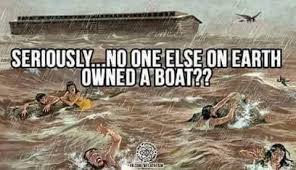
- There was no ark (See also….it’s myth!)
- The ark has NOT been found by anyone. If you’re non-SDA the ark is about 500′ long. If you’re SDA the ark is about 750′ long. (About twice as long as the maximum sea-worthy length of a wooden boat made with modern engineering methods and tools) There’s enough reasons why this is completely and utterly false that I could write several articles and not make a dent in the topic. Just no….. Abandon ship! (hahaha) (See link here)
- There was no exodus, at least not as described in Exodus (See also….it’s myth!)

- The story of Babel is an etiology (See also…it’s myth!)
- It is not to be understood literally. (see my article here)
- Israel was initially polytheistic
- No doubt here. No serious and credible arguments exist to refute this, and there’s sure plenty of biblical and archaeological evidence to support it.
- Later Israel still wasn’t monotheistic
- They were henotheist, which means they believed other gods existed, however they just served one God. We need look no further than the Exodus story to prove this, although it’s undeniably obvious in many places. (Exodus was written MUCH later than the events it portrays)
- There was no Jonah being swallowed by a fish
- Bye fishy!

- The trinity was a post-biblical human invention
- The first time we see a recognizable form of the trinity is in the 4th century A.D. No author of the Bible understands the trinity. None of them are attempting to communicate it. It’s not a doctrine found in whole or even substantive part in the Bible. This isn’t me claiming it’s been “disproven” or “false” rather, it’s just objectively true that the doctrine was created by man hundreds of years after Jesus. Not many trinitarian scholars would object to that view. They often view it as being revealed through post-biblical divine revelation (See my posts here, here, and here) Out of the above scholars that identify as Christian, only two (Pete Enns and Aaron Higashi) hold to the trinity, but acknowledge it’s lacking in scriptural evidence. Evaluate it for yourselves. It’s not necessary to believe this in order to be a Christian.
- There are several NT books widely accepted today as forgeries
- 1st & 2nd Timothy, and Titus. These three are pretty hard to explain any other way. This is about as certain as we can be on anything. Many fundamentalist scholars even acknowledge this…albeit perhaps begrudgingly. (Future article to be linked here)
- Parts of what we today consider apocryphal writings were held as scripture by the Maccabean Jews and 1st-4th century Christians.
- This is reflected in the ideas and direct quotes of the NT authors. For my SDA friends, EGW heavily leans on the apocrypha for her “inspiration.” (See my article on her antics here) Jesus Himself alludes to ideas and sayings found in Enoch. (Future article to be linked here)
- El and YHWH were initially worshiped as two separate Gods
- They were eventually merged together over some period of time, with YHWH coming out on top. Deut 32:8-9 in the Dead Sea Scrolls is a dead giveaway of this, but there are MANY other clues. (See my post on that here)
- The intertestamental period (time between OT and NT) was not actually silent.
- There are many books being redacted and written during this time period. Daniel comes to mind.
- The canonization process was long and contentious
- Revelation barely made it in and was hotly contested. A few books were actually quite debated. It bears no fingerprints of divine guidance. The presence of significant fraudulent material that has either already been removed, or is still present in our Bibles, should be all the evidence you need of this. This was an entirely man-led process. Read the early church father’s debates if you’re curious. (Future article to be linked here)

- The red letters of Jesus in the NT bear no greater protection from alteration than any other portion of the Bible
- The clearest way to show this is via the story of the woman caught in adultery. That story is a later add and definitely contains portions attributed to have come from Jesus’s mouth. Your Bible probably has a footnote on this, although likely leaves the story in. Matthew 17:21 is another great example. It’s ok. Deep breath. Remind yourself this is a book constructed by humans.
- There are verses missing from your Bible, yes.
- We have more than a dozen examples of texts that modern scholarship has found to be fraudulent and thus are usually removed from most Bibles today. (Sometimes it’s left in but contains a footnote explaining the fraud)
- There is no magical divine force protecting the integrity of the Bible
- It has been modified numerous times and in numerous ways over the millennia. This is fully observable and well documented. If there was, why would John the revelator need to add a warning to not add or remove parts of this book? If divine protection existed, there’d be no reason to warn people. God would have it under control. So many philosophical rabbit holes here with that logic. See also: It’s been modified a ton already!
- Biblical prophecy fails more often than you think
- Much of biblical prophecy that can be evaluated based on archaeology & historical records just simply fails or is provably ex-eventu (after-the-fact) prophecy. Yes there are ways to tell (See my post on that here) This is an uncomfortable reality and it took me a long time to get over this. To be honest, it is still a struggle on occasion.
- The Bible disagrees with itself
- It happens. All. The. Time. It’s a book written by hundreds if not thousands of human hands. What do you expect?

- The Bible is not inerrant
- It never claims to be. It was never understood to be until more recently. The Bible is not our infallible God. Just God Himself occupies that category. (see my article on that here)
Category B
- There may have been some type of Moses figure, but not as portrayed in the Bible.
- This is a fascinating rabbit hole I went down recently. I so badly want to write an article on this. Free time is incredibly limited for me though, so…priorities and such.
- Genesis was written/compiled well after the Levitical law was established, probably during/after the exile
- Noah knew about clean/unclean animals eh? Also many other reasons. (Future post will be linked here)
- There was no Sodom and Gomorrah
- Unless God removed all the evidence and reworked history when no one was watching. There’s also a unique geological phenomenon that makes the ground in one area of that part of the world look like it’s burnt, which is probably where that myth comes from.
- Israelites were primarily Canaanites
- Israel was composed of those already living in the land of Canaan with a smaller group that immigrated into the land and brought their God YHWH with them. They rewrote and harmonized the history of the people. Most Israelites were Canaanites already living in Canaan. (see my article here)
- The story of Job is fiction
- Job was probably a real person, but the story attributed to him is fictional narrative retroactively applied by scribes in the genre of wisdom literature. This happened a lot in that time period, and it’s fine. The story is meant to convey a theological message, not provide concrete historicity.
- Jericho is revisionist history
- Jericho’s walls did not fall nor was the city razed at the hand of Joshua (see my article on that here)
- David almost certainly did not kill Goliath
- It was probably Elhanan that did the deed. David’s story arc was retroactively massaged into what we have today. In reality he was likely a warlord who overthrew Saul. Look no further than the authors of Chronicles to see how this process of smoothing over history works. (See my article on that here)
- Daniel is prophecy after-the-fact
- Daniel was composed in three parts. It represents prophecy after-the-fact of the events it predicts, has little relevance to us today (at least as it pertains to the end times), and has been misused for thousands of years. It is probably the newest OT book we have. (2nd century BCE) (Reserving a space here to link my future Daniel article Work-in-progress)
- Isaiah was not written by a single author
- There were at least two authors from two very different time periods. (space reserved for future article)
- Josiah did not “discover” a lost scroll
- This story was almost certainly fabricated to allow Josiah to create a scroll and implement new rules and regulations that he wanted.
- Satan was invented/conceived during/after the Babylonian Exile
- Calamity, deception, and temptation in the early OT were at the hands of God. In the NT they are a result of Satan. Dan McClellan has some great work explaining this phenomenon, but many other scholars echo this. (see my post on that here and here) I personally no longer believe in the personified evil being of Satan. I guess I’m Jewish in that respect.

- The gospels are not eye-witness accounts
- Each reflects a much later revised and massaged history. Each gospel reflects the theology of the community where it was written. (See my article discussing this here)
- John is late to the party
- John is a particularly late add, likely with a final composition in the very late 1st/early 2nd century by someone that was NOT John the apostle. Sometimes John seems to be in conflict with John (debatable) and this could explain why.
- Peter almost certainly didn’t write 2nd Peter
- This is probably a mid-2nd century work
- Revelation was written by a different John (not the apostle)
- The Greek is different, as are the ideas espoused. There’s actually many good reasons to think this.

- There are parts of our Bible that are fraudulent, we just can’t prove it
- There are almost certainly later biblical additions that escape our detection today, and genuine portions that are left out of our modern Bibles (See my post on this here). We just have no good way of determining some of them. Scholars are in pretty widespread agreement about many of them, but there’s no smoking gun to prove it. This is actually a fascinating field of research/scholarship and I’ve only just started exploring it. (Future article to be written here)
- Psalm 29 is an obvious rip-off of a Canaanite hymn to the storm God Baal
Category C
- Israel likely committed child sacrifice under “God’s direction”
- It seems as though the evidence points towards Israel committing child sacrifice under the assumption that it was a divine command. The Bible exhibits the fingerprints of this still. (see Dr. Heath Dewrell’s “Child Sacrifice in Ancient Israel“). Once you read it, see the evidence, and understand it, you can never un-see it. I guess if you want to avoid that admittedly troubling thought, then I would recommend not reading that book. I’m about 90% convinced of this theory.
- There was probably never a unified Israelite kingdom (North and South)
- Sampson was hyper-exaggerated narrative
- If there was an Abraham, he was probably not anything like the Abraham depicted in the Bible
- Paul probably didn’t write Hebrews, Colossians, 2nd Thessalonians, and Ephesians
- These are more debated. It seems like the consensus as far as I can determine, is that it was probably someone who knew of Pauline theology, as there are many similarities. They may have been a student of Paul’s that added their own twist. However, with some level of apologetics, you can make a case that it was still Paul.
- Peter probably didn’t write 1st Peter
- I considered putting this in category B. It’s debated for good reason.
- Revelation has allusions to roman deities used to describe God, Jesus, & Satan
- This book is all kinds of wacky. It was widely spurned during the formation of the canon, however the people loved it. It’s kind of like the Netflix tiger king special of the books of the Bible. Just…can’t….look….away. (Reserving this spot for a future revelation article)
Category D
- The grandeur of Solomon’s kingdom is not even remotely in-line with the evidence we have
- This is a bit of an argument from silence. There’s just no evidence of anything existing (we should have something) of this opulence. It screams “extreme exaggeration” to most scholars.
- YHWH worship started in the region of Edom
What Hope Is Left?

That’s….heavy.
It’s a lot to take in and has taken me years to understand and learn. Even now I feel as though I’ve just scratched the surface of knowledge. So how then, could I still have any faith left after all that?
That’s a fair question.
I want you to take another look at the list of scholars above. Most of them still find a compelling reason to believe in God. Despite knowing far more “damaging” information than I have written here, they believe.
Compared to many Christians, this belief looks a little different. I suppose it’s the same story for me too.
It’s a belief that there’s still something there. Despite the clear and present myth, errors, poor interpretations, and scientific inaccuracies, there’s still something at the heart of this matter that rings true.
Christianity can (for sure not always) be beautiful. With Jesus at its center, it provides hope. It’s hard to imagine this spontaneously coming into existence. There’s something to faith that is more than just evidence seen or understood. It’s yearning for the good. Desiring the divine. Hope that God is indeed love.
Jesus, whether He was literally God, or even was actually raised from the dead at all, is someone who spoke a message that has such undeniable attraction and hope that I want such a role model in my life.
One doesn’t need to check all the boxes of a creed to have hope. It’s not a stretch to think that if God took the time and effort to create such a beautiful world/universe, this same God would therefore love His creation unconditionally.
I will go about my life serving a God who embodies love and the principles of Jesus’s ministry. A God who loves so deeply that He not only desires to save everyone, but will save everyone. (Yes I am a universalist)
I suppose at the end of this world, if I wind up at the pearly gates and find a wrathful God, a God preached in many Christian circles, I will plead with Him to end my existence. That is a God I will not serve, admire, or love.
God’s understanding of our human condition, I believe, is infinite. He understands the reality of what we have on our hands with our Bible.
The Bible is a thoroughly human invention that is used to describe how the people who wrote it experienced God. It is not God. It is not an object that needs reverence by special placement on a shelf. It is not a book that needs one to have religious OCD about, and read cover-to-cover every year in order to “gain a blessing” from it. Memorizing the Bible will not help you understand the Bible.
Treat it as an inanimate object to explore and understand, but not a fragile idol to be sheltered or worshiped. Know it’s limitations. Never abandon critical thinking at the altar of dogmatic thinking. Don’t abdicate use of a skill God has given you (critical thinking), out of loyalty to a literal historically inerrant view of a fallible human creation.
“In search of truth, wherever it may be found.” – Pastor John Hamer (Centre Place – Toronto, Canada) [If I had attended a church like this, I probably would never have needed to deconstruct]
Peace
 Space For Doubt
Leave a comment